

Yes, pet-safe carpet cleaning is real, and it’s not complicated: use an enzymatic treatment on the stain, rinse or extract thoroughly so no residue is left behind, and keep your dog or cat off the carpet until it’s bone dry. Skip anything with bleach, ammonia, or a heavy fragrance load. If the mess covers a big area, or the smell keeps coming back no matter what you try, that’s your cue to call a pro instead of fighting it solo.
TL;DR:
- Enzymatic cleaners contain bacteria that digest pet urine proteins, preventing recurring odors and avoiding residue left by soap or harsh chemicals.
- Avoid using bleach, ammonia, phenolic disinfectants, or heavy fragrances, as they can irritate pets and may encourage re-marking or cause health issues.
- Proper extraction and drying are crucial; never apply heat before enzyme treatment or skip rinsing to prevent setting stains and leaving potentially harmful residues.
- Fresh accidents should be blotted immediately, treated with an enzyme cleaner, and thoroughly rinsed and dried before pets are allowed back on the carpet.
- For persistent or large-scale stains, mold, or odors, it is best to hire a professional using enzyme pretreatment and deep extraction to ensure complete and safe cleaning.
Table of Contents
- Why Enzyme Cleaners Are the Backbone of Pet-Safe Carpet Cleaning
- How Do You Safely Clean Pet Stains Yourself?
- When Should You Call a Professional Instead?
- How Home Service Simple Applies This to Your Carpet
- What Pet-Safe Cleaning Products Actually Work
- How Do You Test a New Cleaner Around Your Pet?
- Simple Habits That Keep Pet Odor From Coming Back
- What the Research Actually Tells Pet Owners
- Book a Pet-Safe Deep Clean With Home Service Simple
- Sources
- FAQ
Why Enzyme Cleaners Are the Backbone of Pet-Safe Carpet Cleaning
Here’s the part most pet owners never learn until they’re standing over a fourth ruined spot on the same corner of carpet: regular soap doesn’t actually break down pet urine. It masks it. Enzymatic cleaners do something different. They contain bacteria cultures that produce enzymes, and those enzymes literally digest the uric acid crystals and proteins in urine, saliva, and vomit instead of just wiping them around. That’s why enzyme cleaners stop the “why does my carpet smell like this again” cycle that regular carpet shampoo can’t touch.
pH matters here too. A pH-neutral, fragrance-free formula is gentler on both carpet fibers and paws, and it matters more for cats than most people realize. Cats groom themselves constantly, so anything on the carpet ends up in their mouth eventually. Their livers process certain compounds, including some essential oils, far less efficiently than a dog’s does, which is why cats are especially sensitive to phenols and heavy fragrance loads.
Ingredients to keep off your shopping list, full stop:
- Bleach — irritates paw pads and mucous membranes, and it’s genuinely dangerous if licked.
- Ammonia — smells like urine to a dog’s nose, which can actually encourage repeat marking in the exact spot you just cleaned.
- Phenolic disinfectants — the class of chemical cats process poorly.
- Heavy synthetic fragrances — can trigger respiratory irritation in pets with sensitive airways.
- Harsh cationic surfactants — some industrial-strength quaternary compounds leave a residue that’s tough to rinse fully.
Extraction is the other half of the equation. Hot water extraction, done right, pulls the enzyme solution and the digested residue up out of the carpet backing instead of leaving it to dry into the fibers. That rinse step is what separates a genuinely pet-safe clean from one that just smells better for a week.
Pro Tip: If a product’s ingredient list is vague marketing copy instead of actual chemistry, that’s a red flag. A real Safety Data Sheet spells out exact hazard classifications. Any legitimate cleaner or cleaning company should hand you one without hesitation.
One number worth sitting with: calls to the ASPCA Animal Poison Control Center involving cleaning supplies increased significantly in a year the ASPCA flagged as a spike. Most of those incidents trace back to people not following label directions, not to the products themselves being unsafe when used correctly.
How Do You Safely Clean Pet Stains Yourself?
Fresh accidents and old, set-in stains need different playbooks. Here’s the sequence that actually works, in order:
- Contain and blot immediately. Grab paper towels or an old bath towel, press straight down, and lift. Never rub. Rubbing pushes the mess deeper into the pad and spreads the surface area you now have to treat.
- Remove solids first. If there’s anything solid, scoop it before you add any liquid to the situation.
- Test the enzyme cleaner on a hidden patch. A corner in a closet or under furniture works. Wait 10 minutes, check for discoloration, then proceed.
- Apply per the label’s dilution and dwell time. This is the step people rush, and it’s the one that matters most. Enzymes need contact time to actually digest the proteins, usually 10 to 15 minutes minimum, sometimes longer for older stains.
- Blot again, don’t scrub. Let the product do the chemistry.
- Rinse or extract. A wet-vac pulls out the dissolved residue instead of letting it dry back into the carpet. This is the step most DIYers skip entirely, and it’s why the smell comes back three weeks later.
- Dry fast and fully. A box fan, your AC on low, or a dehumidifier all speed this along. High indoor humidity can roughly double drying time, so run the fan longer on a humid day than you think you need to.
- Keep pets off until the carpet is completely dry to the touch, not just the surface. Damp fibers plus a curious nose or a grooming tongue is exactly how mild GI upset happens.
Set-in, older stains need the same steps but with a longer enzyme dwell time, sometimes overnight under a damp towel to keep the area from drying out before the enzymes finish working.
The three mistakes that ruin a DIY attempt: applying heat before the enzyme treatment (steam actually sets protein stains rather than lifting them), mixing your own ammonia-based concoction, and dusting the carpet with scented powder to “freshen” it between cleanings. All three either lock the stain in or add exactly the chemical exposure you’re trying to avoid. For fresher accidents specifically, this urine removal walkthrough breaks down the fast-response version, and if the mess is on a rug rather than wall-to-wall carpet, this guide covers the odor-control specifics.
When Should You Call a Professional Instead?
Some situations are past the point where a spray bottle and a shop vac will fix things. Recurring odor in the same spot after multiple cleanings usually means urine has soaked through to the carpet backing or pad, where surface-level treatment can’t reach it. Visible mold, a musty smell that outlasts drying, or stains covering more than a room’s worth of carpet are all signs you need equipment stronger than what’s under your kitchen sink.
Before you book anyone, ask these questions:
- Can you send me the Safety Data Sheet for the products you use?
- Do you use an enzyme pretreatment for pet stains, specifically?
- Are your cleaning solutions pH-neutral and fragrance-free or low-VOC?
- What’s your extraction percentage, meaning how much solution do you actually pull back out?
- What’s the estimated drying time, and is it in writing?
- Do you offer a satisfaction guarantee if odor returns?
A genuinely safe protocol looks the same every time: enzyme pretreatment goes down first to digest the proteins, then hot water extraction pulls up both the enzyme solution and the dissolved residue, and the technician checks that the carpet is drying evenly before they leave. Before the appointment, pick up toys and food bowls, and keep pets in a separate room or crate. Less stress for them, less chance they wander onto a damp section mid-clean.
How Home Service Simple Applies This to Your Carpet
Home Service Simple runs the exact protocol this article recommends: an enzyme-friendly pretreatment step followed by deep steam and hot water extraction, so residue actually comes back out instead of settling into the pad. That maps directly to the checklist above, extraction paired with proper drying, not steam alone.
The Simple Club subscription handles scheduling automatically, which matters more than it sounds for pet households, since regular cleanings catch new accidents before they become set-in odor problems. Every job comes with a satisfaction guarantee.
Before any visit, move small furniture and food bowls, and keep pets in a closed-off room. Always ask for the SDS and a written drying-time estimate. If you want to confirm the job left nothing behind, this quick residue check shows you exactly how.
What Pet-Safe Cleaning Products Actually Work
Skip brand hype and look at the category instead. Enzyme spotters are your first line of defense for fresh urine, vomit, or drool spots, and consumer product roundups consistently list them as the top performer for protein-based pet stains. Oxygen-based cleaners, the kind built around hydrogen peroxide rather than chlorine bleach, work well on organic stains and are generally gentler around pets when used as directed and rinsed out.
For full-room jobs, a rental or owned carpet extractor paired with a pH-neutral, fragrance-free solution beats a spray bottle every time, because it rinses instead of just applying. Steer clear of “carpet powder” fresheners entirely. They sit in the fibers, get kicked up into the air when your dog runs through the room, and add zero cleaning value.
If your dust concerns extend past carpet, into a renovation or a door replacement project happening in a pet household, low-dust construction methods follow the same logic: contain the particulate, don’t let it settle into places your pet breathes or naps.
Whatever product you land on, the category matters more than the label claiming “pet safe” in bold letters. That phrase isn’t regulated, so an actual ingredient list beats a marketing sticker every time.
How Do You Test a New Cleaner Around Your Pet?
Never introduce a new product to your whole carpet on the same day your dog has free run of the house. Pick a small, hidden test patch first, a closet corner or under a couch works fine, apply the product exactly as directed, and let it sit through the full dwell time and drying period before deciding it’s safe.
While it’s drying, keep your pet in a different room entirely. Not just off the wet spot, out of the room. Curious noses find damp carpet fast, and a dog that’s never bothered by cleaning products before can still react differently to a new formula.
Check the test patch for discoloration, texture change, or lingering smell after it’s fully dry. If everything looks and smells normal after a few hours, you’re clear to treat the actual stain. If your pet has known sensitivities, allergies, asthma, or a history of chewing on things they shouldn’t, extend your test window and watch for any sneezing, paw licking, or scratching in the hours after reintroduction.
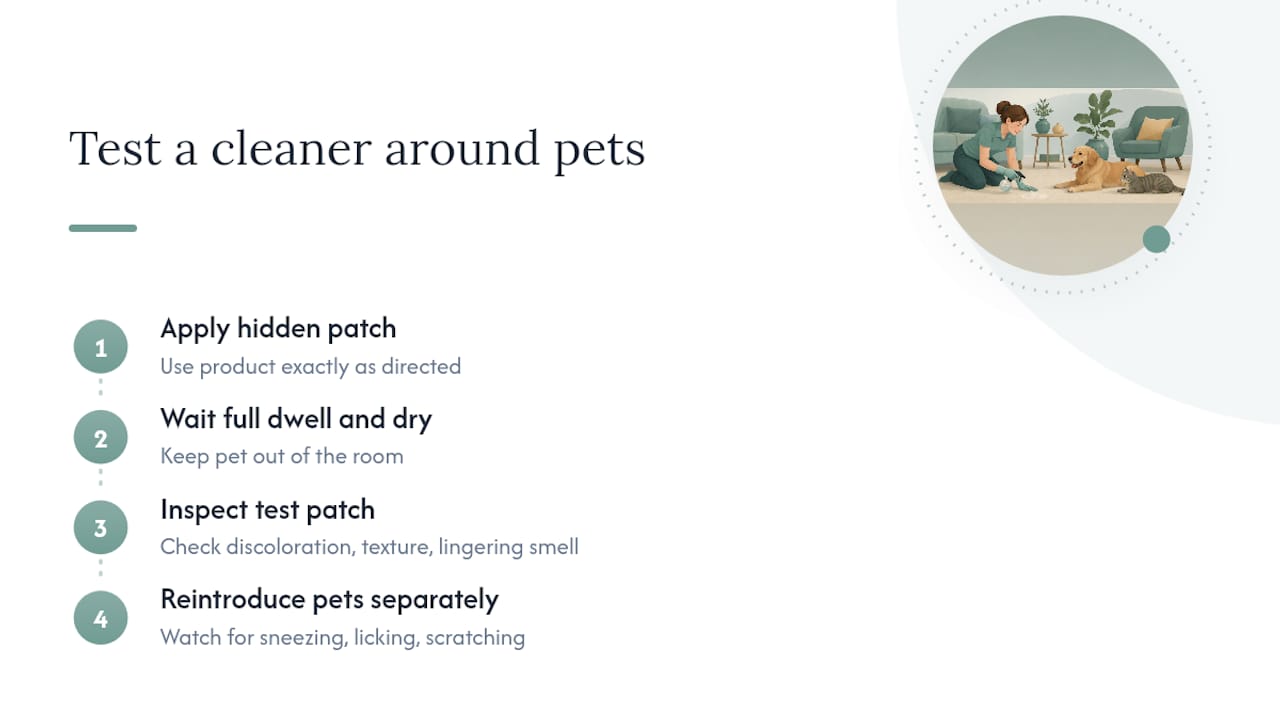
This same caution applies double for multi-pet households. A formula that’s fine for your dog might not sit the same way with your cat, given how differently cats metabolize certain compounds. Test for each pet’s tolerance separately if you have both, rather than assuming one clean bill of health covers everyone in the house.
Simple Habits That Keep Pet Odor From Coming Back
The best pet-safe carpet cleaning routine is the one that prevents you from needing an emergency clean in the first place. Vacuum high-traffic pet areas at least twice a week, since dander and loose fur trap odor-causing bacteria even when there’s no visible stain.
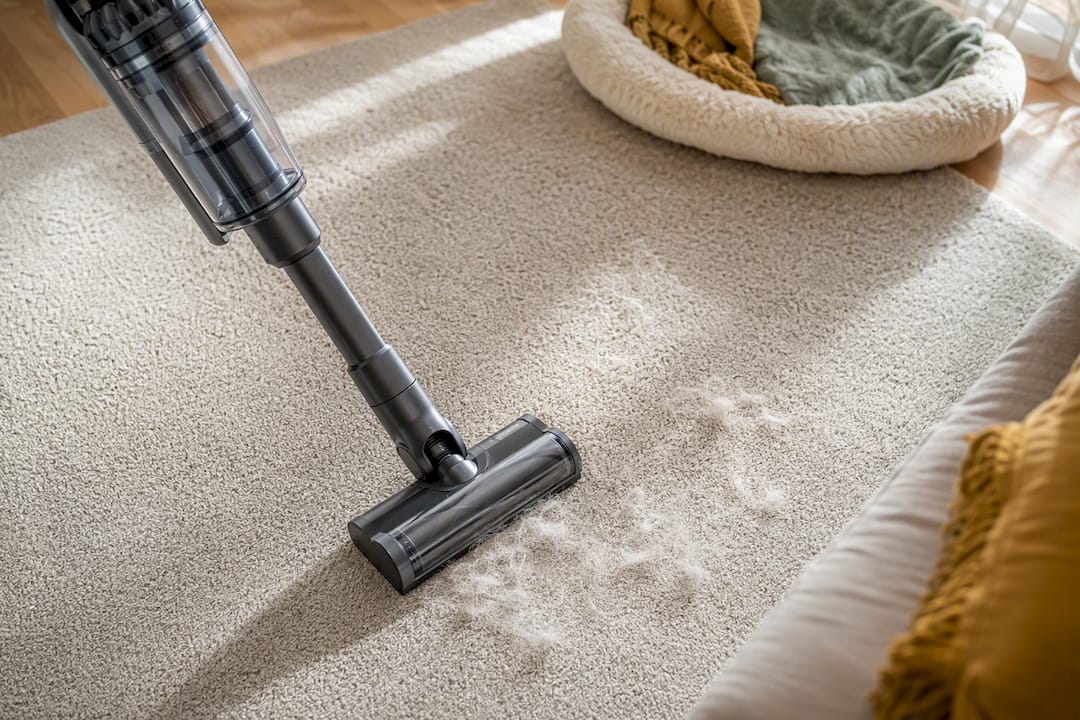
Keep a small bottle of enzyme spotter within arm’s reach, not buried in a cabinet, so accidents get treated within minutes instead of hours. The faster urine gets enzymatic treatment, the less chance it has to soak into the pad and become a repeat-offender spot.
Rotate rugs and furniture occasionally if you can. Pets tend to favor the same napping and marking spots, and moving things around breaks that pattern while giving worn fibers a rest. Address feeding-area spills the same day, even small drips, since food residue attracts bacteria just as readily as urine does.
Finally, schedule a deeper extraction cleaning on a regular basis rather than waiting for a visible problem. Odor and residue build up gradually and invisibly long before you notice a smell, and a scheduled deep clean catches what daily spot treatment can’t.
What the Research Actually Tells Pet Owners
The conventional advice out there treats “pet-safe” as a label to look for on a bottle. That’s backwards. The real safety question is whether a product gets rinsed out, not whether the front of the bottle says “pet friendly.” A perfectly gentle enzyme cleaner left to dry into carpet fibers without extraction can still leave enough residue for a grooming cat or a floor-sniffing dog to ingest.
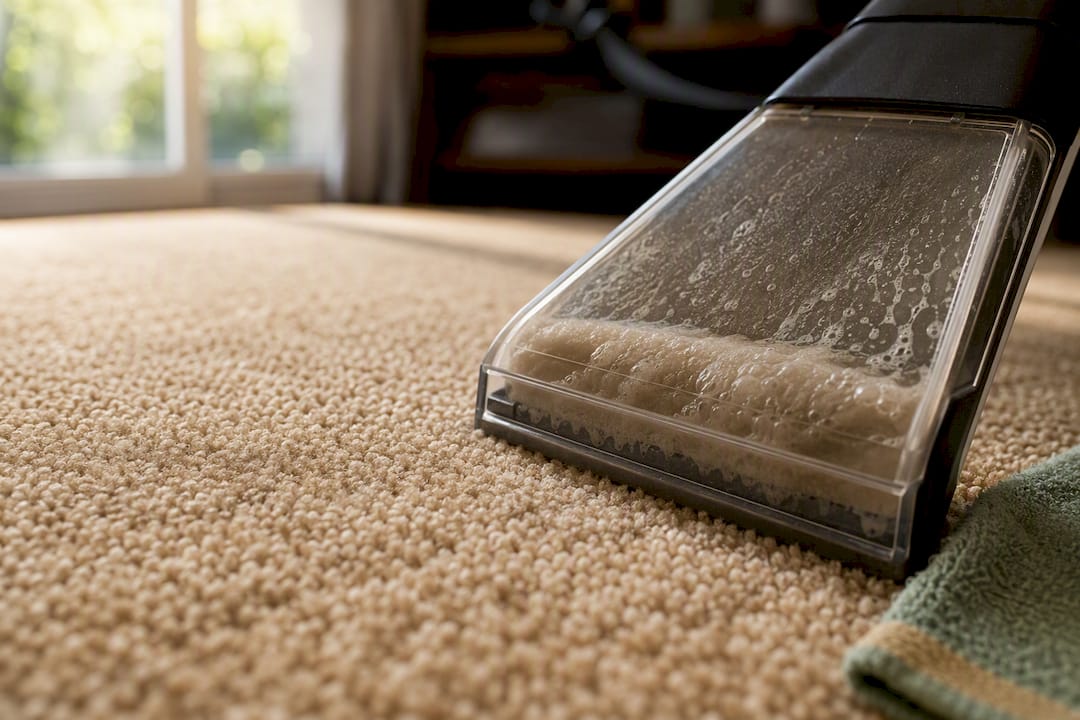
What gets underrated is drying time. Everyone focuses on the cleaning step and treats drying as an afterthought, but a damp carpet is where most low-grade pet exposure actually happens. Humidity can stretch drying time considerably, and that’s exactly when curious pets wander back onto carpet that looks dry but isn’t.
If you take one thing from this: stop asking “is this pet safe?” and start asking “what’s the extraction rate, and how do I know when it’s actually dry?” Request the Safety Data Sheet before you book anyone. It tells you more in thirty seconds than any bottle’s front label ever will.
— chris
Book a Pet-Safe Deep Clean With Home Service Simple
Home Service Simple exists for exactly the situation this article walks through: a pet household that wants stains and odor gone without gambling on harsh chemicals or guesswork drying times. Every job pairs enzyme-friendly pretreatment with deep steam and hot water extraction, then backs it with a satisfaction guarantee if odor sneaks back.
If you’re tired of DIY spot treatments that fade after a week, or you’re not confident your current cleaner is actually rinsing residue out, this is the next step. Homeowners who want ongoing protection instead of one-off panic cleaning also have the Simple Club subscription, so recurring visits happen automatically without you tracking a calendar. Want a written estimate and drying-time forecast before you commit? Request an itemized quote or head straight to book a Wichita appointment and get the enzyme pretreatment and extraction combo scheduled this week.
Sources
- Using Cleaning Supplies safely around pets — ASPCA Animal Poison Control (APCC)
- Poisonous household products | ASPCA
- The 8 Best Carpet Cleaner Solutions for Pets — The Spruce Pets
FAQ
What Is the Safest Carpet Cleaner for Pets?
An enzyme-based, pH-neutral, fragrance-free cleaner is the safest category, since it digests urine proteins without the residue risk of bleach, ammonia, or phenolic disinfectants. Cats process phenols and certain fragrances poorly, so fragrance-free matters even more in a multi-pet household.
What Type of Carpet Cleaning Is Best for Pet Urine?
Enzyme pretreatment followed by hot water extraction is the recommended combination, since the enzymes digest the uric acid and the extraction rinses out what’s left instead of letting it dry back into the fibers.
How Do I Clean Carpet Safely When I Have Pets?
Blot fresh messes immediately, apply an enzyme cleaner per label instructions, rinse or extract the residue, and keep pets off the area until it’s completely dry, running a fan or dehumidifier to speed that up if humidity is high.
Is Steam Cleaning Safe for Pets?
Steam cleaning is safe for pets when it’s paired with an enzyme pretreatment and proper extraction and the carpet is fully dried before pets return, since heat alone can actually set protein stains rather than lift them. Home Service Simple applies this exact enzyme-plus-extraction sequence on every pet-related job.
What Should I Do if My Pet Reacts to a Cleaning Product?
Watch for drooling, vomiting, or respiratory distress, and if you see any of those signs, contact your veterinarian or the ASPCA Animal Poison Control Center at (888) 426-4435 right away.