

For most pet stains on rugs, blot immediately, saturate with an enzyme cleaner, let it dwell, then extract or blot dry. That one sequence handles the uric acid crystals that make odors come back — and it works on both carpet and area rugs.
Here’s what to do right now:
- Blot, don’t rub. Press clean towels firmly onto the wet spot and lift straight up. Rubbing pushes the stain deeper into the fibers.
- Remove any solids first. Scoop or scrape away feces or vomit before applying any liquid.
- Saturate with an enzyme cleaner. Pour enough to reach the backing, not just the surface. The enzymes need to contact the uric acid where it lives.
- Cover and let it dwell. Lay a damp towel over the treated area and leave it 10–15 minutes (longer for older stains). Enzymes need time to work.
- Blot dry or extract. Press clean towels to pull the liquid out, or run a wet/dry vacuum over the spot. Speed up drying with a fan.
Call a pro immediately if: the stain covers a large area and the rug feels wet through to the floor, you can smell urine through the rug backing, or you see visible color change spreading beyond the original spot. Backing and pad contamination require professional decontamination, not a spray bottle.
Key Takeaways
Enzyme cleaners with adequate dwell time are the most reliable DIY solution for pet stains on rugs, but backing or pad contamination requires professional hot-water extraction to fully eliminate odor.
| Point | Details |
|---|---|
| Act fast with enzyme cleaner | Saturate the stain fully, allow 10–20 minutes dwell time, then extract or blot dry. |
| Old stains need rehydration first | Mist with warm water before applying enzyme solution and extend dwell time to 30–45 minutes. |
| Never use ammonia or bleach | Ammonia attracts pets back to the same spot; bleach damages fibers and won’t break down uric acid. |
| Backing/pad contamination needs a pro | If a damp cloth pressed to the backing smells like urine, surface treatment won’t solve it. |
| Homeservicesimple for Wichita homes | Deep steam extraction, odor decontamination, pad replacement, and a satisfaction guarantee. |
Table of Contents
- Why do pet stains and odors keep coming back?
- How to remove a fresh pet stain from your rug
- How do you tackle old, dried urine stains in rugs?
- Which cleaners actually work, and what should you never use?
- When should you call a professional carpet cleaner?
- Wichita pet owners: Homeservicesimple handles what DIY can’t
- Sources
- FAQ
Why do pet stains and odors keep coming back?
The short answer: you cleaned the fiber, but not the chemistry underneath it.
Pet urine contains urea, uric acid crystals, ammonia, and bacteria that penetrate deep into fibers, backing, and the pad below. Most household cleaners dissolve the surface residue and mask the smell temporarily. But the uric acid crystals stay embedded. When humidity rises — a rainy Kansas afternoon, a wet dog shaking off near the rug — those crystals reactivate and release ammonia gas all over again. That’s why a spot you thought was clean suddenly smells like a kennel in July.
The urochrome pigment in urine is what causes the yellow-brown discoloration. On light-colored or natural-fiber rugs, it bonds to the fiber and can become permanent if left untreated or treated with the wrong chemistry. The Carpet & Rug Institute’s technical bulletin on pet urine notes that urine can destabilize dyes in the rug itself, causing color to migrate or fade in ways that have nothing to do with the original stain.
Carpet construction matters a lot here. A thick wool area rug holds urine differently than a low-pile synthetic wall-to-wall carpet. Wool absorbs deeply and quickly. Synthetic fibers resist absorption slightly longer, giving you a better window to act. Glue-backed rugs are the toughest case — the adhesive traps urine salts and makes full deodorization nearly impossible without professional intervention. And if the liquid reaches the pad underneath? The pad acts like a sponge, holding urine long after the surface looks dry.
Unresolved pet stains can also affect your home’s indoor air quality over time. High humidity and bacterial activity in contaminated backing can worsen air quality in ways that go beyond the obvious smell, especially in homes with allergy-sensitive family members.
How to remove a fresh pet stain from your rug
Speed is everything. The faster you act, the less urine reaches the backing and pad.
Supplies to have ready:
- Enzyme-based cleaner (Nature’s Miracle is a widely available example)
- Clean white towels or paper towels
- Rubber gloves
- Spray bottle (if your cleaner doesn’t come in one)
- Wet/dry vacuum or carpet extractor
Step-by-step:
- Remove solids first. Scoop feces or vomit with a spoon or paper towel, working from the outside edge inward so you don’t spread it.
- Blot the wet area. Press firmly with a clean towel and lift straight up. Repeat with fresh towels until you’ve pulled up as much liquid as possible. Cold water only — hot water sets protein-based stains.
- Test for colorfastness. Before saturating, apply a small amount of your enzyme cleaner to a hidden corner of the rug and wait two minutes. If the color bleeds, stop and call a professional. The Carpet & Rug Institute recommends dye-bleed testing before any aggressive treatment.
- Saturate with enzyme cleaner. Apply generously — enough to reach the same depth the urine did. A light mist won’t cut it. The enzymes need to contact the uric acid crystals, not just the surface fibers.
- Cover and dwell. Lay a damp towel over the spot and leave it 10–15 minutes. For cat urine, which is more concentrated, go 20 minutes. Don’t let it dry out — the enzymes stop working when the solution dries.
- Extract or blot dry. Run a wet/dry vacuum over the area, or press clean towels down firmly and repeat until the spot feels nearly dry. The more liquid you pull out, the less residue stays behind.
- Dry fast. Point a fan at the spot or open a window. Slow drying lets bacteria grow and odors return.
Pro Tip: For dog urine on an area rug, flip the rug over and treat the backing side too. Urine travels down, so the underside often holds more contamination than the top.
Do not use heat — no steam iron, no hair dryer — until the spot is fully treated and dry. Heat bonds uric acid to fibers and makes the stain permanent. And never mix cleaning products. Vinegar plus bleach produces chlorine gas. Ammonia-based cleaners actually attract dogs back to the same spot because ammonia smells like urine to them.
For delicate fibers — wool, silk, hand-knotted oriental rugs — skip the DIY route entirely and call a professional. Enzyme cleaners and DIY oxidizers can cause dye migration on natural fibers if not tested first.
How do you tackle old, dried urine stains in rugs?
Old stains are harder because the uric acid has crystallized and the urine has wicked deep into the backing. You’re not cleaning a fresh spill anymore — you’re rehydrating and breaking down a chemical deposit.
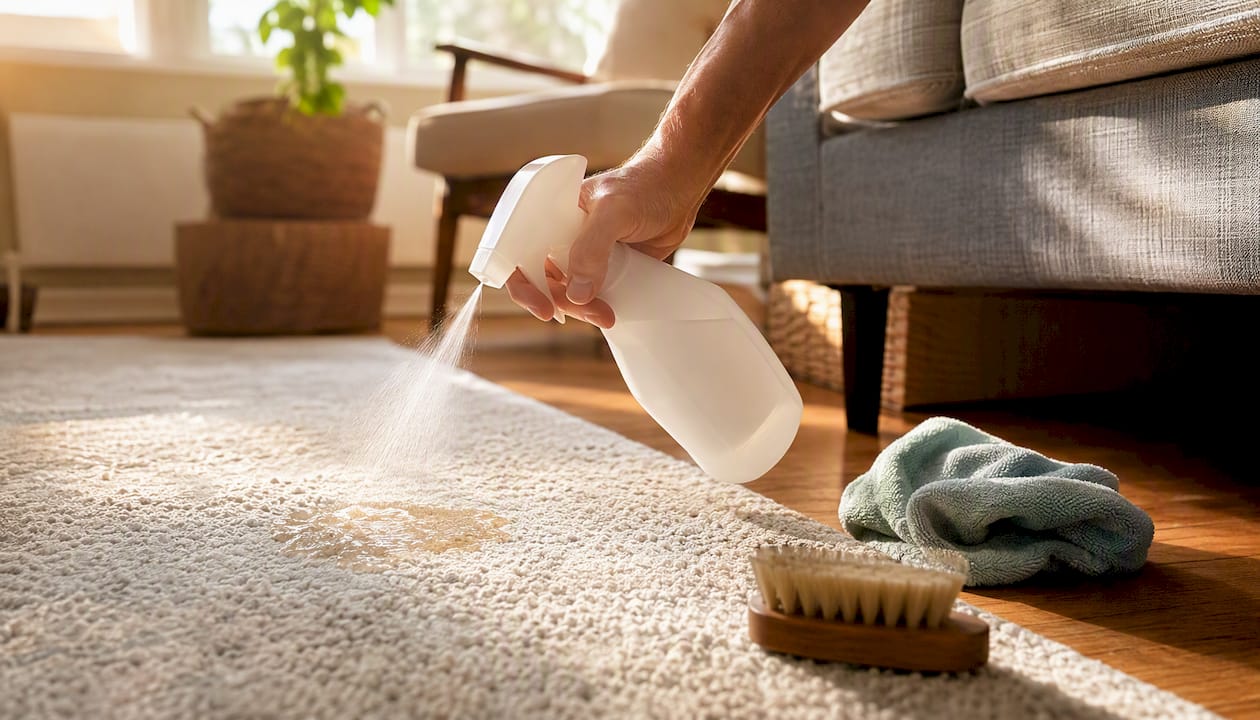
The approach is the same as for fresh stains, but everything gets more aggressive.
Rehydrate first. Mist the area with warm (not hot) water to soften the crystals before applying enzyme cleaner. This gives the enzymes a better chance of penetrating.
Saturate heavily. Pour the enzyme solution generously — more than you think you need. For a stain that’s been sitting for days, the urine has spread outward and downward beyond the visible spot. Treat a wider area than the stain appears to cover.
Extend the dwell time. Cover with a damp towel and plastic wrap to keep it moist, and leave it for an extended period, sometimes recommended overnight for heavily contaminated spots.
Agitate gently. Work the solution into the fibers with a soft brush. Don’t scrub hard enough to damage the pile.
Extract thoroughly. A wet/dry vacuum helps, but a rental carpet extractor pulls significantly more liquid out of the backing than blotting alone. When comparing carpet cleaner rental vs. professional extraction, rental machines are a reasonable middle step for moderate contamination — they reach deeper than towels but don’t match the water pressure and suction of truck-mounted professional equipment.
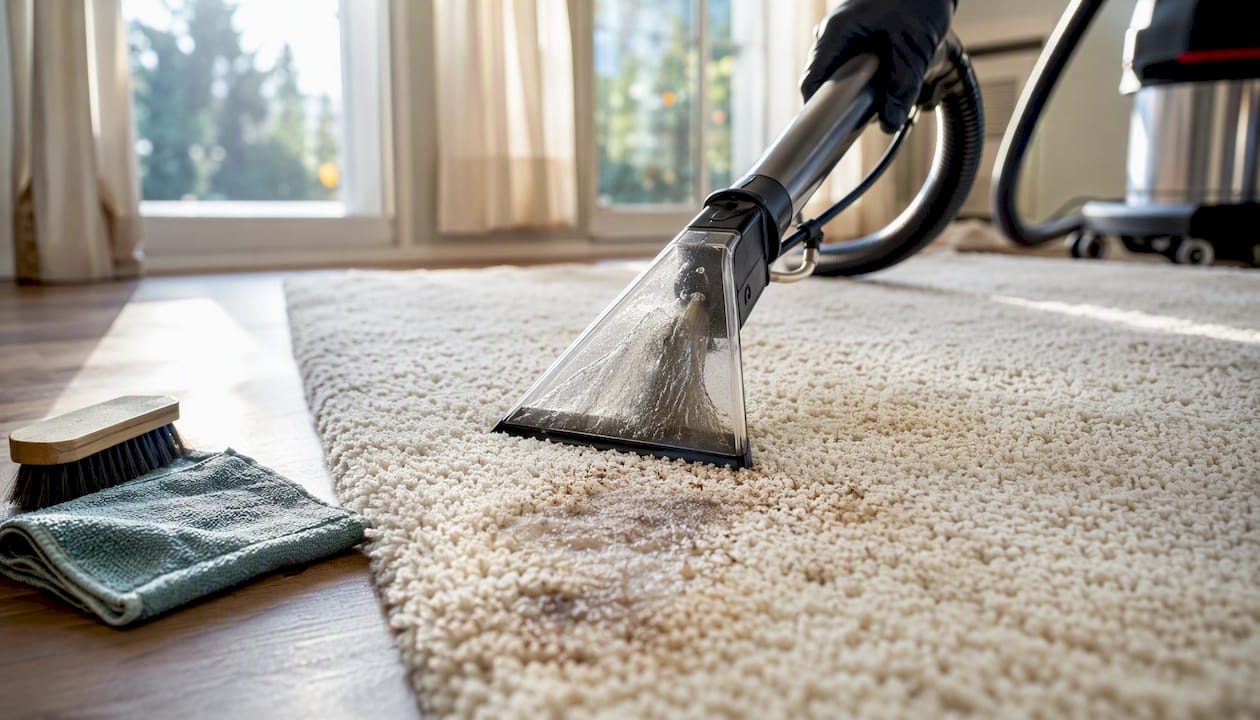
Repeat. One pass rarely solves an old stain. Plan on two or three treatment cycles over a couple of days.
Permanent stains frequently result when urine wicks to fiber tips and dries before treatment. After multiple enzyme treatments, you may lighten the discoloration significantly but not eliminate it entirely. That’s a realistic expectation to set before you start.
If the odor persists after two full treatment cycles, or if you press a damp cloth to the backing and it comes up smelling like urine, the pad underneath is contaminated. No amount of surface treatment fixes that. That’s a professional job.
Which cleaners actually work, and what should you never use?
Enzyme cleaners are the right category for urine
Urine is a biological stain. It needs a biological solution. Enzyme-based cleaners contain specific enzymes that digest uric acid, urea, and the bacteria that feed on them. They don’t mask the odor — they remove the source. That’s why enzyme-action formulas are the preferred option for urine over DIY mixes. Dwell time is non-negotiable: the enzymes need 10–20 minutes of wet contact to work.
Nature’s Miracle is one of the most widely available enzyme cleaners and works well for both dog and cat urine on area rugs and wall-to-wall carpet. Rug Doctor Professional Urine Eliminator is formulated for use with extraction machines and is a solid option when you’re running a rental extractor on a heavily soiled carpet.
What not to use
- Bleach: damages fibers, strips dyes, and doesn’t break down uric acid.
- Ammonia-based cleaners: smell like urine to pets and encourage repeat accidents in the same spot.
- Hydrogen peroxide on non-colorfast rugs: can bleach dyes. Always test first on a hidden area.
- Vinegar alone: neutralizes ammonia odor temporarily but does not digest uric acid crystals. The smell comes back.
- Mixing any two cleaners: vinegar plus bleach produces toxic chlorine gas. Hydrogen peroxide plus ammonia is equally dangerous. Never combine products.
OTC sprays that rely on masking agents (fragrances, baking soda) are the worst long-term choice. Masking agents hide odors but leave the contamination in place, and they can make professional remediation harder later by coating the fibers.
| Category | Best for | Odor removal | Visible stain | Fiber safety | Cost / time |
|---|---|---|---|---|---|
| Enzyme cleaners | Fresh and old urine | Excellent | Good | Safe if tested | a modest cost and dwell time |
| Oxygen bleaches (OxiClean) | Fresh non-urine stains | Moderate | Good | Test first | a modest cost and short dwell time |
| DIY oxidizers (peroxide + dish soap) | Fresh visible stains | Low | Moderate | Risk of dye bleed | low cost and short dwell time |
| Rental extractor + urine formula | Old/heavy contamination | Good | Good | Safe | moderate rental cost and cleaning time |
When should you call a professional carpet cleaner?
Some situations are simply past what a spray bottle and towels can fix. Here’s when to stop DIYing and pick up the phone:
- Odor persists after two enzyme treatments. The urine has reached the pad. Surface cleaning won’t touch it.
- Large saturated area. A single accident from a large dog can deposit enough urine to soak through carpet, backing, and pad across a wide area. Rental machines help, but professional truck-mounted extraction is far more effective.
- Backing or pad contamination confirmed. Press a damp cloth to the back of the rug or the floor under it. If it comes up smelling like urine, the contamination is structural.
- Visible permanent discoloration. Especially on wool, silk, or hand-knotted oriental rugs. Professional rug-cleaning manuals recommend pre-inspection and dye-bleed testing before any aggressive treatment, and in-plant immersion for rugs with deep urine saturation.
- Glue-backed or latex-backed rugs. These trap urine salts in the adhesive layer. Full deodorization often requires pad replacement.
- Delicate or fine rugs — wool, silk, antique, or hand-knotted. These need in-plant cleaning, not a home treatment.
What professionals actually do:
- Hot-water extraction at high pressure and temperature, reaching the backing and pad
- Targeted urine decontamination treatments that break down uric salts rather than masking them
- Pad inspection and replacement when contamination is confirmed
- In-plant immersion cleaning for area rugs with heavy urine saturation
- Post-treatment deodorization to neutralize residual odor sources
Before a pro arrives: clear the area, identify every affected spot (a UV black light shows urine stains clearly in a darkened room), and note what products you’ve already used. That last point matters — masking agents in OTC cleaners can complicate professional remediation, so your technician needs to know what’s already been applied.
What most homeowners get wrong — and a few things that actually prevent repeat accidents
The most common mistake? Not using enough enzyme cleaner. Homeowners spray a light mist, blot it up after two minutes, and wonder why the smell comes back in a week. The enzymes never reached the uric acid. You need enough solution to penetrate to the same depth the urine did — and enough dwell time for the enzymes to finish the job.
The second most common mistake is using heat too soon. A warm fan is fine. A steam iron or hot-water rinse before the stain is fully treated locks the uric acid into the fibers permanently.
And here’s the one that surprises people: assuming the odor is gone because you can’t smell it anymore. Residual uric salts reactivate with humidity and the smell returns. A dehumidifier running in high-humidity rooms can reduce reactivation between cleanings — especially in basements or rooms with poor ventilation.
A quick prevention checklist you can implement this week:
- Place waterproof rug pads under every area rug in pet zones. They protect the floor and make the rug easier to lift and treat.
- Vacuum high-traffic pet areas at least twice a week to remove dander and debris before it works into the pile.
- Rotate area rugs every few months so wear and soiling distribute evenly.
- Keep an enzyme cleaner stocked and within reach — a stain treated in the first five minutes is dramatically easier to remove than one treated an hour later.
- Work with your vet or a trainer on substrate preferences if your pet repeatedly targets the same rug. Sometimes the rug’s texture or location is the trigger.
Wichita pet owners: Homeservicesimple handles what DIY can’t
When the enzyme cleaner and the rental extractor haven’t solved it, that’s exactly where Homeservicesimple steps in. The team provides deep steam extraction that reaches the backing and pad — not just the surface fibers — along with targeted odor decontamination that breaks down urine salts rather than covering them up. Area rugs get in-plant cleaning when the contamination is too deep for on-site treatment. Pad replacement is available when backing contamination is confirmed.
Every job comes with a satisfaction guarantee, so if the odor isn’t gone, the work isn’t done. For Wichita, KS homeowners who want consistent protection without scheduling headaches, the Simple Club subscription keeps your carpets maintained on a regular cycle. Request a free estimate from Homeservicesimple and get a professional set of eyes on the problem before it becomes permanent.
Sources
These are the primary references behind the methods and recommendations in this article.
- Petplace
- Technical Bulletin: Pet Urine and Carpet
- PERMANENT STAINS ON AREA RUGS & WALL-TO-WALL CARPETS
- Best DIY Pet Stain Removers for Carpets & Rugs
- Cleaning Wool Carpet, Oriental Rugs & Area Rugs (Wool Rug Cleaning Manual)
- 5 Shocking Facts About Pet Urine & Carpet Odor
FAQ
Does vinegar remove pet stains from carpet?
Vinegar neutralizes ammonia odor temporarily but does not digest uric acid crystals, so the smell typically returns. An enzyme-based cleaner is the more effective choice for removing pet urine from a rug because it breaks down the actual odor source.
Can dog urine permanently stain a rug?
Yes. Urochrome pigment in urine bonds to fibers, and urine is one of the leading causes of permanent rug stains — especially on wool, cotton, and silk. Treating the stain within the first few minutes gives you the best chance of full removal.
Will Dawn dish soap get pee stains out of carpet?
Dawn can help lift the visible residue of a fresh stain when mixed with water, but it does not break down uric acid crystals. Use it only as a first-pass blotting aid, then follow with an enzyme cleaner to address the odor source.
Does OxiClean remove pet stains from carpet?
OxiClean works well on many organic stains and can improve the appearance of a urine spot, but it is an oxygen bleach rather than an enzyme cleaner. It addresses the visible stain more than the odor, and it carries a risk of dye bleed on non-colorfast rugs — always test on a hidden area first.
When is professional carpet cleaning worth it for pet urine?
When odor persists after two enzyme treatments, when the backing or pad smells like urine, or when the rug is wool, silk, or hand-knotted, professional hot-water extraction and decontamination are the reliable path forward. Homeservicesimple offers that level of service in Wichita, KS, including pad replacement and a satisfaction guarantee.