

The reliable way to handle pet urine carpet removal is an enzyme treatment applied with real dwell time, followed by thorough extraction. Skip the steam mop and the vinegar spray bottle. If the smell keeps coming back on humid days, or the padding is soaked through, that’s your cue to stop DIYing it and call a pro.
TL;DR:
- Enzymatic cleaners require at least 15 minutes of dwell time and proper coverage beyond the visible stain for effective odor and stain removal.
- Fresh pet urine accidents are best handled within an hour to prevent urine from reaching the padding and causing long-term damage.
- Applying heat or steam cleaning before enzymatic treatment can set the stain and odor permanently, and rinsing residue after cleaning is crucial to prevent reappearance.
- Persistent odors often indicate urine saturation in the padding or subfloor, which may necessitate professional inspection and possible replacement.
- DIY approaches are unlikely to succeed on older or heavily soiled areas; professional services with targeted enzyme treatment and high-grade extraction are recommended in such cases.
Table of Contents
- How to Remove Pet Urine From Carpet in the First 60 Minutes
- Why Does Pet Urine Keep Smelling After Cleaning?
- What DIY Products Actually Remove Pet Urine From Carpet?
- Common Mistakes That Make Pet Urine Stains Worse
- When Should You Call a Professional for Pet Urine Removal?
- What Home Service Simple Brings to Persistent Pet Odor Problems
- What Most Pet Urine Advice Gets Backward
- Ready to Book Professional Pet Urine Removal?
- Sources
- FAQ
How to Remove Pet Urine From Carpet in the First 60 Minutes
Fresh accidents are the easiest wins in this whole game. You’ve got a window, maybe an hour, where you can stop urine from ever reaching the padding. Miss that window and you’re playing a different game entirely.
Here’s the play, step by step:
- Blot immediately. Grab white paper towels or a plain white cloth (colored towels can transfer dye onto wet fibers). Press down, don’t scrub. Scrubbing just grinds urine deeper into the pile.
- Add weight. Stack a few layers of towels over the spot and stand on them. Your body weight pulls moisture up faster than blotting alone. Swap towels until they come away nearly dry.
- Flush and extract. Pour a small amount of cool water over the area, then pull it back out with a wet-vac or shop-vac. Cool water, not hot. Extraction pulls out diluted urine that’s already started migrating toward the backing, and a wet-vac does this far more effectively than blotting by hand.
- Apply an enzymatic cleaner. Test it on a hidden patch of carpet first. Saturate slightly beyond the visible stain, since urine spreads sideways under the pile faster than it shows on the surface. If the label calls for a long dwell time, cover the spot with a damp cloth to keep it from drying out early.
- Extract again, then let it dry completely. Keep pets off the area until it’s bone dry, both to prevent remarking and to give the enzymes time to finish their job.
The Carpet and Rug Institute recommends blotting first and mixing a rinse of a quarter teaspoon of liquid dishwashing detergent per cup of lukewarm water. Skip laundry detergent or anything with bleach or optical brighteners. Those can discolor carpet fibers permanently.
Pro Tip: Keep a stack of white shop towels and a small bottle of enzymatic cleaner near wherever your pet tends to have accidents. The faster you catch it, the less likely it is to reach the padding at all.
Why Does Pet Urine Keep Smelling After Cleaning?
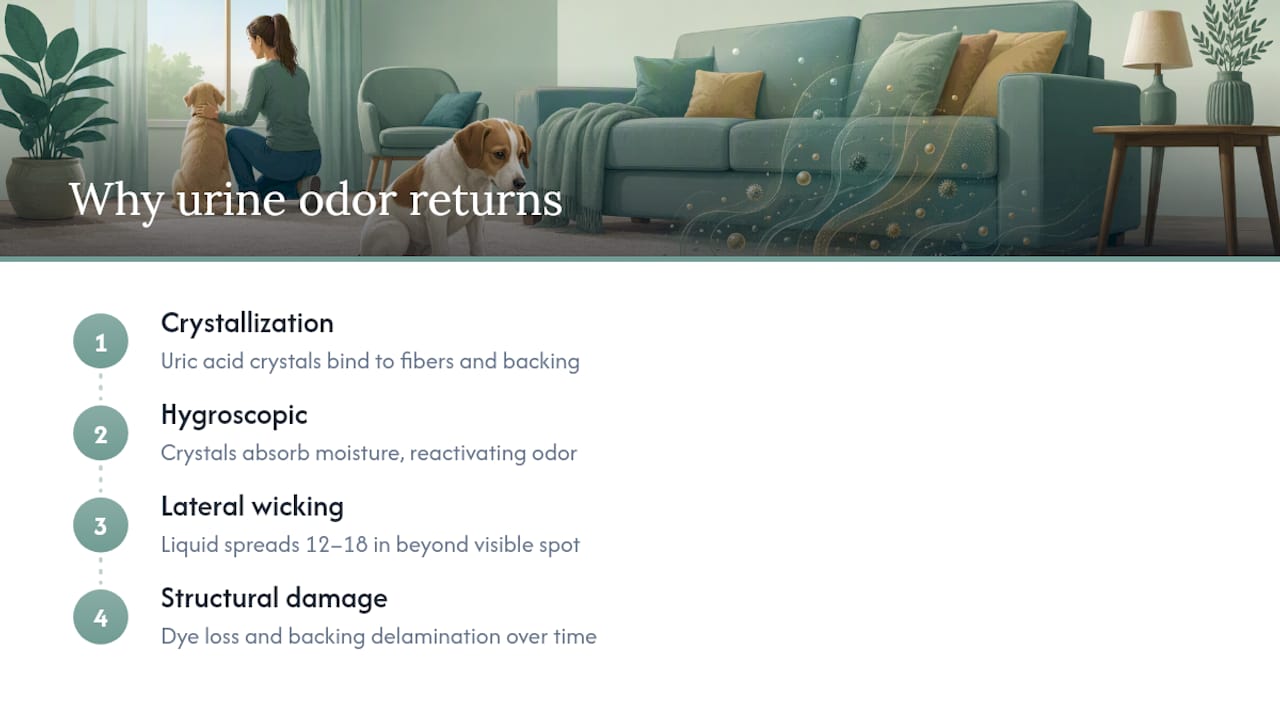
Urine odor is stubborn for a specific chemical reason. Uric acid crystallizes as it dries, and those crystals bind tightly to carpet fibers and the backing underneath. They’re also hygroscopic, meaning they absorb moisture from humid air. That’s why a spot that seemed clean in March can start smelling again during a wet July afternoon.
Liquid urine also wicks laterally the moment it hits carpet backing. The stain you can see is rarely the full extent of the mess. Contamination can spread 12 to 18 inches beyond the visible spot, which is exactly why surface-only cleaning so often fails on older or repeat-accident zones.
Left untreated long enough, urine can also cause dye damage and backing delamination, weakening the adhesive that holds carpet layers together.
What DIY Products Actually Remove Pet Urine From Carpet?
Enzyme cleaners work by breaking down the proteins and uric acid salts in urine into compounds that no longer smell and can be rinsed away. That breakdown takes time. Most enzymatic formulas need at least 15 minutes of dwell time to do meaningful work, and older or more concentrated stains often need longer.
A few things separate a successful DIY job from a wasted afternoon:
- Dwell time is non-negotiable. Spraying and wiping within a minute or two barely scratches the surface chemistry.
- Coverage matters more than intensity. Treat past the visible edge of the stain, not just the center of it.
- Extraction beats absorption. A rented extractor or a household wet-vac pulls broken-down compounds out of the backing; a towel just moves them around.
- Black lights find what your eyes miss. Old urine spots often fluoresce under UV light, which is why municipal cleaning guidance recommends mapping every spot before you start treating.
Retail enzyme sprays are often diluted well below professional strength, and insufficient dwell time or incomplete coverage causes most DIY failures. Baking soda and masking sprays don’t solve anything chemically. They just cover the smell until humidity brings it right back.
Common Mistakes That Make Pet Urine Stains Worse
A lot of well-meaning cleanup attempts backfire because of a handful of repeatable mistakes:
- Steam cleaning before enzyme treatment. Heat can bond urine proteins directly into synthetic fibers, setting the stain and the odor permanently instead of lifting them out.
- Reaching for ammonia or vinegar. Ammonia smells chemically similar to urine, which can actually encourage a pet to remark the spot. Vinegar doesn’t touch uric acid salts at all.
- Layering cleaners without rinsing between them. Leftover residue attracts new soil and blocks enzymes from reaching the crystals they need to break down. Thorough rinsing after any spot treatment is what actually keeps residues from sabotaging the next step.
- Dumping on baking soda. A light dusting can help absorb moisture. A heavy layer just cakes up and traps dampness in the backing, which feeds bacteria instead of starving it.
When Should You Call a Professional for Pet Urine Removal?
Some signs mean it’s time to hand the job to someone with commercial-grade equipment. Watch for odor that only shows up on humid days, a smell with no visible stain to match it, repeated accidents in the same general area, or a padding layer that feels damp or squishy underfoot.
A professional visit typically follows this sequence:
- Locate and map every deposit, including old spots invisible to the naked eye, usually with a black light.
- Apply concentrated enzyme formula and enforce real dwell time instead of rushing the chemistry.
- Run truck-mounted or commercial extraction, which pulls far more moisture and residue out of the backing than a rental unit can manage.
- Control the drying process to prevent mildew and let the treated area cure properly.
- Assess the pad and subfloor, and replace them if urine has soaked all the way through.
Be honest with yourself about outcomes here. Some cases genuinely need pad replacement, and no amount of enzyme spray fixes a subfloor that’s been soaking for months. If you’re also dealing with water damage or mold alongside the urine problem, a restoration specialist may need to get involved before carpet work even starts.
What Home Service Simple Brings to Persistent Pet Odor Problems
Home Service Simple built its process around the same principle that runs through this whole article: chemistry plus extraction, done right, beats guesswork every time. That shows up in a few concrete ways:
- Deep steam cleaning paired with correct pre-treatment sequencing, so heat never gets applied before enzymes finish their job.
- A subscription service intended to catch recurring pet accidents before they turn into padding-level problems.
- Mapping every affected area with UV detection before treatment starts, not just spraying the spot the owner points to.
- Enforced enzyme dwell time and commercial extraction on every visit, with a satisfaction guarantee backing the outcome.
- Related services like upholstery, mattress, and air duct cleaning for households dealing with pet odor beyond just the carpet.
What Most Pet Urine Advice Gets Backward
Most articles on this topic treat urine removal like a shopping decision. Buy the right spray, follow the bottle, done. That’s backward. The product matters far less than the sequence and the patience behind it.
The biggest gap I see between advice and results is dwell time. People buy a legitimately good enzyme cleaner, spray it, wait ninety seconds, and blot it up. That’s not treatment. That’s rinsing. The enzymes never got the chance to digest anything.
The second gap is decision paralysis around padding. Homeowners will spend three weekends and forty dollars in cleaning products trying to save a padding zone that was compromised on day one. If urine reached the subfloor, no amount of surface enzyme work reverses that. Knowing when to stop DIYing and call it is just as valuable as knowing how to blot a fresh spot correctly.
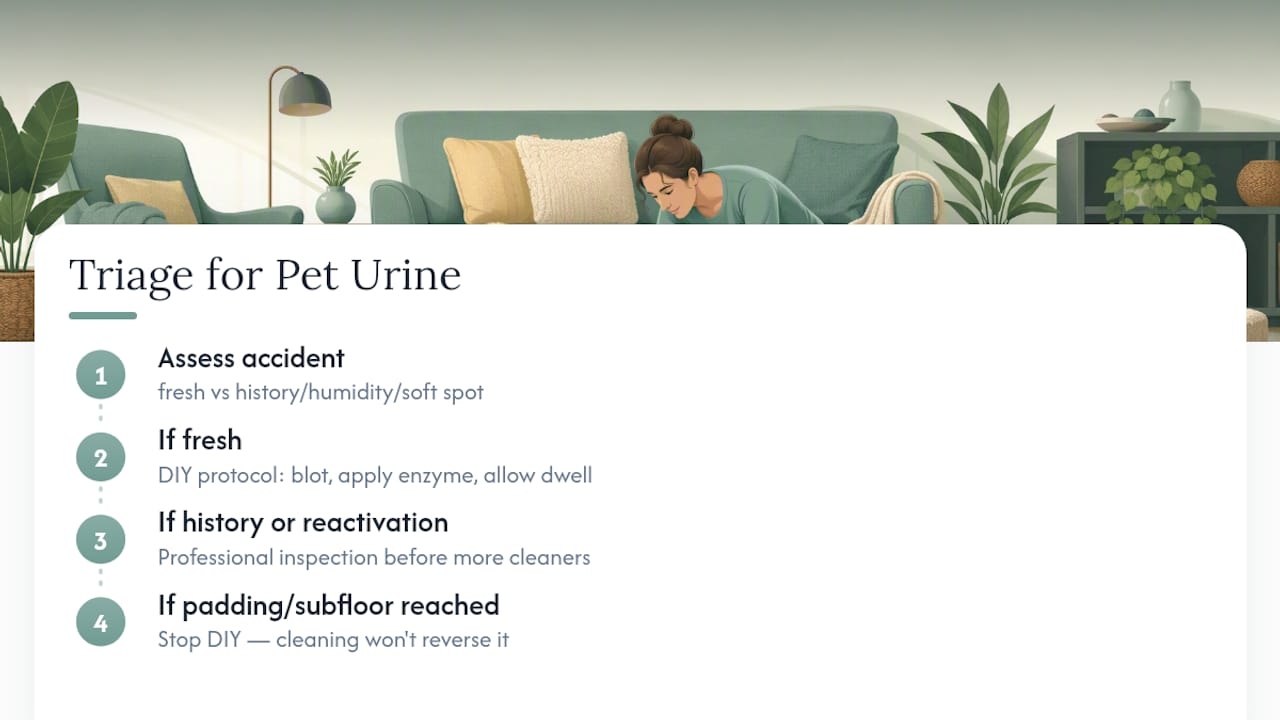
Treat this like triage, not a single fix. Fast accidents get the DIY protocol. Anything with history, humidity reactivation, or a soft spot underfoot gets a professional inspection before you spend another dollar on a cleaner that was never going to solve it.
— chris*
Ready to Book Professional Pet Urine Removal?
If you’ve run the enzyme and extraction routine twice and the smell still returns when the weather turns humid, that’s your answer. Professional service is built for exactly this gap between what a retail spray can fix and what a saturated pad actually needs.
A typical visit starts with inspection and UV mapping to find every deposit, not just the one you noticed. From there, technicians apply concentrated enzyme treatment with enforced dwell time, run commercial extraction to pull it all back out, and manage drying so the area doesn’t turn into a mildew problem later. If the pad turns out to be saturated, you’ll get a straight estimate for replacement instead of a sales pitch.
For households in Wichita dealing with recurring accidents, book a carpet cleaning visit and ask about the Simple Club subscription if pet accidents are a running theme rather than a one-time event. It keeps a technician checking in regularly instead of you waiting for the smell to come back before making another call.
Sources
- Technical Bulletin: Pet Urine and Carpet — Carpet and Rug Institute
- Animal stains — CRI Spot-Solver
- Cleaning stains guidance — Long Beach (municipal resource)
- Pet urine removal from carpet: what actually works — Xtreme Cleans
FAQ
Can You Really Get Pet Urine Out of Carpet?
Yes, in most cases. Enzyme treatment with adequate dwell time followed by extraction removes both the stain and the odor, though heavily saturated padding sometimes needs replacement rather than repeated cleaning.
What Kills Pet Urine Odor in Carpet?
Enzymatic cleaners break down the uric acid crystals and bacteria responsible for the smell, but only if you give them enough dwell time, typically 15 minutes or more, before extracting.
What Draws Urine Out of Carpet?
Blotting with weighted white towels pulls fresh urine up before it spreads, and extraction with a wet-vac or professional equipment pulls moisture and broken-down compounds out of the backing where blotting can’t reach.
Can Urine-Soaked Carpet Be Saved?
Often, yes, if the padding underneath hasn’t fully absorbed the urine. When contamination has reached the pad or subfloor, professional inspection determines whether cleaning is enough or whether pad replacement is the more honest fix.
Should I Use Baking Soda or Vinegar on Pet Urine?
Neither solves the underlying chemistry. Vinegar doesn’t break down uric acid salts, and heavy baking soda applications can cake and trap moisture in the backing instead of drying it out.