

The fastest fix is a four-step routine: vacuum the couch thoroughly with an upholstery attachment, sprinkle baking soda and let it sit before vacuuming again, spot-treat any urine spots with an enzyme cleaner, then dry everything completely with fans or open windows. Check your fabric’s cleaning code and spot-test in a hidden spot before you touch anything with liquid. If the smell or dampness sticks around after all that, it’s time to call a pro.
TL;DR:
- Vacuum all crevices and under cushions thoroughly before applying any cleaning products to prevent deepening trapped dirt and dander.
- Use baking soda for odor neutralization, leaving it on for at least an hour or overnight for stubborn smells, then vacuum thoroughly.
- Apply enzyme cleaners directly on urine stains to digest proteins and uric acid crystals, but avoid using ammonia, bleach, or heavily perfumed sprays that worsen odor or damage fabric.
- Always spot-test cleaning agents in hidden areas, and follow fabric code instructions closely to prevent watermarks, shrinkage, or color changes.
- Proper drying with fans, dehumidifiers, and open windows is critical; cushions damp for over 24 hours risk mold and mildew, requiring professional treatment.
Table of Contents
- How Do You Get Dog Smell Out of a Couch Fast?
- Home Remedies for Dog Odor: What Actually Neutralizes Smell
- Match Your Cleaning Method to the Couch’s Fabric Code
- Why Drying Matters More Than the Cleaning Itself
- Keep the Couch Smelling Clean Between Deep Cleans
- When Does Dog Odor on a Couch Need a Professional?
- A Realistic Take on Dog Smell and Couch Cleaning
- Get a Couch That Actually Stops Smelling Like a Dog
- Sources
- FAQ
How Do You Get Dog Smell Out of a Couch Fast?
You don’t need a full afternoon to make real progress. This checklist tackles the biggest odor sources in the order that actually works, and most of it takes under an hour.
- Strip the couch down. Pull off cushion covers and any removable slipcovers. If the care tag allows machine washing, toss them in on a gentle cycle. This alone removes a surprising amount of trapped dander and saliva residue.
- Vacuum every crevice. Use the upholstery attachment on seams, crevices, and under cushions, not just the flat surfaces. Dog hair and skin oils collect in the gaps where cushions meet the frame, and that’s where a lot of the smell hides.
- Apply baking soda generously. Spread it evenly across the fabric, working it lightly into the nap with a soft brush. Let it sit anywhere from one hour to overnight for stubborn odors, then vacuum it back up.
- Spot-treat problem areas. For urine, vomit, or drool spots, use an enzyme cleaner directly on the stain rather than a general fabric spray. For grease or body-oil patches, a diluted dish soap solution usually does the trick.
- Speed up drying. Point a fan at the couch, run a dehumidifier if you have one, and crack a window. Damp fabric is exactly where odors come roaring back.
This sequence works because it removes cushions and vacuums before any product touches the fabric, which keeps you from grinding loose hair and dander deeper into the weave. Skipping straight to a spray without vacuuming first is one of the most common mistakes dog owners make, and it usually means doing the whole job twice.
Home Remedies for Dog Odor: What Actually Neutralizes Smell
Not every home remedy does the same job, and mixing them up wastes time or damages your couch. Here’s what each one is actually good for.
Baking soda is your everyday deodorizer, and it earns that reputation for a real chemical reason: it acts as a mild base that neutralizes acidic odor molecules rather than just covering them up. Spread a thin, even layer over the affected area, brush it gently into the fabric with a soft-bristle brush, and let it work. For everyday dog smell, an hour is plenty. For a couch that’s been holding odor for weeks, leave it overnight and vacuum thoroughly the next morning. Go easy on boucle or heavily textured weaves, since baking soda can get trapped in the loops and take extra passes to remove.
White vinegar is a light neutralizer, not a soak. Mix it 1:1 with water in a spray bottle and mist it lightly over the smelly area rather than saturating the fabric. Vinegar breaks down some odor compounds on contact, but it can dull certain dyes, so spot-test on a hidden patch first and let it dry before judging the color. Never combine vinegar with bleach. That combination produces fumes you don’t want in your living room.
Enzyme cleaners are the one product on this list built specifically for organic accidents. If your dog has ever had an accident on the couch, this is the tool you actually need. Enzyme formulas contain proteases and other enzymes that digest the proteins and uric acid crystals left behind by urine, vomit, or feces, breaking them down at the molecular level instead of just masking the smell. Regular cleaners can’t touch uric acid crystals, which is why urine odor keeps returning even after a couch looks and smells clean. Saturate the stain, let the product sit per the label’s instructions, and blot dry. Some enzyme sprays leave a slight residue, so follow the label closely and rinse with a damp cloth if it recommends that step.
Mild dish soap, diluted with water, handles surface grease and body oils that build up where your dog naps most. Blot the solution onto the spot, work it in gently, then rinse with a clean damp cloth. Avoid soaking the fabric. Excess water pushed into the padding is how a five-minute cleanup turns into a two-day drying project.
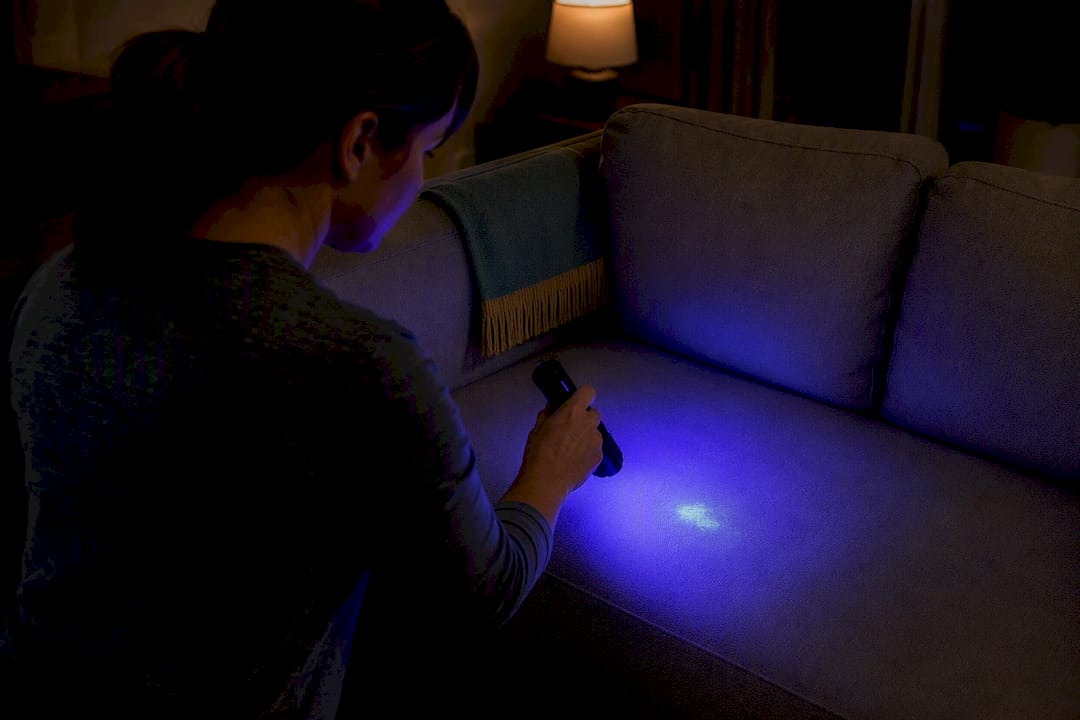
Pro Tip: If you’re not sure whether a smell is urine or just general dog odor, use a UV blacklight in a dark room. Old urine spots glow faintly yellow-green, even ones you can’t see or smell in normal light, which tells you exactly where the enzyme cleaner needs to go.
A few things belong nowhere near your couch. Ammonia-based cleaners actually make urine smell worse, since urine already contains ammonia compounds and adding more intensifies it rather than neutralizing it. Undiluted bleach and hydrogen peroxide can strip color from anything but white fabric, and harsh chemicals like these are a common cause of accidental damage during odor removal. Heavily fragranced deodorizing sprays are the biggest trap of all: they mask smell instead of removing it, and strong fragrances can irritate a dog’s much more sensitive nose, which sometimes triggers more marking, not less.
Match Your Cleaning Method to the Couch’s Fabric Code
Grab a cushion and look for a small tag, usually stapled underneath or hidden in a zipper pocket. That tag has a single letter code that tells you exactly what your couch can handle, and ignoring it is how a stain-removal job turns into a reupholstering bill.
- W means water-based cleaners are safe. This is the easiest fabric to work with, and baking soda, diluted vinegar, and enzyme cleaners all apply cleanly.
- S means solvent-only. Water can cause rings, shrinkage, or watermarks, so skip the vinegar spray and stick to dry solvent-based upholstery cleaners instead.
- WS means either water or solvent is fine, giving you the most flexibility for spot treatment.
- X means vacuum only. No liquid, no exceptions. Professional cleaning is really your only option for anything beyond surface dust and hair on this code.
Upholstery cleaning codes exist specifically to prevent water rings, shrinkage, and color bleed, but the code is a starting point, not a guarantee. Always spot-test in an inconspicuous spot, like the back of a cushion or the underside of an arm, even when the tag says water is fine.
Microfiber and most performance fabrics carry a W or WS code and tolerate water-based cleaners well, but they can water-spot if you soak one section unevenly. Work in small circular motions and blot rather than scrub. Boucle and other loosely woven textured fabrics need a gentler touch regardless of code, since aggressive brushing can pull loops loose. Leather and faux leather are a category of their own: skip enzyme liquids and vinegar entirely, and use a leather-specific cleaner and conditioner instead, since the wrong product can crack or discolor the surface permanently.
To spot-test properly, apply a small amount of your chosen cleaner to a hidden area, wait ten minutes, then blot with a clean white cloth. If color transfers onto the cloth or the fabric changes texture, stop and try a gentler method. Even a fabric rated safe for water shouldn’t be soaked. Controlled dampening and blotting always beat pouring liquid directly onto the cushion, since excess moisture just pushes soil deeper into the padding underneath.
Why Drying Matters More Than the Cleaning Itself
A couch that stays damp for too long doesn’t just smell musty. It becomes a breeding ground for bacteria and mold, which produces an odor that’s arguably worse than the dog smell you started with. Trapped moisture inside cushion padding creates exactly the warm, humid environment mold spores need to take hold, and once mold sets into foam padding, no amount of surface cleaning fixes it.
Here’s how to dry a treated couch properly:
- Remove cushion covers if they’re washable, and let them air-dry flat rather than stuffing them back on damp cushions.
- Stand cushions on their edge rather than laying them flat. Airflow reaches both sides that way instead of just the top.
- Point a box fan or two directly at the treated area for several hours.
- Run a dehumidifier in the room if humidity is high, especially in summer months.
- Open windows when the weather allows, since fresh air moves moisture out faster than a closed, still room.
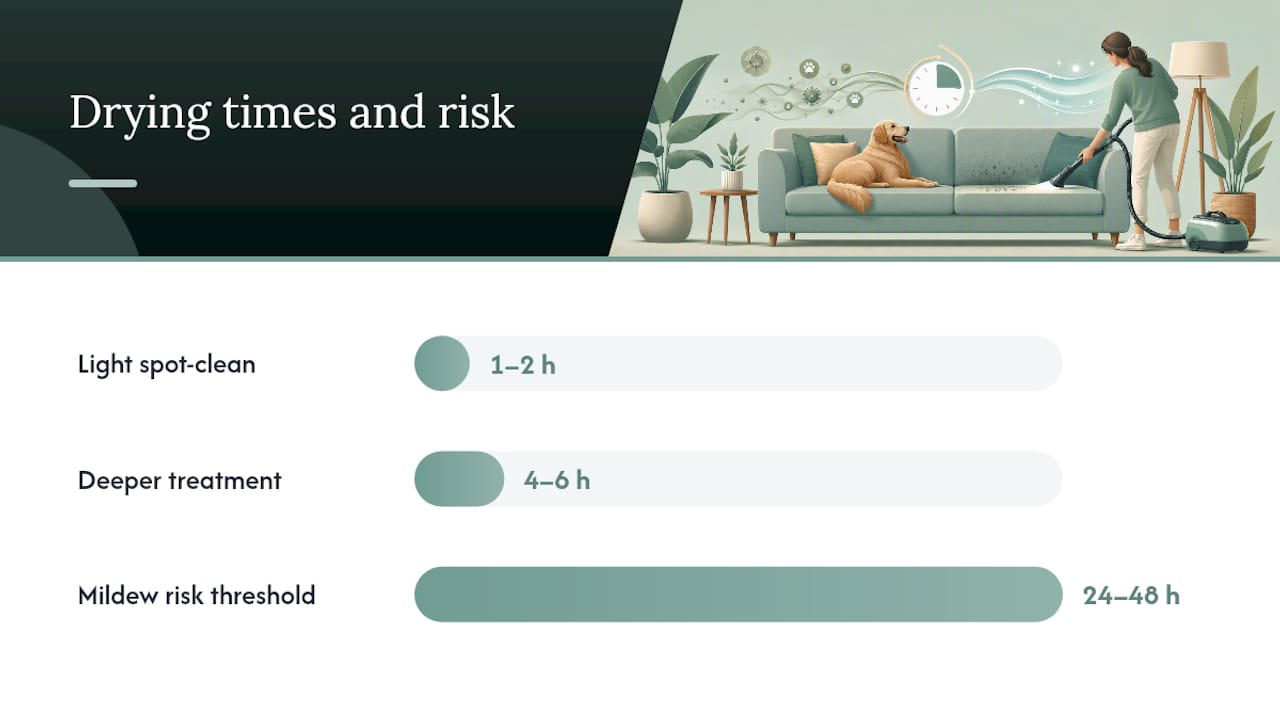
A light spot-clean with baking soda usually dries within an hour or two. A deeper treatment involving enzyme cleaner or a vinegar spray typically needs four to six hours before the fabric feels fully dry to the touch. Cushions or padding that remain damp beyond a day or two are at risk for mildew, and that window is your hard deadline. If a couch still feels cool or damp after a couple of days, or if you catch a musty smell developing instead of fading, that’s your signal to call a professional rather than keep waiting it out.
Keep the Couch Smelling Clean Between Deep Cleans
Prevention beats cleanup every time, and most of it comes down to five minutes a day rather than a full afternoon every month.
Vacuum the couch weekly with an upholstery attachment, and keep a lint roller within reach for quick touch-ups between full vacuum sessions.
Regular grooming and wiping down paws after walks meaningfully cuts down on how much oil and dander actually transfers onto your furniture in the first place. Brushing your dog two to three times a week, especially during shedding season, keeps loose fur out of the couch fibers before it ever gets there. Bathing frequency depends on the breed and coat type, but a dog that smells strong between baths is often overdue.
Washable throws or slipcovers give you a real line of defense. Drape one over the spot your dog favors, and toss it in the wash weekly instead of tackling the whole couch. Rotating cushions periodically also spreads out wear and odor buildup instead of letting one favorite spot absorb all of it.
- Vacuum weekly, deep clean seasonally.
- Wipe paws after every outdoor walk, especially in wet weather.
- Keep a washable throw on the most-used cushion.
- Designate one dog-friendly zone if you want the rest of the couch protected.
Pro Tip: Keep a small “accident kit” in a nearby drawer, a spray bottle of your enzyme cleaner, a stack of clean cloths, and a little baking soda in a shaker jar. Treating an accident the moment it happens takes minutes and prevents the odor from ever setting into the padding.
When Does Dog Odor on a Couch Need a Professional?
DIY methods handle most everyday dog smell, but there’s a point where home remedies stop being enough. Watch for these signals:
- Odor persists even after a full vacuum, baking soda, and enzyme treatment cycle.
- Padding feels soaked through, not just surface-damp, meaning urine reached the foam underneath the fabric.
- You notice visible mold or a musty smell developing instead of fading.
- Wet spots still haven’t dried after 24 to 48 hours.
If urine soaked deep enough to reach the interior foam, surface treatments generally can’t reach it. In that situation, professional extraction that treats the padding directly, not just the fabric surface, is usually the only real fix.
Professional cleaners rely on tools most households don’t have. Hot water extraction combined with antimicrobial treatment and targeted deodorization removes odor at the source rather than masking it, and controlled drying equipment gets moisture out fast enough to prevent the mildew risk that comes with air-drying alone. Home Service Simple builds its upholstery cleaning service around exactly this problem: deep steam extraction paired with pet-safe deodorizing treatments, backed by a satisfaction guarantee so you’re not gambling on the outcome.
Before booking any cleaner, ask these questions:
| Question to ask | Why it matters |
|---|---|
| What equipment do you use for extraction? | Hot water extraction reaches deeper than surface sprays |
| How long will the couch take to dry? | Controlled drying prevents mildew risk |
| Are your products pet-safe? | Protects dogs from residue and fragrance sensitivity |
| Is there a satisfaction guarantee? | Confirms accountability if odor returns |
If your couch has been fighting you for weeks and the smell keeps creeping back no matter what you try, it might be time to compare upholstery cleaning costs against the hours you’ve already sunk into DIY attempts.
A Realistic Take on Dog Smell and Couch Cleaning
Most dog owners chase a fantasy of a couch that never smells like a dog again. That’s not realistic, and chasing it usually means overusing harsh products that damage fabric faster than the dog ever could. The honest goal is management, not elimination: a routine that keeps odor at a level nobody notices when they walk in the door.
What surprises people most is how much of this comes down to drying, not cleaning. You can do everything right with baking soda and enzyme cleaner and still end up with a worse smell than you started with, simply because the cushion stayed damp for three days. Airflow is doing as much work as any product on your shelf.
If you take one thing away from all of this, let it be the spot-test. Skipping it to save two minutes is how a $15 bottle of enzyme cleaner turns into a fabric replacement bill. Test small, dry completely, and treat the couch like the investment it actually is.
— chris
Get a Couch That Actually Stops Smelling Like a Dog
DIY methods buy you time between deep cleans, but they don’t reach urine that’s soaked into cushion padding or years of accumulated dander pressed into the weave. Home Service Simple handles that layer with hot water extraction and pet-safe deodorizing treatments built specifically for households with dogs, backed by a satisfaction guarantee so you know the odor is actually gone, not just masked for a week. The Simple Club subscription takes the guesswork out entirely: instead of scrambling to book a cleaner every time the smell creeps back, you get consistent care scheduled automatically, without the hassle of remembering to call. If your couch, carpet, or even the air ducts pulling dander through your vents need a real reset, book a cleaning near 13th and Greenwich in Wichita and get a straight answer on what it’ll take to fix it for good.
Sources
- How to help remove dog odor from a couch | Febreze
- How to eliminate bad odors at home | Bellona USA
- What is an enzyme cleaner? | EnzymeCleaners
- Understanding upholstery fabric cleaning codes | What a Room
- Why does upholstery take so long to dry after cleaning? | Magic Wand Company
FAQ
How do I get my couch to stop smelling like a dog?
Remove cushion covers, vacuum thoroughly with an upholstery attachment, apply baking soda and let it sit before vacuuming again, then spot-treat any urine with an enzyme cleaner and dry completely. Doing this weekly, paired with regular grooming, keeps the smell from building back up.
What smell will keep a dog off the couch?
Dogs generally avoid strong citrus and vinegar scents, though results vary by dog and these work better as a deterrent than an odor remover. A washable throw over the favorite spot is a more reliable long-term fix than relying on smell alone.
Does vinegar get a dog’s smell out of the couch?
Diluted white vinegar (mixed 1:1 with water) neutralizes some odor compounds when lightly misted on fabric, but it won’t break down urine’s uric acid crystals the way an enzyme cleaner does. Always spot-test first, since vinegar can affect color on some fabrics.
What gets dog smell out of fabric?
Baking soda handles general odor by neutralizing acidic molecules on contact, while enzyme cleaners are the only DIY option that actually breaks down urine, vomit, and organic residue at the source. Using both together, baking soda for the everyday smell and enzyme cleaner for specific stains, covers most situations a dog owner runs into.
When should I call a professional instead of cleaning it myself?
Call a professional if odor persists after a full DIY cycle, if padding feels soaked rather than just damp, or if a treated area hasn’t dried within 24 to 48 hours. Home Service Simple’s extraction and deodorizing treatment reaches padding that surface cleaning can’t touch, with a satisfaction guarantee behind the result.