

Remove the solids first, blot straight down with a white cloth, apply an enzyme cleaner, and extract the moisture completely. That’s the whole game. Do it fast and your carpet survives without a trace. Wait too long and vomit stains can become permanent as the stomach acid etches into the dye and fibers. Here’s what to do right now:
- Remove solids by scooping from the edges inward with a spoon or spatula. Never press down.
- Blot, don’t scrub. The Carpet & Rug Institute is clear on this: pressing straight down lifts contaminants; scrubbing drives them deeper.
- Apply a pet enzyme cleaner and let it dwell. Enzyme cleaners digest the proteins that cause lasting odor and staining.
- Extract and dry with a wet/dry vacuum or clean cloths, then sprinkle baking soda and vacuum after several hours.
Urgent vet callouts: If you see blood in the vomit, your dog vomits repeatedly, seems lethargic, collapses, or shows signs of severe pain, stop cleaning and call your vet immediately. If a toxic substance was ingested, call the ASPCA Animal Poison Control Center at (888) 426-4435.
Homeservicesimple in Wichita, KS is a local professional option when DIY isn’t enough.
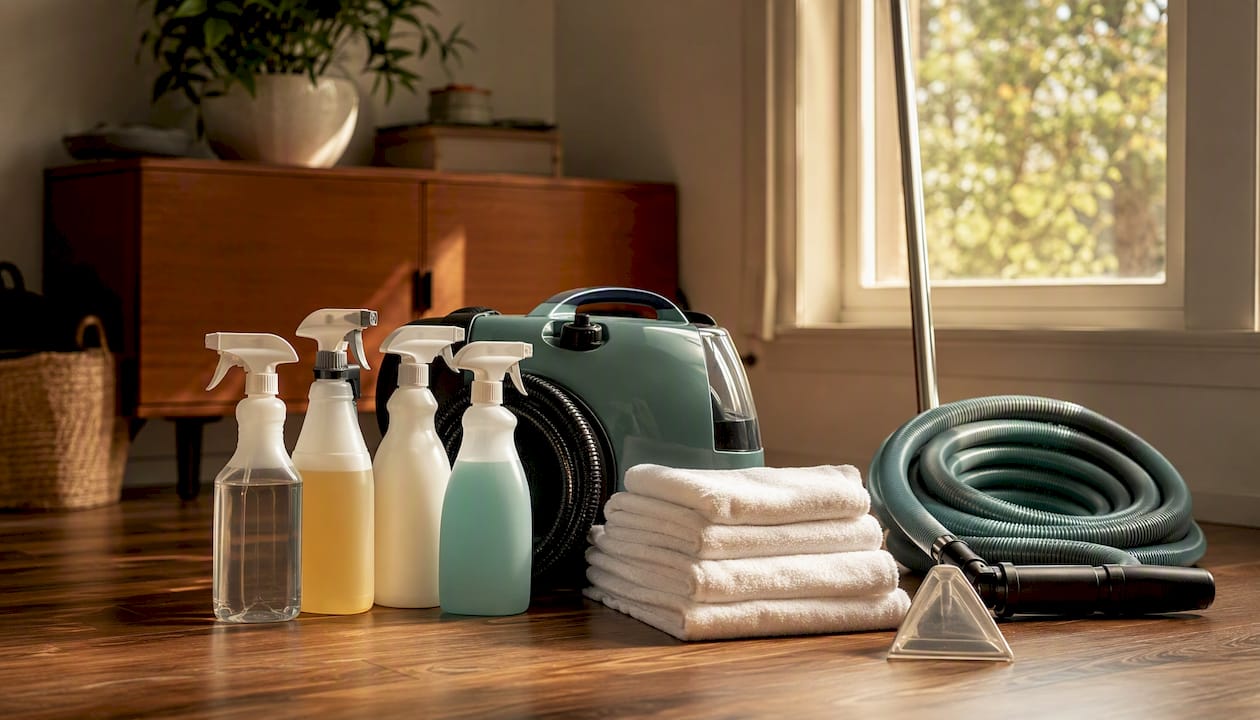
Table of Contents
- What supplies do you need before you start cleaning?
- How do you clean fresh dog vomit off carpet?
- How do you handle dried or older vomit stains?
- How do you get rid of the smell and stop your dog from re-marking?
- Mistakes that make vomit stains permanent
- When does dog vomiting need a vet visit?
- When should you call a professional carpet cleaner?
- Key Takeaways
- What most pet owners get wrong about DIY cleanup
- Homeservicesimple handles the jobs DIY can’t finish
- Useful sources
- FAQ
What supplies do you need before you start cleaning?
Having the right kit ready turns a stressful moment into a five-minute job. Here’s what to keep stocked near common accident spots:
- Disposable gloves — protect your hands from bacteria and stomach acid
- White paper towels or lint-free white cloths — white only; colored cloths can transfer dye to damp carpet fibers
- Blunt scraper (a spoon or silicone spatula works perfectly)
- Enzyme-based pet stain remover — look for “enzymatic” or “pet” on the label; brands like Nature’s Miracle and Rocco & Roxie are widely available at US pet stores
- Baking soda — absorbs residual odor after the wet work is done
- Spray bottle with cool water — for rinsing without flooding the area
- Disposable trash bag — seal solids immediately to contain odor
White cloths matter more than most people realize. A red shop rag pressed onto a wet stain can leave a second stain on top of the first. Enzyme cleaners matter because they chemically break down the proteins in vomit rather than just masking the smell. Baking soda is the finishing move: it pulls residual odor from the fibers before you vacuum.
Pro Tip: Buy a dedicated pet enzyme cleaner and tape it to the inside of a cabinet near your dog’s usual spots. When the moment hits, you won’t be hunting under the sink.
How do you clean fresh dog vomit off carpet?
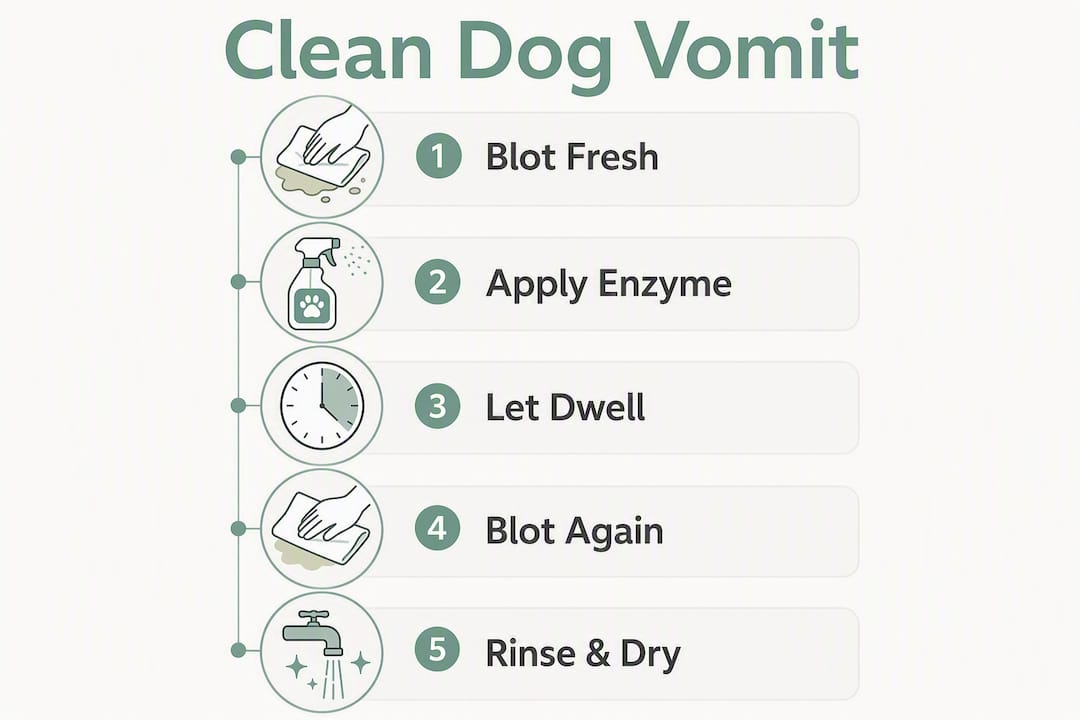
Speed is everything here. The longer stomach acid sits on carpet fibers, the deeper it migrates into the backing and pad. Follow these steps in order:
- Gear up. Put on gloves. Keep other pets and kids out of the area. Grab your scraper, white cloths, enzyme cleaner, and spray bottle.
- Lift the solids. Work from the outer edge of the mess toward the center. Scoop gently with your spatula and drop everything into a trash bag. Do not press down.
- Blot the liquid. Press a folded white cloth straight down onto the stain. Hold it for a few seconds, then lift. Swap to a clean section of cloth as it gets soiled. Keep blotting until no more liquid transfers.
- Apply cool water. Lightly mist the area with cool water from your spray bottle to dilute remaining residue. Blot again. Never use hot water — heat can cook the proteins and lock the stain in permanently.
- Apply your enzyme cleaner. Spray generously, covering the visible stain plus a 2"–3" perimeter around it. Liquid often wicks outward and downward beyond what you can see. Follow the product’s dwell time exactly — enzymes need contact time to break down proteins before you extract them.
- Extract. Blot firmly or run a wet/dry vacuum over the area. Repeat the enzyme application and extraction if residue or odor remains.
- Neutralize odor. Once the area is mostly dry, sprinkle a generous layer of baking soda. Let it sit for several hours, then vacuum thoroughly. Cleaning pros at Good Housekeeping confirm baking soda as a reliable natural odor absorber for this exact situation.
Pro Tip: Always test your enzyme cleaner in a hidden corner of the carpet first. Some wool blends and delicate fibers react differently to enzymatic chemistry.
How do you handle dried or older vomit stains?
Dried vomit is harder, but not hopeless. The proteins have had time to set and migrate toward the backing, and dye loss becomes a real risk if you use the wrong chemistry.
Start by rehydrating the stain. Mist cool water over the dried material and let it sit for two to three minutes to soften. Then gently lift the loosened crust with your scraper, working from the edges inward. Bag the debris immediately.
From there, apply your enzyme cleaner with a longer dwell time than you’d use on a fresh stain. Some manufacturers recommend 10–15 minutes for set stains; read your product label. Gentle pinching and lifting with a cloth can help work the cleaner into the fibers, but avoid any scrubbing motion. Extract with a wet/dry vacuum or firm blotting.
If the odor comes back once the area dries, the contamination reached the backing or pad. Surface treatment won’t fix that. That’s the point where professional extraction becomes the right call.
Pro Tip: Oxygen-based spot treatments like OxiClean can help loosen stubborn dried residue when used as directed, but they work best as a pre-treatment before enzyme application, not as a standalone fix.
How do you get rid of the smell and stop your dog from re-marking?
Masking the odor with a scented spray is the most common mistake pet owners make. Dogs can still smell the protein residue underneath, and they’ll return to the same spot. The goal is elimination, not cover-up.
Enzyme cleaners are the only reliable way to eliminate odor at the source. They digest the organic proteins that bacteria feed on, cutting off the smell cycle entirely.
- Apply baking soda after the enzyme treatment, once the carpet is mostly dry. Let it sit for several hours before vacuuming.
- Find hidden spots with a blacklight in a darkened room. Dried vomit and urine fluoresce under UV light, revealing spots you may have missed. Treat every one of them.
- Check for tacky or darkened areas by running your hand lightly over the carpet after it dries. Those patches often indicate residue that didn’t fully extract.
- Restrict access to the cleaned area until it’s completely dry. A damp spot with residual odor is an invitation for re-marking.
Pro Tip: Place a mat or a crate over the cleaned spot for 24–48 hours after treatment. Once the area is fully dry and odor-free, your dog loses the scent cue that draws them back.
Mistakes that make vomit stains permanent
These are the errors that turn a fixable mess into a lasting problem:
The five mistakes that permanently damage carpet: scrubbing instead of blotting, using hot water, applying bleach near enzyme products, soaking the area with too much liquid, and using colored cloths. Each one either sets the stain deeper, strips the dye, or creates a secondary problem worse than the original.
Scrubbing unravels carpet fibers and pushes stomach acid deeper into the pile and backing. Hot water cooks the proteins, bonding them to the fibers. Bleach mixed with ammonia or enzyme products creates dangerous fumes and causes immediate color loss. Over-wetting saturates the pad, which then becomes a reservoir of bacteria and odor that no surface treatment can reach. Colored cloths transfer dye to the wet carpet, adding a new stain on top of the original.
When does dog vomiting need a vet visit?
One episode of vomiting after eating grass or too fast is usually not an emergency. These signs are different:
- Vomiting that repeats more than two or three times in a short period
- Blood in the vomit (bright red or dark, coffee-ground appearance)
- Signs of severe abdominal pain: hunching, whimpering, or a rigid belly
- Lethargy, weakness, or collapse
- Inability to keep water down for more than a few hours
- Neurologic signs: disorientation, stumbling, or seizures
- Suspected ingestion of a toxic substance or foreign object
Any of those signs means stop cleaning and call your vet or an emergency animal hospital. For suspected poisoning, the ASPCA Animal Poison Control Center is available 24/7 at (888) 426-4435.
When should you call a professional carpet cleaner?
DIY gets you most of the way there on a fresh stain. But some situations genuinely need professional equipment and chemistry.
- Persistent odor after full DIY treatment means contamination reached the pad. Surface enzyme treatment can’t flush that depth.
- Visible discoloration or dye loss after cleaning suggests the stomach acid stripped the carpet’s color. A professional can assess whether restoration is possible.
- Your dog keeps returning to the same spot even after cleaning. That’s a sign residual protein remains in the backing.
- The stain soaked through to the subfloor, especially in older carpet with thin padding.
What professionals actually do is different from what most people picture. Professional pet vomit treatment involves pH stabilization first, because vomit’s acidity can strip carpet dyes on contact. Then enzyme digestion with proper dwell time. Then deep hot-water extraction at controlled temperatures to flush contamination from the pile and backing without cooking the proteins. High-volume drying follows to prevent mold.
A manufacturer-backed approach from BISSELL also recommends testing solutions in an inconspicuous area and using portable extractors for thorough removal.
Pro Tip: If odor returns within a few days of DIY treatment, book professional extraction rather than repeating surface spot cleaning. You’re chasing contamination in the pad at that point, and a mop-and-spray won’t reach it.
Key Takeaways
Treat dog vomit on carpet immediately with the blot-and-enzyme method, and call a professional if odor or discoloration persists after full DIY treatment.
| Point | Details |
|---|---|
| Act immediately | Vomit stains can become permanent if left untreated; prompt treatment gives you the best chance of full removal. |
| Blot, never scrub | Press straight down with a white cloth to lift contaminants; scrubbing drives proteins deeper into fibers and backing. |
| Use enzyme cleaners | Enzyme cleaners digest proteins at the source; baking soda absorbs residual odor after the area dries. |
| Avoid hot water and bleach | Heat sets protein stains permanently; bleach near enzyme products causes dangerous reactions and dye loss. |
| Homeservicesimple for tough jobs | Persistent odor or dye loss after DIY means the pad is contaminated; Homeservicesimple offers deep extraction and pet-odor treatment in Wichita, KS. |
What most pet owners get wrong about DIY cleanup
Here’s the honest truth from the cleaning side: the calls we get most often aren’t from people who did nothing. They’re from people who tried hard and still ended up with a smell that came back three days later.
The pattern is almost always the same. They scrubbed. They used hot water because it felt more sanitary. They sprayed a deodorizer and called it done. The problem is that none of those steps address what’s actually happening below the surface. Vomit doesn’t just sit on top of carpet fibers. It wicks down through the pile, through the backing, and into the pad. A spray bottle and some elbow grease can’t reach that depth.
The chemistry matters too. Enzyme cleaners need dwell time to work. Most people spray and wipe within 30 seconds. That’s not enough contact time for the enzymes to break down the proteins. So the odor source stays intact, bacteria keep feeding on it, and your dog smells it even when you can’t.
Professional extraction with pH stabilization and proper enzyme dwell time corrects both the depth and the chemistry problem in one visit. That’s why the odor doesn’t come back.
Homeservicesimple handles the jobs DIY can’t finish
When the smell comes back after you’ve already cleaned twice, that’s not a technique problem. That’s a depth problem. The contamination is in the pad, and the only way to fix it is professional extraction that reaches all the way through.

Homeservicesimple offers deep steam extraction, pet-odor treatment, and upholstery cleaning right here in Wichita, KS, with a satisfaction guarantee on every job. No sticky residue, no lingering smell, no second-guessing whether you got it all. For pet owners who want consistent protection, the Simple Club subscription keeps your carpets on a regular cleaning schedule without the hassle of booking from scratch each time.
Persistent odor, visible dye loss, or a dog that keeps sniffing the same corner are all signs it’s time to call a pro. Book your cleaning or get a free quote and let Homeservicesimple handle the rest.
Useful sources
These are the references used to build this guide. Each one covers a specific part of the cleanup process:
- Carpet & Rug Institute guidance — industry authority on the “blot, don’t scrub” technique and fiber-safe cleaning methods
- How to Remove Vomit Stains, According to Cleaning Pros (Good Housekeeping) — expert-backed steps including baking soda for odor absorption
- How to clean dog vomit from carpet (Rug Doctor) — manufacturer-backed guidance on oxygen-based treatments and portable extractors
- How to Clean Vomit from Carpet (BISSELL) — equipment and solution recommendations with safety tips
- Best way to clean dog vomit from carpet: a pro’s guide (The Mobile Buff) — professional framing of vomit as an organic contamination event requiring controlled moisture and extraction
FAQ
Does vomit permanently stain carpet?
It can, but it doesn’t have to. Vomit stains can become permanent if left untreated, but prompt treatment with cold water and an enzyme cleaner typically removes them completely.
Can I use Dawn dish soap to clean vomit from carpet?
A small amount of dish soap mixed with cool water can loosen surface residue, but it doesn’t digest proteins the way enzyme cleaners do. Use it as a fallback only, and follow up with an enzyme product for full odor removal.
What neutralizes dog vomit on carpet?
Enzyme cleaners neutralize dog vomit by breaking down the proteins and stomach acids at the molecular level. Baking soda applied after cleaning absorbs any remaining odor from the fibers.
Does OxiClean remove dried vomit from carpet?
Oxygen-based products like OxiClean can help loosen dried vomit residue when used as directed, but they work best as a pre-treatment step before applying an enzyme cleaner, not as a standalone solution for odor.