

Steam cleaning works great on most modern upholstery, but only when you slow down and respect the fabric. Check the tag first: if it reads W or WS, you’re clear to steam it carefully. If it says S or X, put the steamer down and either skip it or call a pro. Heavy soiling, pet odor, or a piece you actually care about? That’s pro territory.
TL;DR:
- Steam cleaning is safe on upholstery with a W or WS fabric code if a proper spot test is performed and the nozzle is kept moving.
- Use dry-vapor steamers for faster drying and lower moisture risks, especially on delicate or older fabrics, instead of hot-water extraction machines that leave excess moisture.
- Avoid steam cleaning on fabrics coded S or X, as water or solvent risks damaging or permanently marking the material, and always call a professional for such textiles.
- Professional techniques utilize controlled-moisture equipment that dries cushions faster and removes more embedded dirt than DIY machines, especially on heavily soiled or odorous furniture.
- Allow 4 to 12 hours for upholstery to fully dry after steam cleaning, using fans and dehumidifiers to speed up the process and prevent mold or lingering odors.
Table of Contents
- What Equipment Do You Need for Upholstery Steam Cleaning?
- How Do You Steam Clean a Couch Step by Step?
- What Do the W, S, WS, and X Fabric Codes Mean?
- DIY Steam Cleaning vs. Hiring a Pro: How Do You Decide?
- How Long Does Upholstery Take to Dry After Steaming?
- How Do You Fix Water Rings or Odor After Steam Cleaning?
- Why Do Professionals Get Different Results?
- An Editorial Take on the Steam Cleaning Rules Everyone Skips
- Get Your Upholstery Steam Cleaned the Right Way
- Where This Guide’s Facts Come From
- Sources
- FAQ
What Equipment Do You Need for Upholstery Steam Cleaning?
Not all steam machines are built the same, and the difference matters more on a couch than on a tile floor.
Dry-vapor steamers push out very little liquid moisture, which is why professionals lean on them so heavily. Hot-water extraction machines, by contrast, inject water and then pull it back out, and that extra moisture is exactly what causes most upholstery disasters. Low-moisture systems dry in a fraction of the time compared to consumer hot-water units, and less standing moisture means less risk of mold hiding inside a cushion.
For a home setup, you’ll want:
- An upholstery-specific attachment, not the floor head
- A soft-bristle brush for agitating fibers without fraying them
- A narrow crevice tool for seams and piping
- A machine with adjustable steam output and a dedicated fabric or “low” setting
Retailers stock plenty of consumer steamers built for upholstery, and most work fine for light annual maintenance on sturdy fabrics.
Fill the tank with distilled water only. Skip the essential oils, the dish soap, the vinegar splash your aunt swears by. Additives can clog the machine or leave residue baked into the fabric that’s harder to remove than the stain you started with. Portable steamers handle light dirt on tough synthetic fabric well. They become risky fast on delicate weaves, antiques, or anything already stained with pet urine.
How Do You Steam Clean a Couch Step by Step?
Rushing this process is how a $30 rental turns into a ruined sofa. Slow down and work through it in order.
- Clear and vacuum first. Move breakables off end tables, pull cushions if they’re removable, and vacuum every surface with the upholstery tool. Crumbs and dust turn to paste under steam.
- Spot test before anything else. Pick a hidden spot, like the back panel or underside of a cushion, and apply steam for 10 seconds. Wait 10 minutes. Check for color change, shrinkage, or texture shift before you touch the rest of the piece.
- Pre-treat visible stains. Use an enzyme cleaner on organic soils like food, sweat, or pet accidents. A solvent-based spotter works on oil-based marks, but only if the care tag allows it. Blot, never rub. Rubbing spreads the stain and roughs up the nap.
- Steam in overlapping passes. Keep the nozzle moving, hold it a few inches off the fabric, and make quick passes rather than lingering in one spot. Avoid seams, welting, and glued trim, where moisture pools and adhesive can loosen.
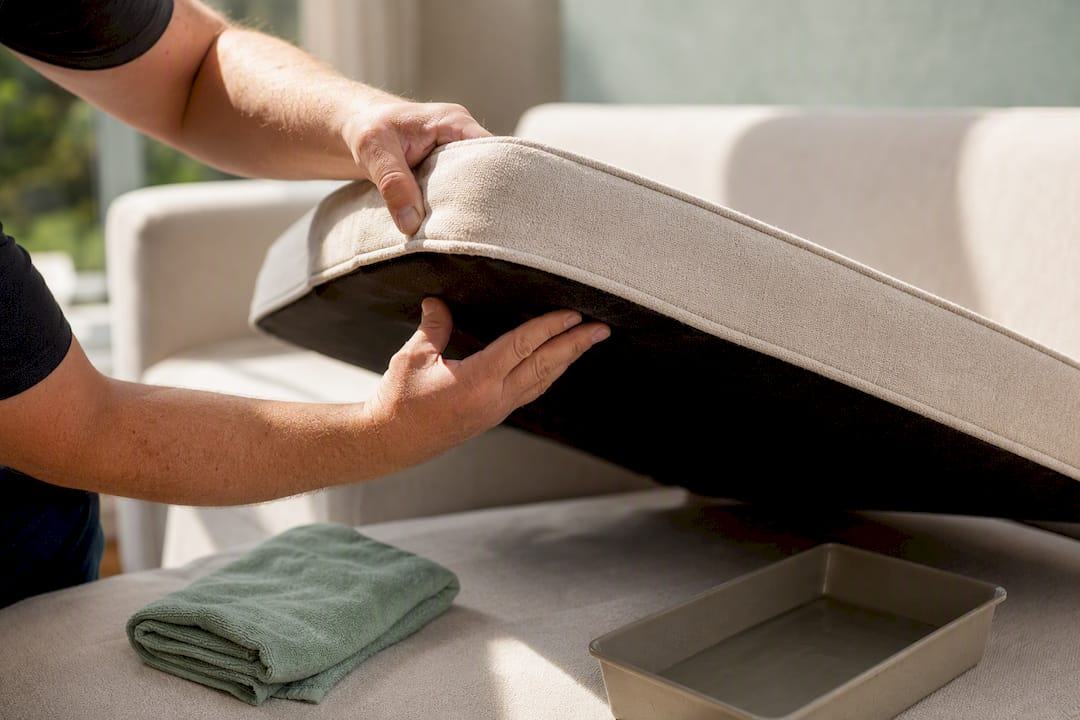
- Blot and dry. Press a clean towel into damp areas immediately after steaming to pull out excess moisture. Get air moving before you replace cushions.
Pro Tip: Keep a second dry towel in your other hand the entire time you’re steaming. Blot each section right after you pass over it instead of waiting until the whole cushion is done. It cuts drying time nearly in half.
Check for damp spots along seams and cushion undersides before you reassemble anything. A cushion that feels dry on top can still be soaked through underneath.
What Do the W, S, WS, and X Fabric Codes Mean?
These four letters, usually stitched into a tag under the cushion or on the frame, decide whether you should even plug in the steamer.
| Code | Meaning | Safe action |
|---|---|---|
| W | Water-based cleaners only | Safe to steam with care |
| WS | Water or solvent-based cleaners | Safe to steam |
| S | Solvent-based cleaners only | Do not steam; risk of shrinkage or watermarks |
| X | Vacuum only, no liquid cleaners | Never steam; professional dry cleaning only |
Cleaning codes are the primary safety check before any steam session touches the fabric, and skipping this step is the fastest way to ruin an otherwise good piece of furniture.
Polyester and microfiber almost always carry a W or WS code, which is exactly why they’re the fabrics you see steamed most often. Silk, wool, rayon blends, and velvet frequently land on S or even X, since water can leave permanent rings or flatten the pile beyond repair.
Even on a W-rated fabric, run the colorfastness test described above and give it the full 10-minute wait. Watch for bleeding dye, puckering, or a texture that feels stiff once it dries.
Here’s something worth knowing: trained technicians using solvent-based systems sometimes safely handle certain S-rated fabrics after their own testing, something no home steamer is equipped to attempt. That gap between what the tag says and what a professional can actually do with the right equipment is the whole reason “call a pro” isn’t just a cop-out line.
DIY Steam Cleaning vs. Hiring a Pro: How Do You Decide?
Cost is usually the first question, but it’s rarely the only one that matters once you factor in your fabric, your time, and how badly you want this to go right the first time.
A rental steamer or a mid-range consumer unit runs a fraction of a single professional visit, but you’re trading dollars for risk and your own Saturday afternoon. Professional technicians using industrial extraction equipment consistently pull more embedded dirt out of the fibers and post higher success rates on set-in stains than a rental machine ever will, and they do it in a fraction of the time a DIY job takes once you count setup, testing, and drying.
Certain situations should send you straight to the phone instead of the rental counter:
- Pet urine or odor that’s soaked past the surface fibers
- Fabric coded S or X, or anything you suspect is an antique
- Older furniture with fragile seams or original upholstery
- A stain that’s already set for weeks and resisted your own spot cleaning
When you do call around, ask a few pointed questions: Is the technician IICRC certified? Do they run dry-vapor or hot-water extraction equipment? Can they show recent references for upholstery specifically, not just carpet? The cost of professional upholstery cleaning varies by fabric and soil level, but it buys you speed, lower risk, and a technician who’s seen your exact stain before.
How Long Does Upholstery Take to Dry After Steaming?
Drying time is where most home steam jobs go sideways, mostly because people underestimate how long “dry” actually takes.
Consumer machines using hot-water extraction typically leave upholstery damp for 4 to 12 hours, depending on fabric density and how humid your house is. Commercial dry-vapor equipment, because it deposits so much less liquid into the fibers, can bring a cushion to surface-dry much faster than consumer units.
Speed things up with a few simple moves:
- Point a box fan directly at the cushion instead of just running the room’s AC.
- Run a dehumidifier in the room for the first few hours.
- Crack a window if the outdoor air is drier than your house.
- Leave cushions standing on edge rather than lying flat, so air reaches both sides.
Watch for a musty smell, a core that still feels cold and damp after 12 hours, or a faint ring appearing as the fabric dries. All three point to trapped moisture, and the fix is more airflow immediately, not more steam.
How Do You Fix Water Rings or Odor After Steam Cleaning?
Even a careful job sometimes leaves a mark or a smell behind, and most of these have a fix if you catch them early.
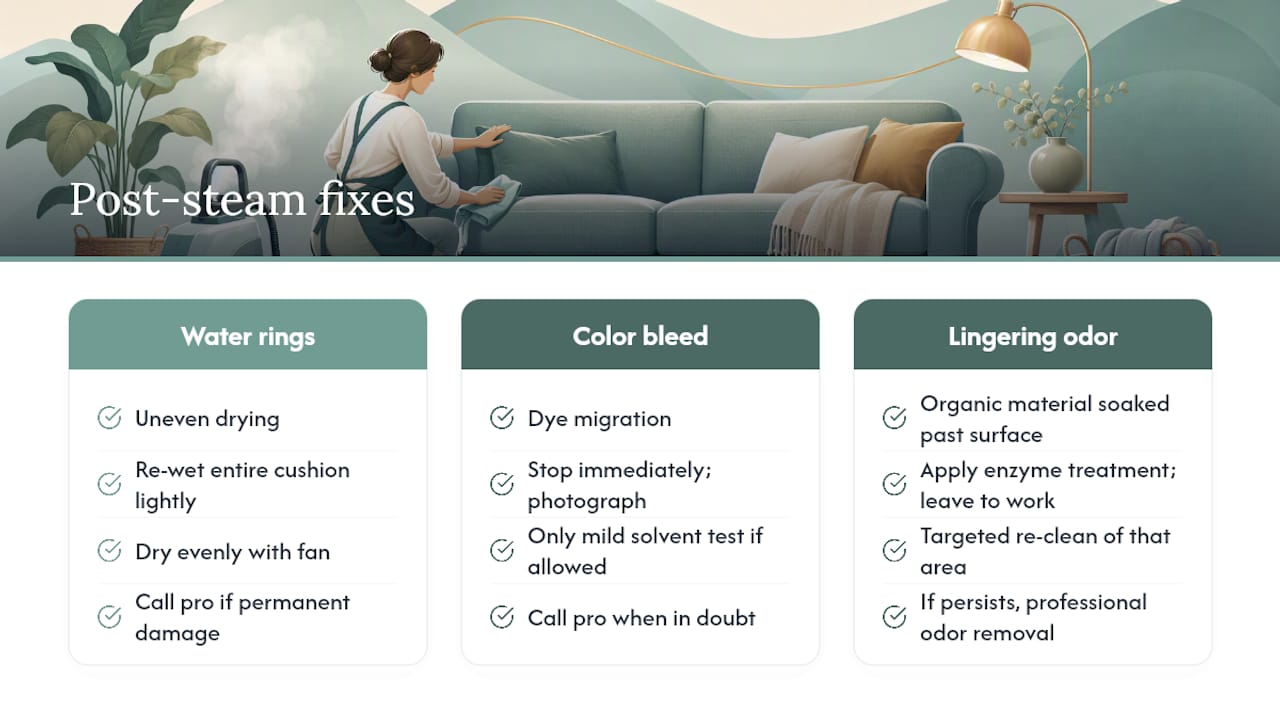
Water rings usually mean uneven drying. Lightly re-wet the entire cushion surface with a damp cloth, then dry it evenly with a fan so the whole panel dries at the same rate instead of drying in a ring pattern.
Color bleed is more serious. Stop immediately, take a photo for your records, and only attempt a mild solvent spot test if the fabric’s care code allows solvents at all. When in doubt, this is a call-a-pro situation rather than a trial-and-error one.
Lingering odor after the piece is fully dry usually means organic material soaked past the surface. An enzyme treatment applied and left to work, followed by a targeted re-clean of just that area, resolves most cases. If odor persists after two attempts, an enzyme-based approach similar to what works on pet accidents on rugs still applies to upholstery, but professional-grade odor removal reaches deeper into the padding than any surface treatment can.
Pro Tip: Photograph any suspected fabric damage immediately, in good light, before you touch it again. If you end up filing an insurance claim or asking a repair shop for a quote, that first photo is your proof of what happened and when.
If the nap has flattened permanently or the dye has visibly shifted, that damage is usually not reversible with home products, and continuing to work the spot will only spread it.
Why Do Professionals Get Different Results?
The gap between a home steamer and a professional setup comes down to moisture control. Dry-vapor systems deliver steam with far less liquid content, which is the main reason trained technicians can work faster and dry cleaner without the guessing game of “is this still wet inside?”
IICRC-trained technicians also read fabric codes differently than a weekend renter does, because they’ve seen how hundreds of different fabrics respond over time. Home Service Simple technicians bring that same controlled-moisture approach to every upholstery job in Wichita, backed by a satisfaction guarantee. Beyond upholstery, the team handles air duct cleaning, mattress cleaning, and full carpet care, and the Simple Club subscription keeps all of it on a schedule so a customer never has to remember to book again.
An Editorial Take on the Steam Cleaning Rules Everyone Skips
Most upholstery damage isn’t caused by steam itself. It’s caused by impatience. People skip the spot test because it feels like an extra step, then wonder why their microfiber has a permanent ring three days later.
The rule that actually matters is simple: read the tag, test a hidden spot, and move the nozzle instead of hovering over one stain hoping steam alone will lift it. Ventilate the room like you mean it, and the moment a fabric is coded S, X, or you smell something that won’t quit, stop DIYing and get a professional opinion instead. A free quote costs nothing and saves you from guessing on a couch you actually like.
— chris
Get Your Upholstery Steam Cleaned the Right Way
Home Service Simple is the direct alternative to renting a machine and hoping for the best: trained technicians, controlled-moisture equipment, and a satisfaction guarantee instead of a damp couch and a fabric tag you’re still not sure you read right.
The service covers deep steam cleaning built to lift embedded dirt and allergens without soaking the padding, so cushions dry faster and stay odor-free. For households that would rather not think about scheduling again, the Simple Club subscription keeps upholstery, carpet, and other cleaning on a recurring plan without the back-and-forth of booking every few months. If you’re in the Wichita area and ready to stop worrying about ruining your fabric, get a free upholstery steam cleaning quote and let a trained technician handle the guesswork.
Where This Guide’s Facts Come From
The fabric-code guidance and spot-test steps draw from Rowenta’s step-by-step steam cleaning guide. Drying-time and mold-risk figures come from Hoffman Steamers’ review of common upholstery mistakes. The DIY-versus-pro comparison relies on Journeyman HQ’s breakdown of professional cleaning differences, and maintenance frequency follows CleanThrust’s safety guidance on upholstery steam cleaning.
Sources
- How to Steam Clean a Couch or Sofa (Step-by-Step Guide)
- Top 12 Upholstery Steam Cleaning Mistakes to Avoid (2026) – Hoffman Steamers
- 7 differences between professional vs DIY upholstery cleaning
- Steam cleaning upholstery: When it’s safe and when it’s a disaster – CleanThrust
FAQ
Is Steam Cleaning Good for Upholstery?
Yes, for most fabrics coded W or WS, steam cleaning lifts dirt and allergens effectively without soaking the material, as long as you spot-test first and keep the nozzle moving.
How Much Does It Cost to Get a Couch Steam Cleaned?
Professional pricing varies by fabric type and soil level, and you can see typical ranges on Home Service Simple’s upholstery cleaning cost breakdown before booking.
What Is the Best Way to Clean a Microfiber Couch?
Vacuum first, spot-test a hidden area, then steam in quick overlapping passes while blotting immediately with a dry towel, since microfiber is usually W or WS rated and handles steam well when it doesn’t get oversaturated.
Is It Okay to Steam Clean a Sofa?
It’s fine on most modern sofas rated W or WS, but check the tag before you start. Never steam a sofa coded S or X, since that risks permanent shrinkage or watermarks.
How Often Should You Steam Clean Upholstery?
Most care guides recommend a deep clean every 6 to 12 months, more often in homes with pets or heavy daily use.