

Carpet isn’t automatically bad for the air in your home. It isn’t automatically good, either. Carpet acts like a sink: it catches dust, dander and other particles, and it lets them go again when you walk, play or vacuum. How well you maintain it, and how dry you keep it, decides which way it tips.
I’m a Wichita dad and a carpet cleaner, so I see both sides. I’ve pulled up carpet that was fine after a good cleaning. I’ve also pulled up carpet that should have gone to the curb after a basement leak. Here’s how to tell the difference.
TL;DR
- Carpet can trap pollutants and allergens such as dust mites, pet dander, mold spores and pesticides. Walking and vacuuming can stir them back up.
- Moisture is the big one. Wet carpet needs to be dried or removed within 24 to 48 hours, or mold becomes the problem.
- New carpet can off-gas VOCs. Ventilate during installation and for 72 hours afterward, and look for Green Label Plus.
- For asthma, skip wall-to-wall carpet in bedrooms if you can. If you can’t, keep it clean and stay out of the room while it’s vacuumed.
- There is no official EPA cleaning schedule. Follow the manufacturer’s instructions and industry standards.
Table of Contents
- How carpet affects the air you breathe
- What lives in carpet: allergens, mold and more
- Carpet and asthma
- How often should you clean carpet for air quality?
- Our perspective: what a good cleaning does and doesn’t do
- A simple routine that keeps carpet working for your air
- Don’t forget the rest of the soft stuff
- Let us handle the cleaning
- Questions people ask
- Sources
How carpet affects the air you breathe
Think of a carpet as a giant, fuzzy filter lying on your floor. Dirt that lands on it stays put, out of your breathing zone, until something disturbs it.
That’s the upside. The downside is that the filter fills up.
The American Lung Association says carpets and rugs may trap dust mites, pet dander, cockroach allergens, particle pollution, lead, mold spores and pesticides. A review in the research literature, Ten questions concerning the implications of carpet on indoor chemistry and microbiology, notes that carpet and rugs make up about half of the U.S. flooring market, and that how they shape our exposure to microbes and chemicals matters.
An EPA-funded study of resuspension and tracking of particulate matter from carpet looked at exactly this: adults and children get exposed to particles from floors and other horizontal surfaces in their homes just by living there.
So the honest answer: carpet holds a reservoir of particles. That reservoir is finite, but it is a steady source every time the carpet gets disturbed.
The Wichita factor
We have wind, red dirt and a lot of open fields. Fine dust rides in on shoes, paws and open doors. If you’ve ever seen a hallway look like the infield after a Saturday doubleheader, you know what I mean. That grit settles into carpet fibers and sits there. Nothing about it is special to Kansas air, but our lifestyle makes entryways and family rooms work hard.
What lives in carpet: allergens, mold and more
Dust mites and pet dander
Dust mites like warm, soft, undisturbed places. Carpet qualifies. Allergen from house dust mites is an important cause of asthma, according to a study on how mite allergen levels vary within carpets. Pet dander works the same way, and it’s sticky stuff that settles deep.
One common misunderstanding: vacuuming gets it all. It doesn’t. Mites often live deep in the fibers where a standard household vacuum can’t reach, which is why EPA-cited research on carpet particle resuspension points people with severe sensitivities toward professional cleaning, or toward removing the carpet.
Mold and moisture
This is where I get serious. The EPA’s biological contaminants guidance says moisture control is the most effective way to manage mold and other biological pollutants. Wet or damaged carpet should be dealt with within 24 to 48 hours. Past that point, deep cleaning often can’t remove the contamination, and replacement is usually the answer.
The EPA’s Inside Story guide even lists wet or damp carpet as a source of indoor air pollutants.
Common trouble spots:
- Carpet laid directly over a concrete basement slab with no moisture barrier
- Pet accidents that soaked through to the pad
- Appliance leaks (washer, water heater, dishwasher)
- Storm water coming in around a basement window
If you’ve had a flood, a guide to the first hour after a basement floods covers safety and triage before anyone touches the carpet. Safety first, then drying.
VOCs from new carpet
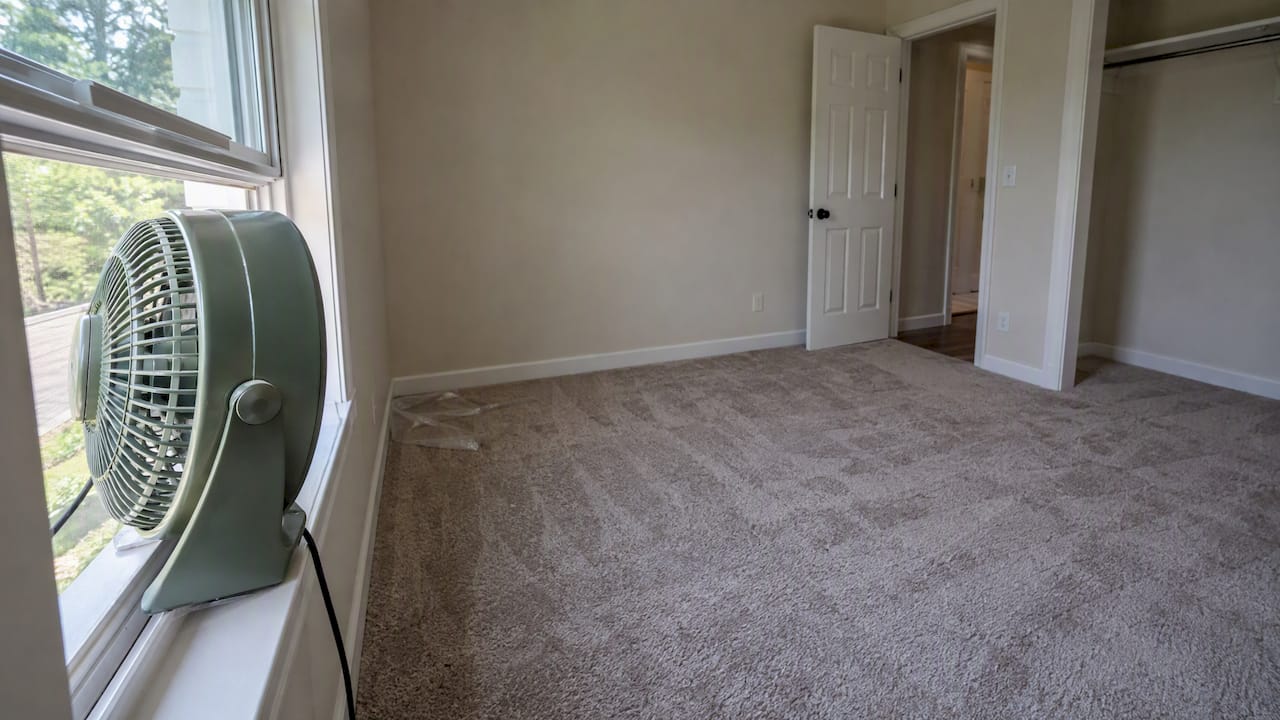
New carpet can give off volatile organic compounds. The EPA’s introduction for health professionals notes these commonly show up as headaches and throat irritation, and it recommends extra ventilation during installation and for 72 hours after: open windows and use fans to push air outdoors.
When you’re shopping, look for Green Label Plus. It replaced the original Green Label in 2009 and sets VOC emission limits based on California’s Section 01350, including a formaldehyde limit of 17 μg/m²/h or less. A closet and storage company’s green-products page is also a handy read if you’re thinking about low-emission materials across your whole house, not just the floor.
Carpet and asthma
If someone in your house has asthma, this section is for you.
The EPA’s home environment checklist suggests avoiding wall-to-wall carpet in bedrooms or the rooms where sensitive people spend the most time. If the carpet stays, the person with asthma should be out of the room while it’s vacuumed and for a while afterward, because vacuuming stirs allergens into the air.
The CDC’s ATSDR asthma triggers page adds that indoor pollutants may matter more for childhood asthma than outdoor air.
Practical moves for an asthma household:
- Talk to your child’s doctor or allergist about triggers before you rip out or replace anything. They know your situation. I don’t.
- Pick one room to be the low-allergen zone, usually the bedroom.
- Have someone else vacuum, or vacuum while the sensitive person is out.
- Use a vacuum with a high-efficiency filter. The EPA notes some vacuums can raise airborne particle levels if they lack one.
- Schedule a deep clean when the person with asthma can be away for the day.
We wrote a longer piece on carpet cleaning for allergies if you want the details.
How often should you clean carpet for air quality?
Here’s something that surprises people. The EPA has not issued a specific cleaning schedule. It tells people to follow manufacturer recommendations and industry standards. A 1989 EPA office letter that gets quoted all over the internet was a professional opinion, not agency policy.
So anyone telling you “the EPA says every X months” is stretching it. Your carpet maker’s warranty instructions are the real starting point.
What we do in practice depends on the house:
| Household | What we’d suggest |
|---|---|
| Kids and pets, lots of foot traffic | Deep clean on a regular schedule, with extra attention to hallways and entries |
| Asthma or allergies | Regular deep cleaning plus a careful vacuuming routine |
| Adults only, light use | A less frequent schedule, based on how the carpet looks and smells |
| Rental turnover | Clean between tenants |
For schedules in more detail, see our 12 to 18 month carpet care plan, our room-by-room vacuuming schedule and the high-traffic area guide.
Our perspective: what a good cleaning does and doesn’t do
We clean carpet in Wichita for a living, so here’s our honest take.
A professional hot water extraction cleaning pulls out the soil, dander and residue that a household vacuum leaves behind. That’s the whole point of deep steam cleaning. When it’s done right, there’s no sticky residue left behind to attract new dirt. You can read more about what steam cleaning does for allergens and the wider benefits of regular cleaning.
But we won’t tell you cleaning fixes everything.
- Water-damaged carpet: If it sat wet for days, we’ll tell you straight that replacement may be the better call. We’d rather lose a job than sell you a cleaning that can’t work.
- Severe sensitivities: Some people do better with hard flooring in the bedroom. A cleaning won’t change that.
- Cleaning chemistry: What’s left in the carpet matters. Ask what products we use, and ask to see the safety data sheet. We cover that in our eco-friendly carpet cleaning guide and the pet-safe cleaning checklist.
The pattern we see: families do best when cleaning is routine, not a panic. Dirt builds slowly. So does a good habit.
One more thing. Air ducts push air through the whole house, so if your allergy trouble isn’t just the floor, they’re worth a look. Here’s what we say about air duct cleaning for allergies, including when it’s not worth it.
— chris
A simple routine that keeps carpet working for your air
You don’t need a complicated system. Here’s the short version.
- Stop dirt at the door. Mats outside and inside, shoes off if your family will go for it.
- Vacuum on a schedule. Slow passes, a good filter, more often in high-traffic rooms.
- Treat spills fast. Blot, don’t rub. Pet accidents are the ones that soak down to the pad, so don’t wait.
- Watch the humidity and the moisture. Fix leaks quickly. Dry anything wet inside 24 to 48 hours.
- Deep clean on a routine. Professional extraction reaches what the vacuum can’t.
- Ventilate after anything new. New carpet, new paint, new cleaners. Windows and fans.
If the smell is the problem, not the dirt, we have a guide for stubborn pet odors in carpet. Smells are often a moisture sign, so don’t just cover them up.
Don’t forget the rest of the soft stuff
Carpet gets all the blame. But the EPA’s biological pollutants page lists draperies, bedding, carpet and other places where dust collects as spots where biological contaminants can build up. Sofas, area rugs and mattresses belong on the same list.
If you’re doing the whole house, think about:
- Upholstery cleaning for the couch your dog thinks is his
- Area rug cleaning, since rugs hold dust just like wall-to-wall
- Mattress cleaning, because you spend a third of your life there
- Tile and grout cleaning in the rooms that don’t have carpet
Let us handle the cleaning
We’re Home Service Simple, a Wichita, KS carpet cleaning company. We do deep steam cleaning for homes and businesses, and we stand behind our work with a satisfaction guarantee.
If you’d rather not think about scheduling, look at the Simple Club. It’s our subscription plan: Standard is 20 USD per month and Premium is 40 USD per month. You get consistent care without juggling appointments.
Ready to book? Head to our carpet cleaning page and call or text for a free quote.
Questions people ask
Is it healthy to have carpet in your house?
For many people, yes, as long as the carpet stays dry and clean. Carpet traps particles, but it can release them when disturbed. If anyone has asthma or allergies, talk with their doctor, and consider hard flooring in the bedroom.
How do I know if my carpet is making me sick?
Watch for patterns. Symptoms that get worse at home, flare after vacuuming, or show up with a musty smell or past water damage are worth raising with your doctor. Headaches and throat irritation after new carpet may be VOC off-gassing, so ventilate and check with a healthcare provider.
Is 20-year-old carpet unhealthy?
Not automatically. Older carpet can hold a larger reservoir of particles, and age alone isn’t a verdict. Its condition is: if it has had water damage, smells musty, or triggers symptoms even after cleaning, replacement is worth considering.
Which carpet is the least toxic?
Look for Green Label Plus certification, which means the carpet meets low VOC emission limits. Then ventilate well after installation, for at least 72 hours.
Sources
- Carpets and rugs, American Lung Association
- Ten questions concerning the implications of carpet on indoor chemistry and microbiology
- Resuspension and Tracking of Particulate Matter From Carpet Due to Human Activity, EPA
- Variability of house-dust-mite allergen levels within carpets
- Biological Contaminants and Indoor Air Quality, EPA
- The Inside Story: A Guide to Indoor Air Quality, EPA
- Indoor Air Pollution: An Introduction for Health Professionals, EPA
- Home environment checklist, EPA
- Environmental Triggers of Asthma, ATSDR
- Has EPA issued specific recommendations on how frequently carpet should be cleaned?
- Biological Pollutants’ Impact on Indoor Air Quality, EPA