

Regular professional carpet cleaning cuts down embedded dust and allergens, freshens the air you breathe, and stretches the life of your carpet by years instead of months. It only works if the technique is right: HEPA vacuuming first, residue-free hot water extraction or dry steam second, and fast drying every time. A carpet cleaning process built around that order ensures better results, which is why it’s worth understanding before you book anyone.
TL;DR:
- Proper carpet cleaning combines HEPA vacuuming, residue-free hot water extraction or dry steam, and fast drying to effectively reduce allergens and extend carpet lifespan.
- Regular cleaning is preventive, but it cannot fix damaged carpets or undo wear from sun exposure, traffic, or padding breakdown, which requires replacement.
- Overwetting, residual shampoo, or fragrance use are common risks, but these can be prevented by asking about extraction recovery, drying time, and fragrance-free options before service.
- Monthly vacuuming with HEPA filters and prompt spill treatment help maintain deep-clean results and prevent dirt from re-settling into the fibers.
Table of Contents
- Top Regular Carpet Cleaning Benefits at a Glance
- Health and Indoor Air Quality: What the Research Says
- Protecting Your Carpet Investment for the Long Haul
- What Professional Cleaning Methods Actually Do
- How Often Should You Schedule Professional Cleaning?
- Downsides and Risks: The Honest Picture
- Keeping Results Fresh Between Visits
- A Publisher’s Note on Applying This in Practice
- How Home Service Simple Makes Regular Cleaning Simple
- Sources
- FAQ
Top Regular Carpet Cleaning Benefits at a Glance
If you’ve got kids running through the house after practice, or a dog that thinks the living room rug is second base, you already know carpet takes a beating. Here’s what a proper deep clean actually gives you back.
- Cleaner air, fewer allergens. Your vacuum grabs surface dirt. A professional hot water extraction pulls out the fine dust and dander sitting down in the fibers, which is where most allergen buildup actually lives.
- A longer-lasting carpet. Grit acts like sandpaper on carpet fibers every time you walk across the room. Remove it regularly and you slow that wear down considerably.
- Restored color and texture. Matted, dingy carpet almost always bounces back lighter and softer after a real deep clean, not just a surface pass.
- Stains and odors gone at the source. DIY spot cleaners mask a spill. Extraction pulls the residue and the smell-causing bacteria out of the pad underneath.
- Lower mold risk. Controlled drying after cleaning keeps moisture from sitting in the backing, where mold and mildew get their start.
- Easier upkeep going forward. A clean baseline means your weekly vacuuming actually keeps up, instead of chasing months of buried grime.
Health and Indoor Air Quality: What the Research Says
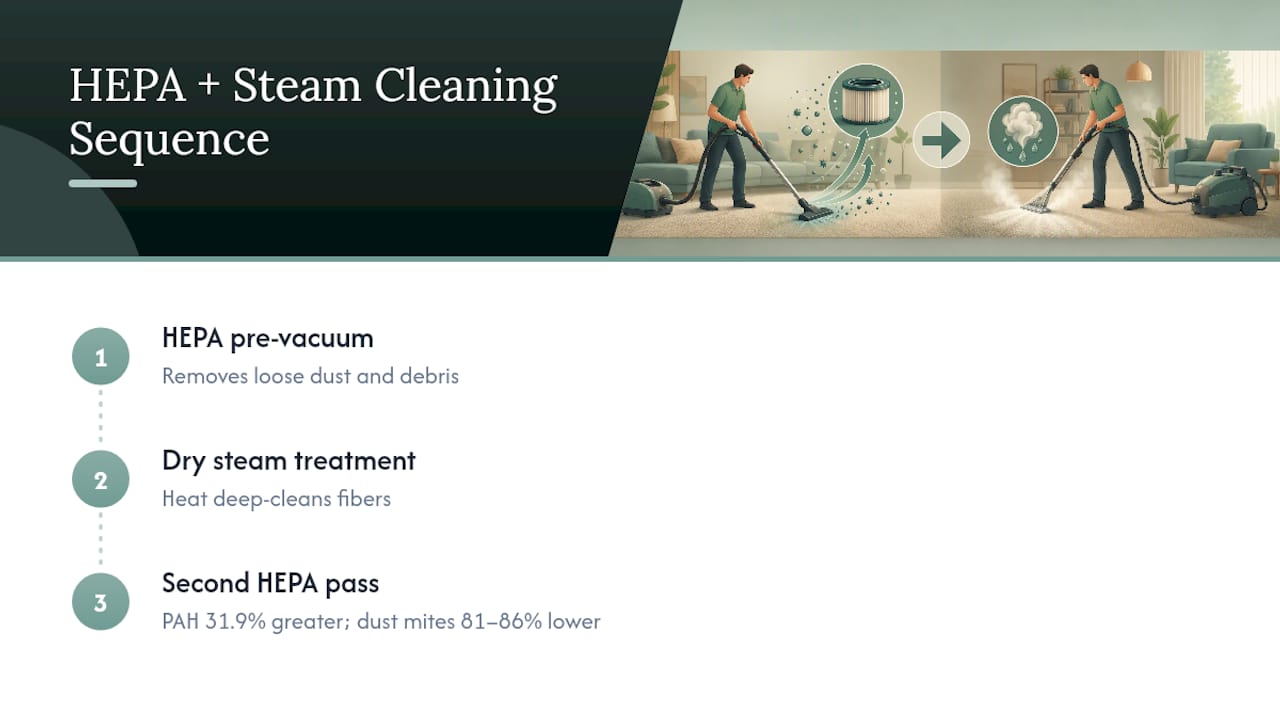
The health case for regular cleaning isn’t guesswork. A controlled intervention study across 50 low-income homes found that a HEPA vacuum, dry steam, HEPA vacuum sequence cut total polycyclic aromatic hydrocarbon (PAH) levels by roughly 31.9% more than repeated HEPA vacuuming alone, with dust mite allergen loads dropping 81 to 86% in homes where allergens were detectable before cleaning.
That’s a real number, not marketing. But don’t mistake it for a cure. The National Center for Healthy Housing notes that cleaning reduces allergen reservoirs, but it works alongside ventilation and humidity control, not instead of them. If someone in your house has asthma, carpet cleaning is one lever among several.
Carpets also absorb and later re-release volatile organic compounds (VOCs) depending on humidity and material, according to a review of carpet and indoor air quality behavior. That’s another reason airflow matters as much as the cleaning itself. When you book a professional carpet cleaning for allergies, ask specifically for HEPA pre-vacuuming and proof of extraction recovery, not just a quick surface rinse.
Statistic Callout: HEPA vacuuming followed by dry steam and a second HEPA pass reduced dust mite allergen loadings by up to 86% compared with pre-cleaning levels, according to the RSC intervention study.
Protecting Your Carpet Investment for the Long Haul
Dirt isn’t just ugly. It’s abrasive. Every grain of grit ground into your carpet fibers by foot traffic works like tiny sandpaper, fraying and dulling the fibers a little more each day. Regular extraction removes that grit before it does permanent damage.
A consistent cleaning schedule typically helps carpets hold their color and texture longer than cleaning only when visibly dirty. That said, cleaning can’t reverse everything. Sun-bleached patches, worn traffic lanes, and padding that’s already broken down need replacement, not another cleaning cycle. Think of regular cleaning as preventive maintenance, the carpet equivalent of an oil change, not a fix for a carpet that’s already worn out.
What Professional Cleaning Methods Actually Do
A real deep clean has two jobs: pull out what’s loose, then pull out what’s stuck. HEPA vacuuming handles the first part, capturing fine dust particles a standard vacuum recirculates right back into the room. Hot water extraction and dry steam handle the second, breaking down oils, dander, and residue bonded to the fiber and pulling it back out with strong suction.
The difference between a good clean and a soggy mess comes down to recovery. Weak extraction leaves moisture and cleaning residue behind, which attracts dirt faster and can encourage mold if drying drags on. A proper deep carpet cleaning should leave carpet damp, not wet, and dry within hours, not days.
Before you book anyone, ask:
- How long will drying take, realistically?
- What products are you using, and can I see the safety data sheet (SDS)?
- Is there a satisfaction guarantee if the results fall short?
Pro Tip: If a company can’t give you a drying time estimate before they start, that’s a sign they’re not controlling moisture carefully. Walk away.
How Often Should You Schedule Professional Cleaning?
Frequency depends on your household, not the calendar. Consumer guidance generally recommends cleaning low-traffic homes about once a year, average households every 6 to 12 months, and homes with pets, kids, or allergy sufferers every 3 to 6 months.
Certain events should move up your schedule regardless: a major spill, a lingering odor you can’t place, a remodel that tracked in construction dust, or anyone smoking indoors. Between professional visits, weekly HEPA vacuuming in high-traffic areas keeps loose dirt from working its way down into the pad.
Downsides and Risks: The Honest Picture
Carpet cleaning isn’t risk-free, and pretending otherwise doesn’t help you. The most common complaints trace back to a few specific causes.
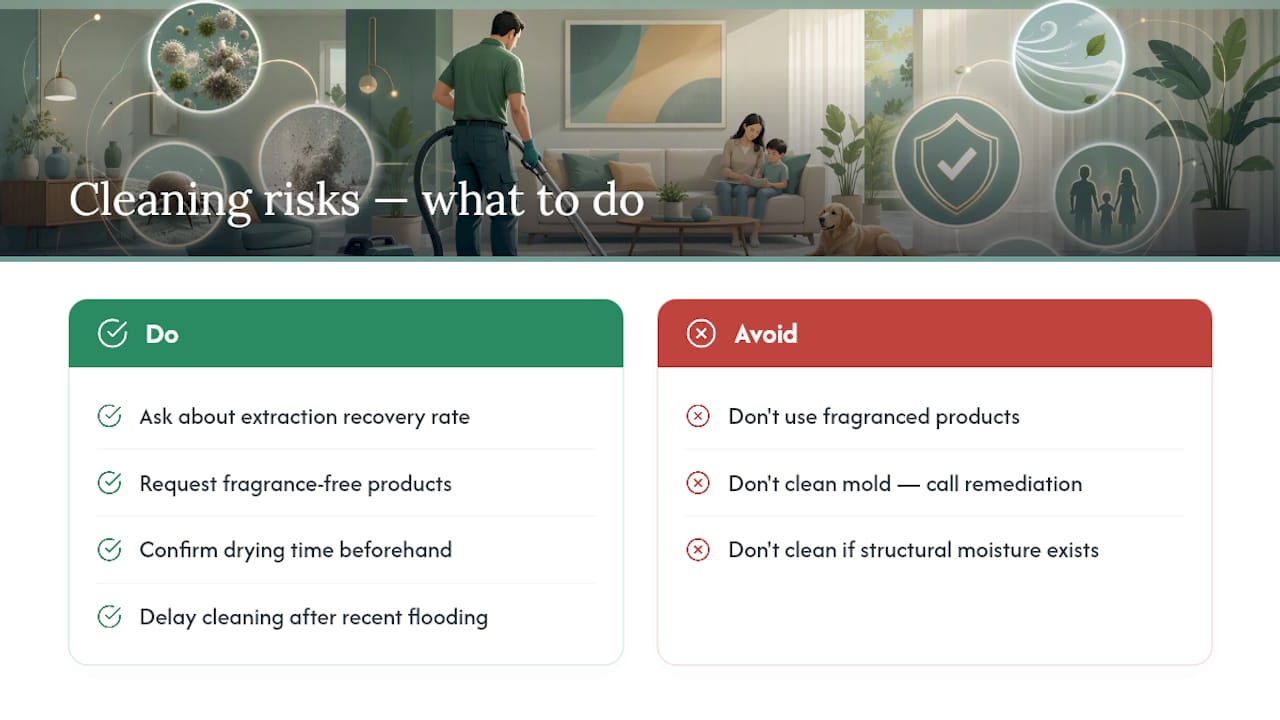
Overwetting from weak extraction leaves carpet damp for a day or more, which can trigger mold or a musty smell. Leftover shampoo residue attracts new dirt faster than a clean carpet would. Fragranced products can bother sensitive noses or trigger allergies in some households.
Every one of these is preventable. Ask about extraction recovery rates, request fragrance-free products if anyone in your home is sensitive, and confirm drying time before the crew arrives. Hold off on cleaning entirely if you’ve had recent flooding or a structural moisture problem. In those cases, cleaning alone won’t solve contamination. The EPA’s own testing found that standard wet extraction struggles to fully remove mold spores once they’ve taken hold, and that situation calls for a remediation specialist, not a routine clean. If a carpet is genuinely beyond saving, a carpet removal and disposal service is a more honest answer than another cleaning cycle.
Keeping Results Fresh Between Visits
A great deep clean fades fast without upkeep. Here’s how to protect that investment.
- Vacuum weekly with a HEPA filter, moving slowly enough to actually pull dust up instead of just fluffing the surface.
- Treat spills the moment they happen. Blot, don’t rub, and keep a stain remover on hand so nothing sets into the pad.
- Set an entry-mat policy. Shoes off, or mats at every door, cuts down on the grit that grinds fibers down between cleanings.
- Check your HVAC filter monthly. A dirty filter recirculates the same dust your carpet just got rid of.
- Watch indoor humidity. Keeping it in a moderate range limits how much dust and allergens resettle into carpet fibers.
A Publisher’s Note on Applying This in Practice
A service process built around the sequence this research supports: deep steam cleaning with proper extraction, not just a surface pass that leaves residue behind. A subscription option exists because the biggest gap in most homes isn’t knowledge, it’s follow-through between cleanings.
Jobs often include a satisfaction guarantee, and local providers understand the specific dirt and clay challenges of the area.
— chris
How Home Service Simple Makes Regular Cleaning Simple
Home Service Simple is the alternative to juggling multiple cleaning appointments a year. You sign up once for the Simple Club, and routine care just happens, no repeated phone tag, no forgetting until the carpet looks bad again.
The Standard Membership runs $20 per month and the Premium Membership runs $40 per month, both through the Simple Club, built for households that want consistent care without rebooking every time. Beyond carpet cleaning, the same steam extraction approach covers upholstery, air ducts, and mattresses, so one relationship handles most of what collects dust and allergens in your home.
When you book, expect a clear estimate up front, a defined service window, a realistic drying time estimate before the crew leaves, and a satisfaction guarantee behind the whole job. Ready to see what a residue-free deep clean actually feels like? Get your carpet cleaning estimate and get it scheduled this week.
Sources
- Carpets and healthy homes — NCHH fact sheet
- Physical intervention study: HEPA and dry steam cleaning reduced PAHs and HDM allergens (2009)
- EPA assessment: efficacy of wet/vacuum carpet cleaning systems for spore removal
- Review: How carpets affect indoor VOCs and particulate behavior
- How often should you clean carpet? (Martha Stewart, 2025)
FAQ
Is It Worth Having a Carpet Professionally Cleaned?
Yes, for most households. Regular professional cleaning removes embedded allergens and grit that vacuuming alone leaves behind, and research shows combined HEPA and steam protocols cut dust mite allergen loads by up to 86% in homes with detectable allergens beforehand.
Do Carpets Get Dirtier After Cleaning?
Carpet can attract dirt faster if cleaning leaves behind soapy residue or if fibers stay damp too long. That’s why extraction recovery and fast drying matter more than the cleaning solution itself, and it’s a good question to ask any provider before booking.
What Happens if You Never Clean Your Carpet?
Dust, allergens, and abrasive grit keep building up, wearing down fibers faster and creating a steady source of indoor air pollutants. Carpets can also absorb and later re-release VOCs and particulates depending on humidity, so a never-cleaned carpet becomes an ongoing air-quality liability, not just a cosmetic one.
What Are the Downsides of Carpet Cleaning?
The main risks are overwetting, slow drying, leftover residue, and fragrance sensitivity in some households. All of these are avoidable by asking about drying time, extraction recovery, and fragrance-free product options before the job starts.
How Much Does Regular Carpet Cleaning Cost With Home Service Simple?
Pricing for individual visits is available directly on the carpet cleaning page, while ongoing care through the Simple Club starts at $20 per month for the Standard Membership or $40 per month for the Premium Membership.