

Professional hot water extraction with a high-suction machine is the most reliable fix for sticky, soap-filled carpet, and a proper DIY rinse comes in second when done right. First, run the water test: spritz a hidden spot, work it in, and watch for foam. Foam means residue is still there. If a careful rinse at home doesn’t clear it, it’s time to call a pro like Home Service Simple.
TL;DR:
- Most carpets feel sticky after cleaning because over-application of products and weak rinsing leave behind detergent or residue, attracting dirt and causing faster resoil.
- Professional high-suction hot water extractors and tested chemistry are essential for truly residue-free carpets, especially when low-moisture and neutral or acid rinses are used.
- DIY rinsing can help for small spots, but if foam persists or re-soiling occurs within a week, professional cleaning with proper extraction and pH testing is necessary.
- Testing for residue using water spray and pH strips can identify lingering cleaners, preventing mold risks and ensuring long-lasting cleanliness.
- Residue problems often indicate the need to stop DIY efforts and call a professional, as insufficient rinsing leaves carpets sticky, dull, and prone to mold and odor buildup.
Table of Contents
- What Does “No Residue” Carpet Cleaning Actually Mean?
- How Do Professionals Get Carpets Truly Residue-Free?
- How Do You Remove Soap Residue From Carpet at Home?
- How Do You Test If All the Residue Is Gone?
- Why Leftover Residue Is More Than a Cosmetic Problem
- When Should You Call a Professional Instead of Trying Again?
- How Home Service Simple Handles Residue in the Field
- What Most Carpet Cleaning Advice Gets Wrong
- Ready to Get Your Carpets Truly Residue-Free?
- Sources
- FAQ
What Does “No Residue” Carpet Cleaning Actually Mean?
If you’ve ever walked across a “freshly cleaned” carpet in socks and felt that faint stickiness, like the floor is trying to hold onto you, you already know what residue feels like. No residue carpet cleaning just means the fibers get rinsed clean enough that nothing sticky, soapy, or oily is left behind to attract dirt.
Residue shows up in a few different forms. Detergent residue comes from over-soaping or under-rinsing. Spin-finish residue is a manufacturing coating on new carpet fibers that hasn’t fully worn off. Oily film residue often comes from certain pre-conditioners that were never properly flushed out.
Most of the time, the real culprit is simple: too much cleaning product and not enough rinsing power to pull it back out. That combination, over-application paired with weak extraction, is the number one reason carpets feel gummy after a “clean.”
Signs your carpet has residue trouble:
- A sticky or waxy feel underfoot once it dries
- Foam or bubbles when you press a wet cloth into the fibers
- A musty smell that lingers days after cleaning
- Carpet that gets dirty again within a week or two
How Do Professionals Get Carpets Truly Residue-Free?
This is where a $30 rental machine and a professional-grade extractor part ways. Home hot water extraction machines pump out cleaning solution but often can’t pull enough of it back up. Truck-mounted and portable professional units are built with far higher suction, which matters because heat and suction together are what flush trapped detergent out of the pad and fiber instead of just pushing it around.
Some technicians use purified or softened water systems that cut down on the surfactants needed in the first place, since less soap going in means less soap that has to come back out. For carpets that can’t handle a lot of moisture, encapsulation or compound cleaning uses a low-moisture approach that crystallizes dirt for vacuuming rather than rinsing it away, a smart option for busy offices or carpets that need to dry fast.
Then there’s the chemistry side. Alkaline pre-conditioners break down grease and grime well, but they can leave a crusty film that actually attracts more dirt. That’s why an acid rinse frequently follows an alkaline cleaner, neutralizing the pH and leaving fibers softer and less likely to re-soil fast. Neutral rinses are also gaining ground for cleaning power without the pH swing.
When you’re vetting a company, ask about:
- IICRC certification for the technician
- Whether they check pH on the fiber after cleaning
- The extractor’s suction power and rinse method
- Expected drying time and a satisfaction or re-clean guarantee
Pro Tip: Ask if they test a dried sample of the rinse water on your carpet before committing to the full job. It’s a quick way to confirm the chemistry won’t leave a film.
How Do You Remove Soap Residue From Carpet at Home?
If you rented a machine last weekend and now your living room feels like a soda spill, don’t panic and don’t add more soap. That almost always backfires.
- Blot, don’t scrub. Press a clean white towel into the damp spot to lift moisture without spreading suds.
- Rinse with small amounts of lukewarm water, working in sections rather than soaking the whole room.
- Blot again immediately after each rinse pass to pull the water (and soap) back out.
- If you have a wet-vac or a rented extractor, run it dry over the area to pull remaining moisture.
- For light residue, sprinkle baking soda once the carpet is dry, let it sit a few hours, then vacuum thoroughly.
- If foam or stickiness persists after two or three rinse passes, stop. Repeated flooding raises the risk of soaking the pad.
Trapped moisture from unresolved soap residue is a real mold risk, especially in the padding and subfloor where it’s harder to dry out. Run fans, open windows if the weather allows, or use a dehumidifier, and aim to have the carpet fully dry within 12 to 24 hours. A mild acid rinse (a small amount of white vinegar in water) can help as a last resort for stubborn alkaline residue, but skip it on wool or delicate fibers unless you’ve confirmed it’s safe.
How Do You Test If All the Residue Is Gone?
Testing takes five minutes and saves you from re-cleaning the same spot next month.
- Water and foam test: spray a small amount of water on a suspicious area, work it in with your fingers, and check for bubbling. No foam is a good sign.
- pH paper test: press a strip against the dry fiber. Most carpets do best landing slightly acidic to neutral; a high alkaline reading suggests leftover cleaner.
- Touch test: once fully dry, run your hand across the spot. Stickiness means residue is still present.
- Watch for fast re-soiling: if the same area looks dingy again within a week, that’s often the clearest sign a rinse was incomplete.
Insufficient rinsing is one of the most common reasons a “stain” turns out to be recurring residue rather than something permanent. If your tests fail twice, it’s time for a professional re-rinse instead of a third DIY attempt.
Why Leftover Residue Is More Than a Cosmetic Problem
A sticky carpet isn’t just annoying to walk on. It’s a magnet for dirt, dust, and pet hair, which is why carpets that were “cleaned” a week ago suddenly look dull again.
- Trapped moisture under a residue layer raises the risk of mold in the padding and subfloor, especially in humid Wichita summers.
- Detergent film acts like flypaper for soil, which is a major reason carpets resoil faster after a detergent-heavy clean than after a properly rinsed one.
- Lingering residue can trap allergens and hold onto odors long after the carpet feels dry.
- In severe, repeated soaking situations, the padding underneath may need full replacement rather than another cleaning attempt.
When Should You Call a Professional Instead of Trying Again?
Some residue problems are simple fixes. Others are a sign your DIY toolkit has hit its limit.
- Call a pro if the carpet keeps re-soiling within days no matter how many times you vacuum.
- Call a pro if the padding feels damp or smells musty more than 24 hours after cleaning.
- Call a pro for large rooms, whole-house jobs, or multiple problem spots. A proper hot water extraction job handles volume that a rented machine can’t.
- Call a pro if your own rinse-and-blot routine hasn’t cleared the stickiness after two honest attempts.
When you’re on the phone, ask directly: What’s the extractor’s suction power? Do you check pH after rinsing? What’s the rinse chemistry, acid, neutral, or an encapsulation method? What’s the expected drying time? Are your technicians certified? And what happens if the spot comes back? A company that hesitates on any of these is worth a second call to someone else. For step-by-step comparisons of DIY versus professional deep carpet cleaning, it helps to know exactly what a technician should be doing before they walk in the door.
How Home Service Simple Handles Residue in the Field
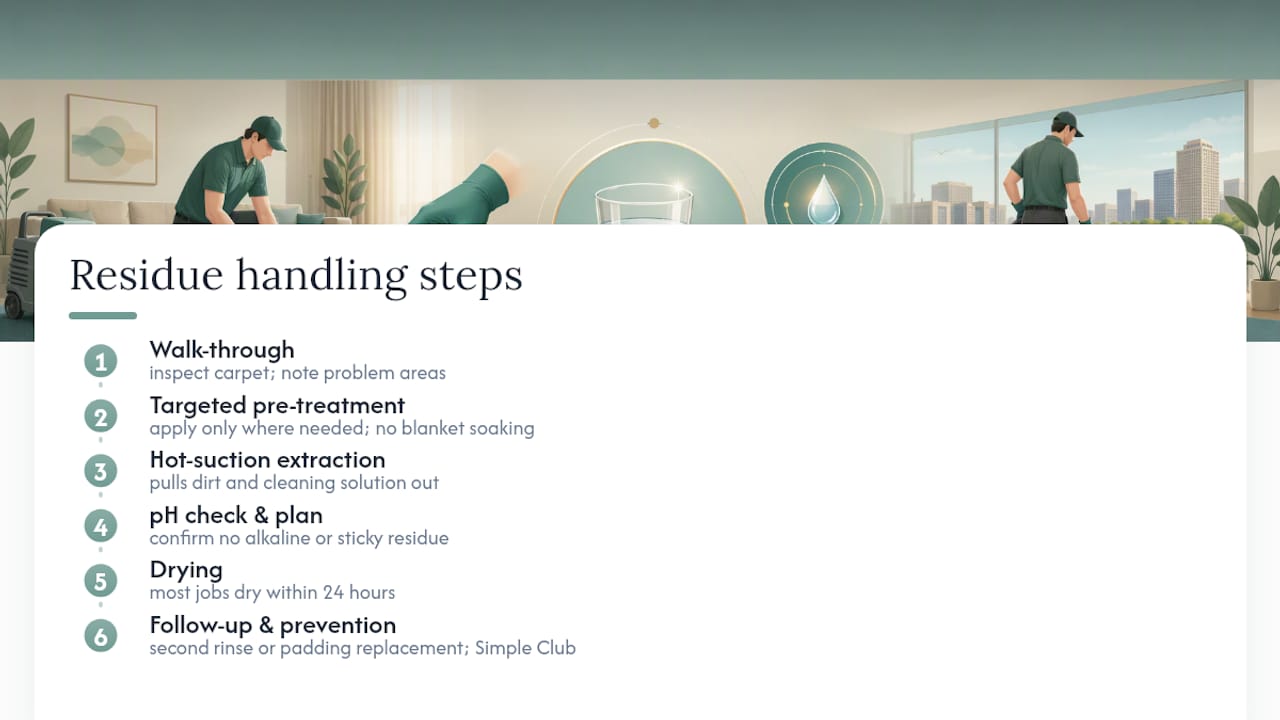
Every job starts with a walk-through, not a hose. Technicians inspect the carpet, note problem areas, and apply pre-treatment only where it’s needed instead of blanket-soaking the whole room. Then comes high-suction hot water extraction, pulling both the dirt and the cleaning solution back out rather than leaving it to dry into a film.
Before the crew packs up, they check pH on the fiber to confirm nothing alkaline or sticky is left behind, and they walk the homeowner through a realistic drying plan. Most jobs dry well within the 24-hour window.
The most common residue calls Home Service Simple gets are from homes where a rental machine or a well-meaning DIY attempt left carpets tacky, demonstrating the importance of steam cleaning and steam extraction for truly deep carpet care. Usually a second, proper rinse solves it. In rare cases where padding has absorbed too much moisture over time, replacement is the honest recommendation rather than another cleaning pass. That’s part of why the Simple Club subscription model exists, to keep carpets on a regular schedule so residue and re-soiling never get the chance to build up in the first place.
What Most Carpet Cleaning Advice Gets Wrong
Most residue advice online treats the fix like a recipe: add vinegar, add baking soda, done. That’s backwards. Residue is a chemistry and mechanics problem, not a “right ingredient” problem, and the ingredient matters far less than whether you actually extracted it afterward.
The conventional wisdom oversells DIY extractors. A rental machine can apply cleaner just fine. What most of them can’t do is pull it back out with enough suction to matter, which is exactly why so many homeowners end up with the same stickiness a week after “cleaning” it themselves. The fix isn’t a better solution. It’s better rinsing and stronger suction.
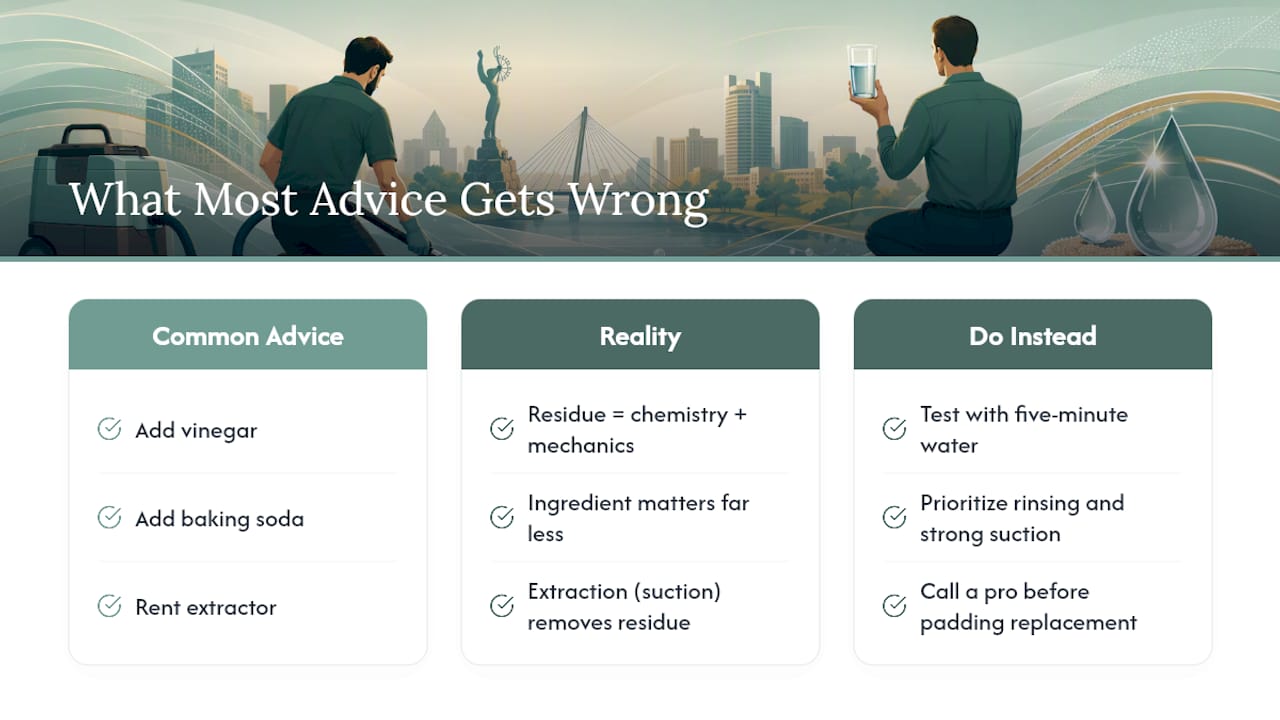
If there’s one thing worth prioritizing, it’s testing before declaring victory. A five-minute water test tells you more than any product label. Skip that step and you’re just guessing whether the carpet is actually clean or whether it’s going to feel gummy again by Thursday.
None of this means DIY is a bad idea for small spots. It just means knowing when to stop rinsing and start dialing a professional, before a minor residue problem turns into a padding replacement.
— chris
Ready to Get Your Carpets Truly Residue-Free?
If you’ve tried the rinse-and-blot routine and your carpet still feels tacky, that’s Home Service Simple’s specialty. Deep steam cleaning with high-suction hot water extraction pulls out the soap, dirt, and grime that a rental machine leaves behind, and every job wraps up with a satisfaction guarantee, so if something feels off, the crew comes back to fix it.
For homes that keep sliding back into the same sticky, re-soiling cycle, the Simple Club subscription keeps carpets on a consistent cleaning schedule so residue never gets the chance to build up between visits. It also covers upholstery, air ducts, and mattresses if those are on your radar too.
Ready to stop guessing whether your carpet is actually clean? Book a deep carpet cleaning near 13th and Greenwich and let a high-suction extraction handle what a rental machine couldn’t.
Sources
- How to avoid over-shampooing your carpets | Bissell Commercial
- Carpet Cleaning Residue – Parish Supply
- How to: Carpet care | Cleanlink
- How to get soap out of the carpet before it causes mold | Avalon Home Inspections
FAQ
What Is the Best Carpet Cleaner That Doesn’t Leave Residue?
Hot water extraction with high-suction equipment and a properly balanced rinse (acid or neutral) removes residue most reliably; for light DIY jobs, a plain warm water rinse or baking soda often works without adding new soap.
Do Carpet Cleaners Leave Residue?
Some do, usually from over-applying detergent or using equipment without strong enough suction to rinse it back out; insufficient rinsing is one of the most common causes of carpets feeling sticky after cleaning.
How Do I Know If My Carpet Still Has Soap Residue?
Spray a small amount of water on the fiber and work it in; foaming or bubbling means residue is still present, and a sticky feel once dry confirms it.
Should I Hire a Pro or Try to Fix Residue Myself?
Try a careful rinse and blot routine first for small spots; if the carpet still foams on the water test or keeps re-soiling within days, a professional with high-suction extraction equipment like Home Service Simple can correct it properly.
Can Leftover Residue Cause Mold?
Yes. Soap residue traps moisture in the padding and subfloor, which raises mold risk if the carpet isn’t dried thoroughly within 12 to 24 hours after cleaning.