

That musty smell hitting you every time the furnace kicks on almost always means moisture is feeding microbial growth somewhere in your system, according to CDC guidance on mold and the EPA’s advice on duct cleaning. The smell alone doesn’t confirm mold, but it’s your cue to check the filter, look at your vents, and cut HVAC use if anyone in the house is already struggling to breathe. See visible mold or standing water? Skip the guesswork and call a pro.
TL;DR:
- Most musty odors originate from moisture-related issues like mold, wet duct insulation, or clogged condensate drains rather than actual mold presence.
- Checking and replacing dirty filters, vacuuming vents, and inspecting the condensate pan can resolve many odor problems without professional help.
- Visual inspection and moisture assessment outperform air sampling, focusing on coil, drain pan, and return plenum locations to find the source.
- When contamination or mold is visible, or symptoms worsen, professional intervention is necessary to address the moisture source and contaminated materials.
- Routine maintenance, including humidity control, leak prevention, and duct cleaning every three to five years, helps prevent future musty odors.
Table of Contents
- Six things to check before you touch the thermostat
- What’s actually causing the smell in your ductwork
- How to inspect your system without making things worse
- When it’s time to bring in a professional
- Stopping the smell from coming back
- What we see on real jobs
- How Home Service Simple can help with musty odors
- Sources
- FAQ
Six things to check before you touch the thermostat
Before you panic or start Googling “black mold vent smell” at midnight, run through these. Most musty odors trace back to something simple.
- Pull the filter and check it. A filter caked in dust or sitting past its replacement date (look at the MERV rating printed on the frame, most homes do fine with MERV 8 to 11) is often the whole problem.
- Pop off a few supply and return grilles and vacuum inside them. Note exactly where the smell is strongest. That location matters.
- Check the condensate pan and drain line. Standing water or a slow drip means trouble is brewing right there.
- Switch the thermostat to fan-only and see if the smell fades, stays put, or gets worse.
- Write down the pattern. Only at startup? Constant? Worse on humid days? This tells a technician a lot.
- If the odor is strong or someone’s coughing or wheezing, stop running the system and get a professional in before you do anything else.
Pro Tip: Snap a photo of the filter and drain pan before you clean anything. It gives a technician a head start and saves you a callback.
What’s actually causing the smell in your ductwork
A handful of usual suspects account for most musty vent complaints.
- A biofilm-coated evaporator coil, sometimes called “dirty sock syndrome,” where moisture sits on the coil long enough for microbes to colonize it.
- A clogged condensate drain that lets water pool in the air handler instead of draining outside.
- Wet or moldy duct insulation, which traps moisture inside the ductwork itself.
- A soiled filter or dusty return plenum pulling stale, dusty air through the whole system every cycle.
- Moisture from a basement, crawlspace, or attic getting pulled into return air and distributed through every room.
NIOSH and the CDC report that visual and moisture inspection outperform short-term air sampling for figuring out what’s going on in a building, which is exactly why tracing the smell by hand beats guessing from a lab result. Follow the odor upstream from the register toward the coil, drain pan, and return plenum. Those spots hide the problem more often than the vents themselves.
How to inspect your system without making things worse
Work from least invasive to most, and stop the moment something looks beyond a homeowner fix.
- Start with what’s easy: pull grilles, vacuum visible dust, and look for anything obviously wet or discolored.
- Open the air handler panel only if you’re comfortable doing so, and use a flashlight to check the coil and drain pan for water stains or standing moisture.
- If you own a moisture meter, run it over any wet-looking insulation or panel seams.
- Never scrape, brush, or aggressively disturb anything that looks moldy. Disturbing it can release spores into the air you’re trying to clean.
- If the system looks contaminated, shut it off. EPA guidance is direct on this: running a contaminated HVAC system spreads spores through every room it serves.
Pro Tip: Keep your phone handy during the inspection. Photos of anything questionable, plus your notes on when the smell shows up, turn a vague complaint into useful information for whoever you call next.
When it’s time to bring in a professional
Some situations call for expertise, not another can of odor spray.
- Visible mold anywhere in the ductwork or on the coil.
- Wet or moldy insulated duct material. The EPA notes that this kind of porous material generally can’t be cleaned. It has to come out.
- Signs of pests, heavy dust buildup, or water damage stretching beyond a small patch.
- Anyone in the house dealing with worsening allergies, asthma, or unexplained respiratory symptoms.
A reputable provider documents the moisture source before touching anything, shows you what they found, fixes the actual cause, and replaces what can’t be salvaged instead of just cleaning around it. If a company shows up and only offers to spray a deodorizer or an antimicrobial without ever mentioning where the moisture is coming from, that’s your signal to call someone else. The EPA is blunt that skipping the moisture fix means the smell just comes back. For a deeper look at what remediation actually involves, see our guide on mold in air ducts and what duct cleaning realistically delivers.
Stopping the smell from coming back
Once the immediate problem is handled, a few habits keep it from returning.
- Keep indoor humidity below about 60% most of the time, per building science guidance from the EPA. A dehumidifier in a damp basement earns its keep fast.
- Check that condensate drains stay clear and properly pitched, and have the coil and drain pan looked at during routine HVAC maintenance.
- Seal and insulate ducts that run through unconditioned spaces like attics and crawlspaces, where temperature swings invite condensation.
- Replace filters on schedule and don’t let airflow get restricted. Poor airflow is a quiet driver of condensation on coils.
- Plan on professional duct cleaning roughly every 3 to 5 years, sooner if you’ve had a leak, pest problem, or musty smell that keeps coming back. Our duct cleaning frequency guide breaks down what changes that timeline.
For more on humidity’s role in indoor air quality, this overview of humidity control covers the mechanics well.
What we see on real jobs
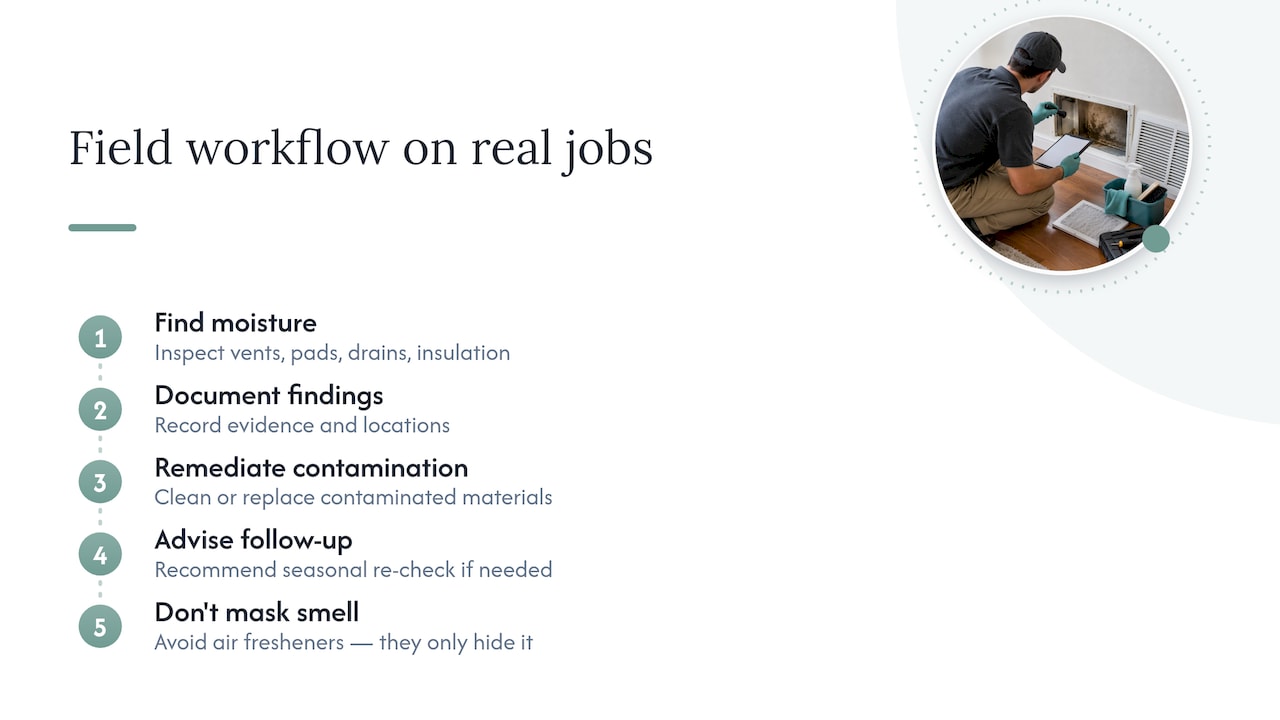
The musty smell rarely starts where homeowners think it does. We’ve walked into plenty of houses where the vents got blamed for a wet carpet pad, a clogged drain line nobody noticed, or insulation that had been damp for months behind a panel nobody opens. Spraying an air freshener into the vent covers the smell for a day and does nothing else.
Our approach starts the same way every time: find the moisture first. We document what we find, clean or replace whatever’s contaminated, and if the fix needs to happen again next season, we say so instead of pretending one visit solves everything. That’s part of why we built the Simple Club, so maintenance happens on a schedule instead of only after the smell gets bad enough to notice.
— chris
How Home Service Simple can help with musty odors
If the smell traces back to more than just the ductwork, carpets, upholstery, and mattresses hold onto moisture and odor just as stubbornly as insulation does. We offer air duct cleaning, deep carpet cleaning, upholstery cleaning, and mattress cleaning, all aimed at the same goal: getting rid of the odor source instead of masking it.

Every booked service starts with an inspection, so you get straight answers about where the moisture is coming from and whether a component needs cleaning or replacing, not just a spray-and-go visit. Every job comes backed by our satisfaction guarantee.
- Air duct cleaning targets coil buildup, drain pan residue, and contaminated ductwork.
- Deep carpet and upholstery cleaning removes trapped moisture and odor at the source, not just on the surface.
- Mattress cleaning addresses the same kind of moisture buildup that often gets overlooked in a bedroom.
For ongoing prevention instead of one-off fixes, our Simple Club membership plans (Standard at $20 a month, Premium at $40 a month) build routine cleaning into your calendar so problems get caught before they turn into a smell you can’t ignore. If your vents already smell musty, book an air duct cleaning and let’s find out what’s really going on.
This article is general information, not a substitute for advice from a qualified doctor. Consult a qualified healthcare professional about your own circumstances before acting on anything here.
Sources
- Mold, Testing, and Remediation | Mold | CDC
- Should You Have the Air Ducts in Your Home Cleaned? | US EPA
FAQ
Does a musty smell automatically mean mold?
No. A musty smell signals moisture, and mold is one common but not automatic explanation. The CDC recommends a visual and moisture inspection rather than jumping straight to mold testing, since odor alone isn’t a diagnosis.
What does mold in vents smell like?
Mold in vents typically produces a damp, earthy, musty odor, often compared to wet cardboard or old basements. It tends to get stronger when the HVAC system first kicks on, which is a useful clue when you’re tracing the source.
What neutralizes musty smell?
Nothing neutralizes a musty smell for good until the moisture source is fixed. EPA guidance is clear that deodorizers and antimicrobial sprays only mask the problem and it returns once the spray wears off.
Is it bad to breathe in musty smell?
Musty odors themselves aren’t necessarily harmful, but the dampness and mold behind them can be. The CDC notes that mold exposure is linked to respiratory irritation and worsened asthma, and people with weakened immune systems face higher risk and should avoid affected spaces until the issue is resolved.