Carpet cleaning can be asthma friendly when it uses low-residue hot-water extraction, HEPA vacuuming, fast drying, and fragrance-free, low-VOC products. Before you book, ask for those four things by name and confirm the drying plan. Keep the person with asthma out of the house until the carpets are fully dry.
TL;DR:
- Ask for the cleaner’s product name and Safety Data Sheet, and favor fragrance free, low VOC products or recognized certification over hypoallergenic claims.
- After cleaning, keep the carpet off limits until fully dry, ideally within 12 to 24 hours, and maintain indoor humidity between 30% and 50%.
- Vacuum once each week with a HEPA vacuum when the person with asthma is away, and wash bedding and washable rugs in hot water.
- The Carpet and Rug Institute says research does not support removing carpet for asthma management; HEPA vacuuming and humidity control offer practical alternatives.
Table of Contents
- Your quick asthma friendly carpet cleaning checklist
- Why cleaning helps: what EPA and CRI guidance say
- What professionals should do to limit asthma triggers
- Choosing products: low-VOC, fragrance-free, and labels that mean something
- Getting ready and staying safe on cleaning day
- Aftercare: keep the allergen cuts going
- An honest take from chris
- Book an asthma friendly carpet cleaning with us
- FAQ
- Sources
Your quick asthma friendly carpet cleaning checklist
Think of this as the cheat sheet you tape to the fridge before cleaning day. Short, simple, and in order.
Before the job
- Launder bedding, throws, and washable toys, and clear clutter off the floor.
- Plan for the person with asthma to stay somewhere else on job day.
- Ask your cleaner for product Safety Data Sheets (SDS), a fragrance-free option, HEPA vacuuming, and a drying timeline.
During the job
- Technicians pre-vacuum with a HEPA vacuum, then use hot-water extraction.
- Windows open where weather allows, air movers running, no scented products or aerosol sprays.
After the job
- Check that carpets are dry within 12–24 hours, the target the Carpet and Rug Institute gives.
- Run a HEPA air cleaner if you own one, and keep indoor humidity around 30–50%.
- Resume normal use only when the carpet is dry to the touch, edges and corners included.
Pro Tip: Put your drying-time question in writing when you book. A cleaner who answers it clearly usually has a real plan.
Why cleaning helps: what EPA and CRI guidance say
Carpet holds dust, pollen, pet dander, and the debris dust mites feed on. Sealing it in isn’t the answer. Pulling it out and keeping it out is.
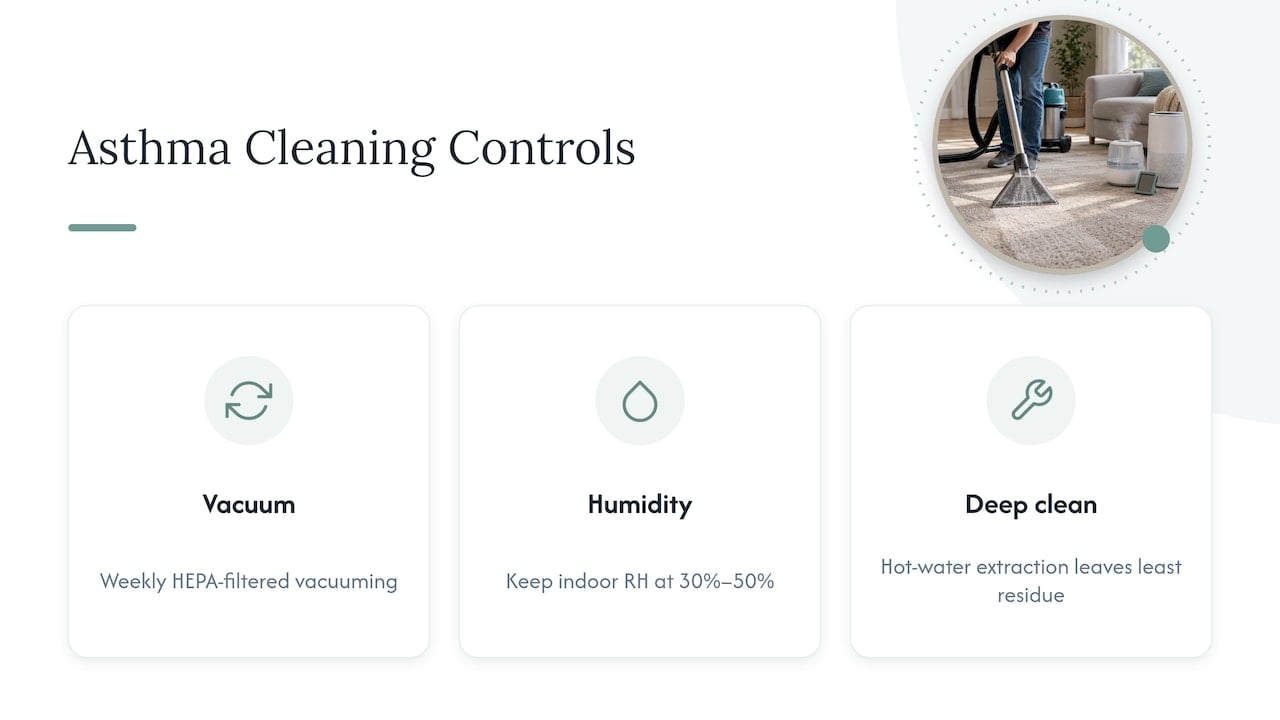
The EPA points to weekly vacuuming with a HEPA-filtered vacuum and indoor relative humidity between 30% and 50% to hold down dust mites and mold. Those two habits do most of the day-to-day work.
For deep cleaning, the Carpet and Rug Institute recommends professional hot-water extraction. Done properly, it leaves the least cleaning residue, which means less sticky film to attract fresh dirt. The CRI says scientific research does not support tearing out carpet to manage asthma. Environmental control measures, such as HEPA vacuuming, may be a more practical approach.
What professionals should do to limit asthma triggers
Not every cleaning visit is built the same. Here’s what a technician should be doing for an asthma household, and what to confirm before you book:
- Hot-water extraction with real rinsing. The method pulls embedded soil out of the carpet, and thorough extraction takes the cleaning solution out with it. Our own hot-water extraction process walks through each step.
- Moisture control. Air movers and good airflow get carpet dry in the 12–24 hour window. Slow drying invites mold, and mold wipes out the whole point of cleaning.
- Residue control. Ask for minimal chemistry and a full rinse. Tacky leftovers re-soil fast and keep irritants parked in the pile.
- HEPA vacuuming before and after. Choose a HEPA-filtered vacuum to help manage airborne allergens.
Airflow matters here too. Good ventilation and humidity control speed drying, and HVAC air quality upgrades can help with both. If you want to know what “steam cleaning” means in practice, our page on steam carpet cleaning breaks it down.
Choosing products: low-VOC, fragrance-free, and labels that mean something
Walk into any store and you’ll see “gentle,” “natural,” and “hypoallergenic” stamped on bottles. Most of those words have no strict definition behind them.
The American Lung Association warns that fragranced cleaners and VOC-heavy products can irritate the lungs, and suggests Safer Choice or low-VOC options with good ventilation. Their guide to VOCs in household cleaning products says the same thing in more detail.
How to vet a provider, in order:
- Ask for a fragrance-free service and skip air fresheners and scented deodorizers.
- Request the product name and Safety Data Sheet so you can check VOC and fragrance content.
- Look for third-party marks, such as the Asthma & Allergy Friendly® Certification or the CRI Seal of Approval, rather than vague claims.
- Be cautious with pine or citrus terpene cleaners if you are concerned about fragrances or respiratory irritation.
Pro Tip: “Hypoallergenic” has no federal standard in the U.S., according to AAFA’s certification guide. A certification mark does more for you than a friendly adjective.
Our guides on fragrance-free carpet cleaning and certified green carpet cleaning cover what to look for in more depth.
Getting ready and staying safe on cleaning day
Cleaning day is the one moment when you’re stirring up the most stuff. A little prep keeps the person with asthma out of the middle of it.
- Send them out. If you can, have the person with asthma stay elsewhere during the job and until carpets are dry.
- Move air. Open windows where weather allows, run fans and air movers, and keep the HVAC going to speed drying. A portable HEPA air cleaner helps too.
- Ask four questions. What’s the expected drying time? Can I see the SDS? Do you use HEPA vacuums? Is a fragrance-free option available?
- Keep kids and pets off. Treated areas stay off limits until the carpet is thoroughly dry.
Drying times vary with weather, carpet thickness, and airflow, so give yourself some slack. Our carpet cleaning prep guide has a full homeowner checklist.
Aftercare: keep the allergen cuts going
A good deep clean is a reset. What you do over the next few weeks decides how long it lasts.
- Vacuum weekly with a HEPA vacuum. Vacuum when the person with asthma is not present. The EPA’s asthma triggers infographic gives the same advice.
- Wash washable rugs and bedding weekly in hot water and dry them fully. Clean soft toys on a regular schedule.
- Hold humidity at 30–50%. The EPA and CDC home checklist also says to dry damp items within 24–48 hours.
- Set a professional schedule based on traffic, pets, and kids. Our carpet care plan lays out a rhythm that fits most homes, and our page on carpet cleaning for allergies shows what actually cuts symptoms.
An honest take from chris
Some people with asthma may be told to rip out the carpet. That advice sounds decisive, but it skips the real problem: dust and moisture, not the fiber itself. A clean, dry, well-vacuumed carpet may be compatible with asthma management, while a bare floor alone may not address other indoor triggers.
What matters is the method. We steam clean with hot-water extraction built to avoid sticky residue and offer a satisfaction guarantee on our work. Our Simple Club subscription keeps the schedule going so results don’t fade between visits. Ask us anything before you book. We’d rather you ask than guess.
— chris
Book an asthma friendly carpet cleaning with us
If you’d rather have a pro follow this checklist for you, that’s what we do. Our carpet cleaning service is available when you’re ready, and you can request a quote.
- Deep steam carpet cleaning
- Air duct cleaning and mattress cleaning as companion steps for the whole home
- Simple Club membership for routine care: Standard at 20 USD per month, Premium at 40 USD per month
- A satisfaction guarantee on our work
Tell us about the asthma when you call or text. We’ll plan the day around it.
This article is general information, not a substitute for advice from a qualified doctor. Consult a qualified healthcare professional about your own circumstances before acting on anything here.
FAQ
What type of carpet is best for people with allergies and asthma?
No carpet type is safe on its own. How well you maintain it matters more than the fiber. The Carpet and Rug Institute says vacuuming with certified vacuums and scheduled deep cleaning reduce airborne allergens.
Does carpet cleaning get rid of allergens?
It removes a good share of them, especially with hot-water extraction and HEPA vacuuming. Results fade without upkeep, so regular vacuuming and humidity control keep the gains in place.
Do cleaning products trigger asthma?
They can. Fragranced and VOC-heavy cleaners may irritate the lungs, which is why the American Lung Association recommends skipping fragrance and ventilating while you clean. Ask for fragrance-free, low-VOC options.
What do professional carpet cleaners use on pet urine?
Methods differ by company. Ask for the product name and Safety Data Sheet before the job, and request a fragrance-free option if asthma is a concern.
Sources
- Asthma Triggers: Gain Control | US EPA
- Frequently Asked Questions – The Carpet and Rug Institute
- Asthmaandallergyfriendly
- Safer Spring Cleaning Practices for Healthy Lungs and a Clean Home | American Lung Association