The fastest reliable fix for pet odor on upholstery is an enzyme-based cleaner followed by cold-water extraction, never steam. Check the fabric’s cleaning code first and skip the heat, because hot water can set urine odor permanently. If the smell lingers after two honest tries, or it keeps coming back, that’s your sign to bring in a pro who follows IICRC guidance, or give us a call.
TL;DR:
- Check the upholstery tag before using liquid: W allows cleaners that use water, S requires solvents, WS allows either, and X allows vacuuming only.
- For fresh urine, blot without rubbing, follow the cleaner’s labeled dwell time, extract moisture, and let the cushion dry fully for 24 hours.
- For aged odors, rinse and extract with cold water two or three times, drying between rounds; call a professional if two full attempts fail.
- For vomit or feces, remove solids first and use an unscented organic matter neutralizer; on S or X fabrics, avoid liquids and vacuum instead.
Table of Contents
- Quick checklist: what to do in the first 30 to 60 minutes
- Read the tag: fabric codes, spot-tests, and fabrics that need special care
- DIY: step-by-step for fresh pet urine and surface odors
- DIY for set-in or aged odors and stained urine
- What professional treatments do (and realistic outcomes)
- Products and ingredients to use and avoid
- Prevention and routine maintenance
- Dealing with upholstery odors caused by pet vomit or feces distinct from urine
- Author perspective: why odors sometimes survive cleaning
- Home Service Simple: professional upholstery odor removal and prevention plans
- FAQ
- Sources
Quick checklist: what to do in the first 30 to 60 minutes
Fresh accidents are the easy ones. Act in the first hour and you’ll save yourself a bigger headache later.
Here’s your game plan the moment you find the mess:
- Blot, don’t rub: rubbing pushes urine deeper into the padding.
- Scoop or vacuum any solids before adding liquid.
- Use cold water, never hot, for your first rinse pass.
- Apply an enzyme cleaner and let it sit per the label.
- Extract with a wet/dry vac or upholstery attachment, not a steam cleaner.
Keep these on hand before you ever need them: an enzyme cleaner, baking soda, microfiber cloths, and a wet/dry vacuum with an upholstery nozzle.
Fresh accidents feel wet and smell sharp. Aged ones feel stiff or crusty, show a yellowish ring, and carry a musty, ammonia-heavy smell that gets stronger when the cushion is pressed. That difference tells you which playbook to use next.
Read the tag: fabric codes, spot-tests, and fabrics that need special care
Flip the cushion and look for a small tag with a letter code. That letter decides what you’re allowed to put on the fabric.
- W means water-based cleaners are fine.
- S means solvent only, water can stain or shrink it.
- WS allows either water-based or solvent cleaners.
- X means vacuum only, no liquid of any kind.
Using a water-based enzyme spray on an “S” rated sofa can leave permanent rings or cause the fibers to pucker. Before treating the whole cushion, test your cleaner on a hidden patch, like the underside of a cushion or the back of the arm, and wait ten minutes to check for color change or bleeding.
Velvet, wool, leather, and anything with a flame-retardant ticking underneath deserve extra caution. These materials can water-spot, mat, or react poorly to enzyme formulas, and our upholstery steam cleaning guide walks through which fabrics tolerate water-based treatment at all.
Pro Tip: Keep a sample of your couch’s fabric tag photo in your phone so you can check cleaning codes before you buy any product at the store.
DIY: step-by-step for fresh pet urine and surface odors
For a fresh accident, speed and temperature matter more than anything else you do.
- Remove any solid waste with a paper towel or gloved hand.
- Blot the wet area with a dry microfiber cloth, pressing straight down rather than scrubbing.
- Rinse lightly with cold water on a clean cloth, blotting again to lift diluted urine.
- Apply an enzyme cleaner, saturating the spot as directed on the label.
- Let it sit for the full dwell time listed, usually 10 to 15 minutes.
- Extract the moisture with a wet/dry vacuum or an upholstery attachment.
- Dry fast: open a window, point a fan at the cushion, or run a dehumidifier nearby.
Enzymes work by breaking down the uric acid crystals that cause the smell, rather than just masking it with fragrance. Heat does the opposite: applying hot water or steam to urine before it’s fully treated can bond those proteins into synthetic fibers, which makes the odor nearly impossible to remove later, according to guidance from the Humane World.
Give the cushion 24 hours to dry fully, then do a smell test with your nose close to the fabric. If the odor is gone, you’re done. If it’s faint but still there, repeat the enzyme application once more before deciding whether to escalate.
Pro Tip: Treat accidents the same day you find them. A urine spot that sits overnight is far harder to fully neutralize than one treated within the hour.
DIY for set-in or aged odors and stained urine
Set-in odors behave differently because the urine has already traveled past the fabric surface into the padding or foam underneath. Signs include a smell that returns after cleaning, visible dampness that never fully dries, or a yellow-green glow when you check with a blacklight in a dark room.
For these cases, a single treatment rarely finishes the job:
- Apply enzyme cleaner generously, letting it penetrate rather than sit on top.
- Extract with cold water, repeating the rinse-and-extract cycle two or three times.
- Allow a full drying cycle between treatments so you’re not trapping moisture inside the cushion.
- Repeat the entire process once more if the smell is fainter but not gone.
- Stop and call a professional if odor persists after two complete attempts.
A practical home threshold: after two careful DIY enzyme and extraction attempts that include proper drying cycles, lingering odor usually points to contamination that’s reached the padding, which is a strong signal to bring in a pro for targeted extraction.
Avoid hot water, undiluted hydrogen peroxide, and bleach on anything colored. Hot water sets odors deeper, peroxide can bleach wool and other natural fibers, and bleach will strip color from most upholstery in seconds. Our guide on removing couch odor without damaging fabric covers safer alternatives for stubborn, older stains.
What professional treatments do (and realistic outcomes)
Professional treatment starts with finding out exactly where the contamination sits, not just where it smells strongest.
A typical inspection and treatment includes:
- UV light mapping to locate urine salts that aren’t visible under normal light.
- Dismantling cushions when needed to treat both the cover and the foam core.
- Sub-surface flushing and extraction to pull contamination out of the padding, not just the surface.
- Applying enzymatic neutralizers built for uric acid, rather than fragrance that only masks the smell, as outlined by UNO Clean’s SOS system.
Sometimes the honest answer is that the foam or cushion core is too far gone and needs replacing rather than treating. A good technician will tell you that upfront instead of charging you for repeat visits that won’t fix a saturated core.
Before you book anyone, ask what guarantee they offer and whether they’ll give you a written inspection report. Professional extraction is the right call once you’ve tried two honest DIY rounds and the smell keeps returning, especially if it gets worse on humid days, which is a classic sign of trapped moisture deep in the cushion.
Pro Tip: Ask any cleaner you’re considering whether they inspect with UV light before quoting a price. If they skip that step, they’re guessing at the scope of the job.
Products and ingredients to use and avoid
The active ingredient on the label matters more than the brand name on the front.
- Choose enzymatic formulas for any urine-based odor, since they break down the compounds causing the smell.
- Choose fragrance-free odor neutralizers, like Zep Air & Fabric Odor Eliminator, for vomit or general pet smells that aren’t urine-based.
- Skip fragrance-only sprays as your main treatment. They cover the smell for a few hours and let it come right back.
The EPA’s guidance on soft-surface textile claims is worth knowing about too. It outlines how disinfectant claims on fabric products are supposed to be tested and labeled, and it’s a useful reminder to follow label directions closely rather than assume every spray that says “disinfecting” works the same way on your couch at home.
A few household items deserve caution: hydrogen peroxide can bleach wool and other natural fibers, bleach strips color from nearly anything, and hot-water extraction can set odors into synthetic fibers rather than lift them out.
Prevention and routine maintenance
A little routine upkeep does more for odor control than any single deep clean.
- Groom pets regularly to cut down on dander and oils that settle into fabric.
- Wash pet bedding weekly so odors don’t transfer onto nearby furniture.
- Vacuum upholstery at least once a week if pets are allowed on it.
- Change HVAC filters on schedule to keep recirculated odors from settling back into fabric.
- Use washable covers or throws on high-traffic cushions made from durable, pet-friendly fabrics, since swapping a cover is easier than deep cleaning a whole sofa.
If you’ve got multiple pets or a household that just can’t keep up with the vacuum schedule, a recurring plan takes the guesswork out of it. Our Simple Club membership options give homes with pets a standing appointment instead of waiting until the smell forces the issue.
Dealing with upholstery odors caused by pet vomit or feces distinct from urine
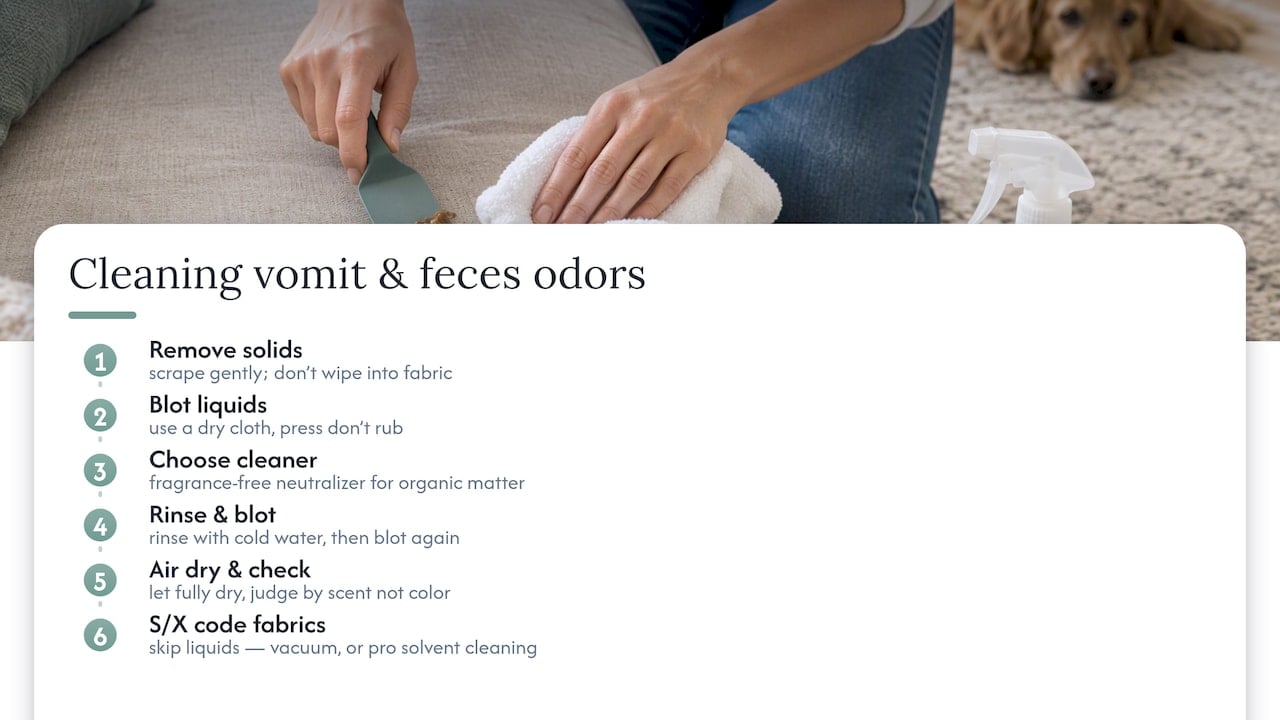
Vomit and feces odors behave differently from urine, and treating them the same way often falls short. Urine odor comes from uric acid crystals that bond to fibers and reactivate with humidity. Vomit and feces leave behind bile, bacteria, and food residue that sit more on the surface but can still stain and smell if left too long.
Start by removing all solid material first, scraping gently rather than wiping it into the fabric. Blot any liquid residue with a dry cloth before applying any product. For these messes, a fragrance-free odor neutralizer formulated for organic matter, rather than a urine-specific enzyme cleaner, tends to work faster since the chemistry of the stain is different.
Rinse with cold water and blot again, then let the area air dry completely before deciding whether a second treatment is needed. Bile stains in particular can leave a yellowish tint even after the smell is gone, so don’t judge success by color alone, judge it by scent after full drying.
If the mess happened on a fabric with an “S” or “X” cleaning code, skip liquid treatment entirely and vacuum thoroughly instead, then consider a professional solvent-based cleaning if odor remains.
Author perspective: why odors sometimes survive cleaning
Odors survive DIY cleaning for one of three reasons: heat set the proteins before treatment, contamination reached the padding where surface cleaners can’t reach, or the household stopped treatment one round too early.
None of those mean you did it wrong. They mean the contamination outran the tools you had on hand. That’s the gap professional sub-surface extraction and UV inspection are built to close.
— chris
Home Service Simple: professional upholstery odor removal and prevention plans
When DIY rounds aren’t cutting it, our upholstery cleaning team steps in with the sub-surface extraction and inspection tools a sofa or chair actually needs, not just a surface spray and a prayer. We check fabric codes before touching anything, map contamination with UV light, and back every job with a satisfaction guarantee.
Before booking any upholstery job, ask what cleaning code the technician checked for and whether they inspect before quoting. Those two questions tell you a lot about who you’re hiring. If pet odors keep coming back in your home, our Simple Club membership, starting at $20 a month for the Standard plan, keeps routine care on the calendar instead of waiting for the next accident to force a call.
Ready to get your furniture smelling right again? Visit our upholstery cleaning service page to see what’s included, or check our upholstery cleaning cost guide to get a sense of what to budget before you book.
FAQ
What kills the smell of dog urine?
Enzyme-based cleaners kill the smell of dog urine by breaking down the uric acid crystals that cause it, rather than just masking the scent. Cold-water extraction after the enzyme treatment helps pull the broken-down residue out of the fabric for good.
Will hydrogen peroxide remove old pet stains from carpet?
Hydrogen peroxide can help lift some old pet stains, but it carries real risk of bleaching color out of carpet fibers and wool upholstery, so test it on a hidden spot first. An enzyme cleaner is generally the safer first choice for both the stain and the odor underneath it.
Why does my carpet smell like urine even after I clean it?
Lingering smell after cleaning usually means the urine soaked past the surface into the padding or backing, where surface cleaners never reached. Humidity can reactivate those trapped uric acid crystals, which is why the smell seems to come and go.
How do you get dog urine smell out of a couch after it has dried?
Dried urine needs repeated enzyme treatments rather than a single pass, since the uric acid has already bonded to the fibers. Apply the enzyme cleaner, let it sit for the full dwell time, extract with cold water, and repeat once more if the smell is only partly gone before considering a professional sub-surface treatment.
Sources
For readers who want the underlying guidance behind this playbook, the IICRC’s upholstery tip sheet and carpet topics sheet cover penetration risks in detail, while the EPA’s soft-surface guidance explains label claims. Product specifics are available from UNO Clean and Zep.
- IICRC consumer upholstery tip sheet
- Guidance for products including or adding disinfectant efficacy claims for use on soft surface textiles in non-residential settings | US EPA
- UNO Clean – SOS Pet Odor Control Stain Out System
- Zep Air & Fabric Odor Eliminator – Neutralizes Pet Odors – 1 Gallon – Zep Inc.
- How to remove pet stains and odors — Humane World