

Most fresh urine stains and odors come out if you move fast: strip the bedding, blot (never scrub), then hit the spot with an enzyme cleaner or a vinegar protocol before it dries. Dried-in stains take more patience, usually two or three enzyme cycles over a few days. If the mattress still smells after that, or the soak went all the way through the foam core, it’s time to weigh professional cleaning against replacement.
TL;DR:
- Cleaning a fresh urine stain within 30 minutes greatly improves chances of complete removal, especially when blotting rather than scrubbing.
- Dried urine requires enzyme cleaners and multiple treatments across days to break down uric acid crystals and proteins effectively.
- Hot water, steam, bleach, and aggressive scrubbing damage mattresses and should be avoided, as they set stains and promote mold growth.
- Memory foam and certain specialty mattresses need minimal moisture and longer drying times; always test cleaning solutions on hidden areas first.
- Replacing the mattress becomes necessary when urine reaches the support core or odor persists after several enzyme treatment cycles.
Table of Contents
- How Do You Clean Up Mattress Urine Right Away?
- What’s the Best Way to Get Old, Dried Urine Out of a Mattress?
- What Cleaning Products Should You Never Use on a Mattress?
- Does Mattress Type Change How You Should Clean It?
- How Do You Know When a Mattress Is Actually Dry?
- What’s the Best Way to Prevent the Next Accident?
- When Should You Hire a Professional Instead of DIY?
- A Quick Note on Getting This Right the First Time
- Get Help When DIY Isn’t Cutting It
- Sources
- FAQ
How Do You Clean Up Mattress Urine Right Away?
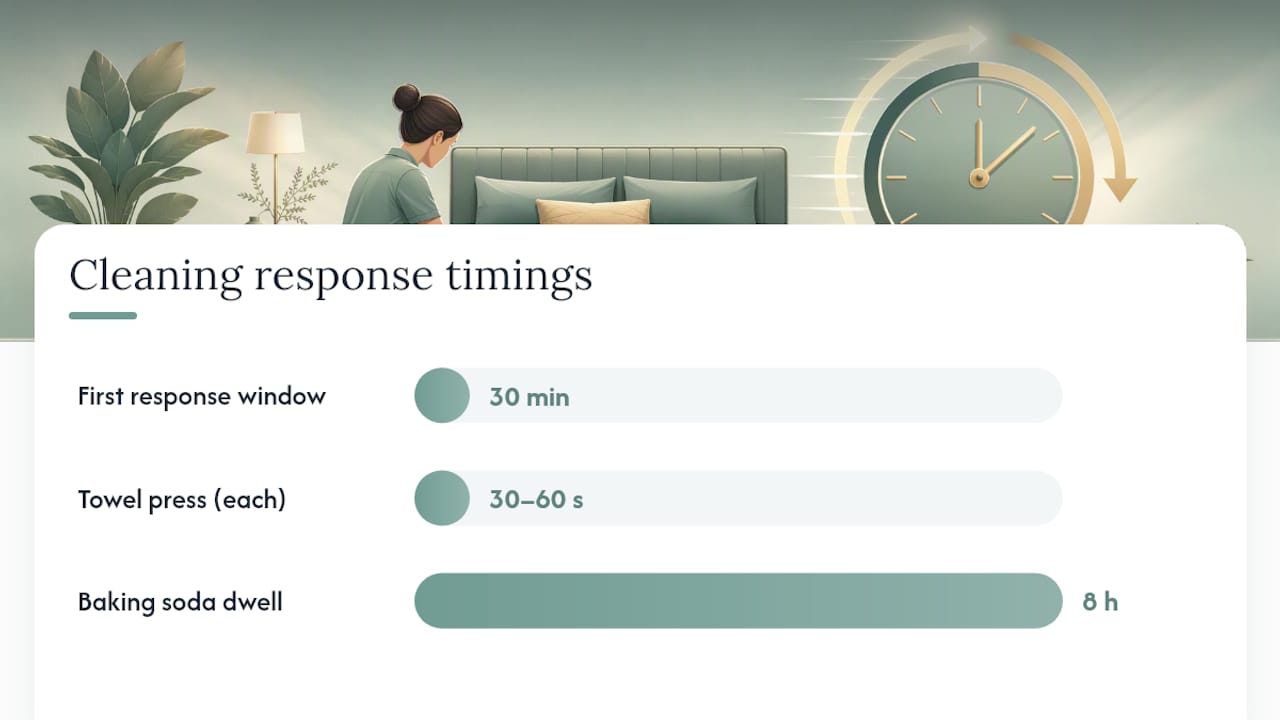
The clock matters here. Urine that’s still wet is a completely different job than urine that’s had eight hours to soak in, so treat the first 30 minutes like the most important part of the whole process.
Start with the bedding, not the mattress. Strip every sheet, mattress pad, and blanket that got hit and get it into the wash immediately. Add 1 cup of distilled white vinegar to the load along with your regular detergent. Vinegar neutralizes the ammonia smell in urine before it has a chance to set into the fabric.
While that’s washing, work the mattress itself:
- Grab a stack of clean towels, four or five if it’s a bigger accident.
- Press one towel flat against the wet spot and hold it there for 30 to 60 seconds. Don’t wipe. Don’t grind it in circles like you’re scrubbing a pan.
- Swap in a fresh towel and repeat until the towel comes away barely damp.
- Keep pressing outward from the edges of the stain inward, so you’re not spreading it wider.
This press-and-lift technique matters more than any product you use afterward. Cleaning experts consistently point to blotting instead of scrubbing as the single move that keeps a stain removable instead of pushing it deeper into the foam or padding.
If you don’t have an enzyme cleaner handy, mix a DIY vinegar solution: equal parts distilled white vinegar and water, plus 1 to 2 tablespoons of laundry detergent. Spray it lightly over the stain, blot again, then move to baking soda.
Cover the damp area with a generous layer of baking soda and leave it alone for at least 8 hours, overnight if you can manage it. The baking soda pulls out lingering moisture and neutralizes what’s left of the smell. Vacuum it up thoroughly the next morning, going over the spot twice to get it all.
Finish with airflow: point a box fan at the mattress, run a dehumidifier in the room, or stand the mattress on its side if you have the space. Skip the hair dryer and skip the space heater.
Pro Tip: Keep a spray bottle of the 1:1 vinegar and water mix in a bathroom closet. Having it ready to grab means you’re treating the stain in minutes instead of hunting for supplies while it dries.
What’s the Best Way to Get Old, Dried Urine Out of a Mattress?
Dried urine isn’t the same chemistry as fresh urine, which is why the vinegar trick that works on a same-day accident often falls flat on a stain that’s a week old.
As urine dries, urea breaks down and forms uric acid crystals that bond to fibers and foam. Those crystals are what cause the sour smell that seems to reappear every time the humidity rises, and they don’t dissolve with soap or vinegar. Enzyme cleaners are built specifically to break down those crystals and the leftover proteins, which is why they’re the standard recommendation for anything that’s had time to set.
The protocol takes patience:
- Pre-wet the dried stain lightly with water so the enzyme cleaner can penetrate instead of sitting on top of a dry crust.
- Apply the enzyme cleaner generously, enough to fully saturate the stained layer.
- Let it dwell 15 to 30 minutes for a stain that’s only a few hours old, or 30 to 60 minutes (or longer) for anything that’s fully dried.
- Cover the area with plastic wrap or a damp cloth while it dwells. Keeping it moist prevents the enzymes from drying out and losing their effectiveness before they finish the job.
- Blot dry, then repeat the whole cycle if odor or shadow remains.
Set-in stains often need two to three treatment cycles spread across a couple of days rather than one long session. Fresh urine treated within 30 minutes has a much better shot at full removal than a stain that’s had hours to dry, which is the whole reason speed matters so much in the first section.
When shopping for a product, check the label for protease and urease enzymes specifically. These break down protein and urea, the two components responsible for staining and smell. Follow the dwell time printed on the bottle rather than guessing.
Use it sparingly and test an inconspicuous spot first. It can bleach fabric, especially on darker mattress covers, so don’t reach for it as your first move.
What Cleaning Products Should You Never Use on a Mattress?
A few common household fixes make urine stains worse, not better, and they’re the mistakes that turn a fixable accident into a ruined mattress.
- Hot water, steam cleaners, or hair dryers. Heat sets protein stains permanently and drives moisture deeper into foam layers, raising the risk of mold growing where you can’t see or reach it.
- Bleach or ammonia-based cleaners. Both can break down mattress fabric and foam, and ammonia specifically can intensify the urine smell rather than eliminate it since urine already contains ammonia compounds.
- Aggressive scrubbing. Pressing a brush or rag into the stain forces liquid further into the padding and springs, exactly the opposite of what blotting accomplishes.
- Air fresheners and masking sprays. These cover the smell temporarily but leave the uric acid crystals intact, and for households with pets, an unresolved scent trail can actually encourage repeat marking in the same spot.
Does Mattress Type Change How You Should Clean It?
Not every mattress handles liquid the same way, and picking the wrong technique for your specific mattress is how a fixable stain turns into a mold problem.
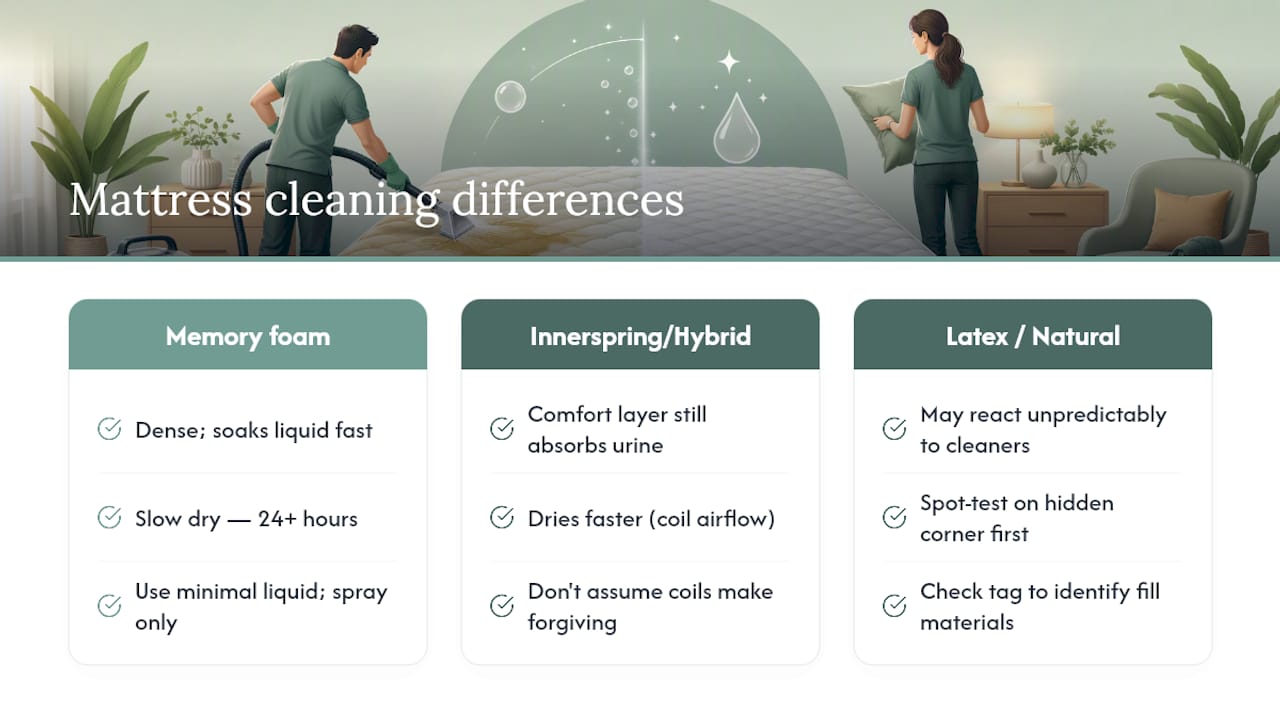
Memory foam is the trickiest material here. It’s dense and porous, which means it soaks up liquid fast and releases it slowly. Use the least amount of liquid possible during cleanup, favor spray applications over pouring, and plan on a longer drying window, sometimes 24 hours or more, before you remake the bed.
Innerspring and hybrid mattresses dry faster thanks to the airflow the coil layer creates. That said, the comfort layer on top (foam, fiberfill, quilting) still traps urine the same way any absorbent material does, so don’t assume the coils make the mattress forgiving.
Latex mattresses and organic cotton or wool covers can react unpredictably to enzyme cleaners and hydrogen peroxide. Spot-test any solution on a hidden corner first and wait to see if discoloration shows up before treating the whole stain.
Pro Tip: If you’re not sure what’s inside your mattress, check the tag sewn into the seam. It usually lists the fill materials, which tells you whether you’re dealing with a fast-drying innerspring or a slow-drying foam core.
When accidents happen repeatedly in the same spot, urine can work its way past the comfort layers into the support core. At that point, no amount of surface treatment reaches it, and replacement becomes the more practical option than continued cleaning.
How Do You Know When a Mattress Is Actually Dry?
Skipping this step is how a mattress that looked clean ends up smelling musty a week later. Moisture trapped inside foam or padding is a breeding ground for mold, and once that starts, no amount of enzyme cleaner fixes it.
- Set up airflow immediately after treatment: a box fan aimed directly at the wet area, a dehumidifier running in the room, or both. Open a window if the weather allows it.
- Skip anything heat-based, including hair dryers, space heaters, or steam. Heat can push moisture deeper before it evaporates and risks warping foam.
- Expect innerspring and hybrid mattresses to dry within 4 to 8 hours with good airflow. Memory foam often takes 12 to 24 hours because of how deep the liquid penetrates.
- Test with a clean, dry towel: press it firmly on the treated spot and check whether any dampness transfers. If the towel stays dry, the area has fully dried.
- Do a smell check up close. Lingering sour odor almost always means uric acid crystals are still present, which calls for another enzyme cycle before you put sheets back on.
If moisture or odor persists after a full drying cycle, repeat the enzyme treatment rather than covering the smell with a topper or extra sheets.
What’s the Best Way to Prevent the Next Accident?
The fastest mattress urine cleanup is the one you never have to do, and that comes down to what’s covering the mattress before an accident happens.
A waterproof mattress protector sits on top of the mattress like a fitted sheet and blocks liquid from soaking through. A full encasement zips around the entire mattress, sealing all six sides, which matters more for households dealing with bedwetting, incontinence, or pets that have had repeat accidents, since it stops seepage at the seams too.
For kids and most pet situations, a quality waterproof protector is usually enough. For recurring accidents or anyone managing a health condition, the added seam protection of a full encasement is worth the extra cost.
Look for a protector that’s:
- Breathable, so it doesn’t trap heat overnight
- Machine-washable on a regular cycle
- Topped with a terry cloth or quilted layer, since bare vinyl can feel plasticky against skin
The real payoff of a protector shows up the moment an accident happens: instead of treating the mattress at all, you strip the protector and throw it in the wash like any other load of laundry. That one change turns a stressful, time-sensitive cleanup into a five-minute chore, a shift worth making after even one incident. For step-by-step guidance on the removal side, Home Service Simple’s mattress urine removal guide walks through the same protocol in more detail.
If an accident happens overnight, strip the protector or top sheet right away, blot the mattress underneath if any liquid reached it, and let it air out before remaking the bed.
When Should You Hire a Professional Instead of DIY?
Some stains genuinely fall outside what a spray bottle and some patience can fix, and knowing that threshold early saves you from wasting days on a mattress that needed a different approach from the start.
Call in a professional when:
- The urine soaked through to the mattress core, not just the top layer
- You’ve run two or three full enzyme cycles and odor still lingers
- The same spot has taken repeated accidents over weeks or months
- You’re dealing with a health situation where hygiene matters more than a DIY gamble
Professional equipment reaches deeper than a household spray bottle can. Deep extraction pulls moisture and residue out of layers you can’t access with towels and a fan, and controlled drying equipment removes it without leaving the mattress damp for a full day. Professional mattress cleaning services handle this kind of deep deodorization without leaving behind the sticky residue some store-bought sprays do.
Before a technician arrives, strip all bedding and let the mattress air out if possible. Tell them what you’ve already tried, including any vinegar, enzyme, or peroxide treatments, since that affects which method they use next.
A Quick Note on Getting This Right the First Time
Accidents happen. Kids, pets, aging parents, a bad night, none of it means your mattress is ruined. The mistake most people make isn’t the accident itself, it’s waiting a day to deal with it or reaching for bleach because it seemed like the strongest option in the cabinet.
Move fast, blot instead of scrub, and put a protector on the mattress once this one is clean. That single habit prevents almost every repeat cleanup you’d otherwise be dealing with.
— chris
Get Help When DIY Isn’t Cutting It
Home Service Simple gives Wichita homeowners a faster way through a stubborn urine stain than another round of vinegar and baking soda: a technician who extracts moisture and odor from deep inside the mattress instead of just treating the surface. Where DIY enzyme cycles can take two or three tries spread across several days, a professional visit handles the deep layers in a single appointment, with controlled drying that gets the mattress usable again without the guesswork.

Regular cleaning subscriptions can keep carpets, upholstery, and mattresses on a schedule so accidents get handled fast instead of piling up. Some services offer a satisfaction guarantee to avoid living with lingering smells.
If your mattress has been fighting you for more than a couple of enzyme cycles, check out the mattress urine removal service page for what’s included and how to book a visit.
Sources
- How to get urine smell and stains out of a mattress
- How to get urine out of a mattress — and stop the smell from coming back
- How to Remove Urine from Mattress: 7-Step Method That Actually Works – MattressHelp
- How to clean a memory foam mattress and get urine out
FAQ
Can You Fully Clean a Mattress That’s Been Urinated On?
Yes, in most cases, especially if you treat it while it’s still fresh. Blot immediately, treat with an enzyme cleaner or vinegar solution, and dry completely. Older, dried stains take longer and may need two or three enzyme cycles to fully clear.
What Draws Urine Out of a Mattress?
Baking soda draws out residual moisture when left on the stain for 8 or more hours before vacuuming. Enzyme cleaners work differently, breaking down the uric acid crystals and proteins in the stain itself rather than just absorbing liquid.
What’s the Best Cleaner for Human Urine on a Mattress?
An enzyme cleaner formulated with protease and urease is the most reliable option for both fresh and dried urine, since it breaks down the actual proteins and acid crystals causing the smell. For a fresh accident, a DIY mix of vinegar, water, and a little detergent also works well if you don’t have an enzyme product on hand.
When Should You Replace the Mattress Instead of Cleaning It?
Replacement makes more sense than continued cleaning when urine has soaked through to the support core, when odor persists after two or three full enzyme cycles, or when the same area has absorbed repeated accidents over time. At that point, professional extraction is worth trying before assuming the mattress is a loss.