

Blot the spill now, don’t rub it. If your leather is finished or pigmented (the kind with a smooth, consistent coat), you can usually handle leather couch cleaning yourself with mild soap suds and a good conditioner afterward. If you’re dealing with oil, ink, or unfinished aniline leather, test carefully first. If it doesn’t lift fast, stop and call a pro before you make it worse.
TL;DR:
- Finished or pigmented leather couches tolerate mild soap and water cleaning, but aniline or unfinished leathers absorb liquids and require professional treatment.
- Weekly dusting and vacuuming with a soft attachment, followed by spot cleaning and periodic conditioning, can extend a leather couch’s lifespan significantly.
- Oil, ink, and water-based stains demand tailored approaches, with home remedies only suitable for fresh, minor marks on finished leather, while deep or old stains need expert care.
- Conditioning every three to six months with pH-balanced products prevents cracking and maintains leather flexibility, especially in dry or heavy-use households.
- Professional cleaning is advisable for large, set-in stains or delicate leathers like aniline, with costs varying based on leather type and stain severity.
Table of Contents
- How Do You Identify Your Leather Couch’s Type and Finish?
- What’s the Right Routine for Cleaning Leather Couches at Home?
- How Do You Get Different Stains Out of a Leather Sofa?
- How Often Should You Condition and Protect a Leather Couch?
- When Should You Call a Professional Leather Cleaner?
- How Does Home Service Simple Approach Leather and Upholstery Care?
- What Most Leather Care Advice Gets Backwards
- Get Your Couch Professionally Cleaned Without the Guesswork
- Sources
- FAQ
How Do You Identify Your Leather Couch’s Type and Finish?
Before you touch a cleaning product, you need to know what kind of hide you’re working with. Wichita living rooms see everything from bonded faux leather to full-grain aniline, and treating one like the other is how a coffee ring turns into a permanent dark blotch.
Run a simple water droplet test on a hidden spot, like the underside of a cushion. If the water beads up and sits on top, you’ve got finished or “protected” leather, sealed with a topcoat that resists moisture. If it soaks in fast and darkens the surface, you’re likely dealing with aniline or unfinished leather, which drinks up liquid (and stains) the same way.
A quick way to sort your couch:
- Finished or pigmented leather — smooth, uniform color, slightly plastic-feeling. This is the most common type on family sofas and tolerates mild soap and water.
- Protected leather — similar to finished, with an added sealant layer for extra stain resistance.
- Aniline or full-aniline leather — soft, natural grain, visible pores, richer color variation. Gorgeous, but absorbent and fragile.
- Nubuck or suede — brushed, velvety texture. Water and most cleaners will mark it.
- Faux leather (vinyl or polyurethane) — totally sealed, no pores, and generally the most forgiving for DIY cleaning.
Check the tag under a cushion or the manufacturer’s care booklet before you do anything else. Those instructions override any general advice here, including this article. If you can’t find a tag, a fabric-code breakdown can help you figure out what you’re actually dealing with.
What’s the Right Routine for Cleaning Leather Couches at Home?
Dust isn’t just gross. It behaves like fine sandpaper, grinding into the grain every time someone sits down, and regular dusting and vacuuming is one of the most effective ways to slow that wear. Build a simple rhythm and your leather will thank you for years.
Here’s the cadence that actually works:
- Weekly — Dust and vacuum with a soft brush attachment. Skip anything abrasive; a stiff brush will scratch the finish over time.
- As needed — Spot clean with suds only, whipped up from a few drops of mild soap in distilled water. Wipe with a damp microfiber cloth, never soaking wet, then dry immediately with a second cloth.
- Every 3 to 6 months — Apply a leather conditioner to keep the hide supple and prevent cracking.
Always test any cleaner in a hidden spot first, and let it dry fully before judging whether the color held. Skipping that step is how one bad Saturday afternoon turns a couch cushion into a two-tone couch cushion.
Keep a small kit on hand: microfiber cloths, a soft-bristle brush, distilled water, a mild pH-neutral soap or a dedicated leather cleaner, and a conditioner made for your leather type.
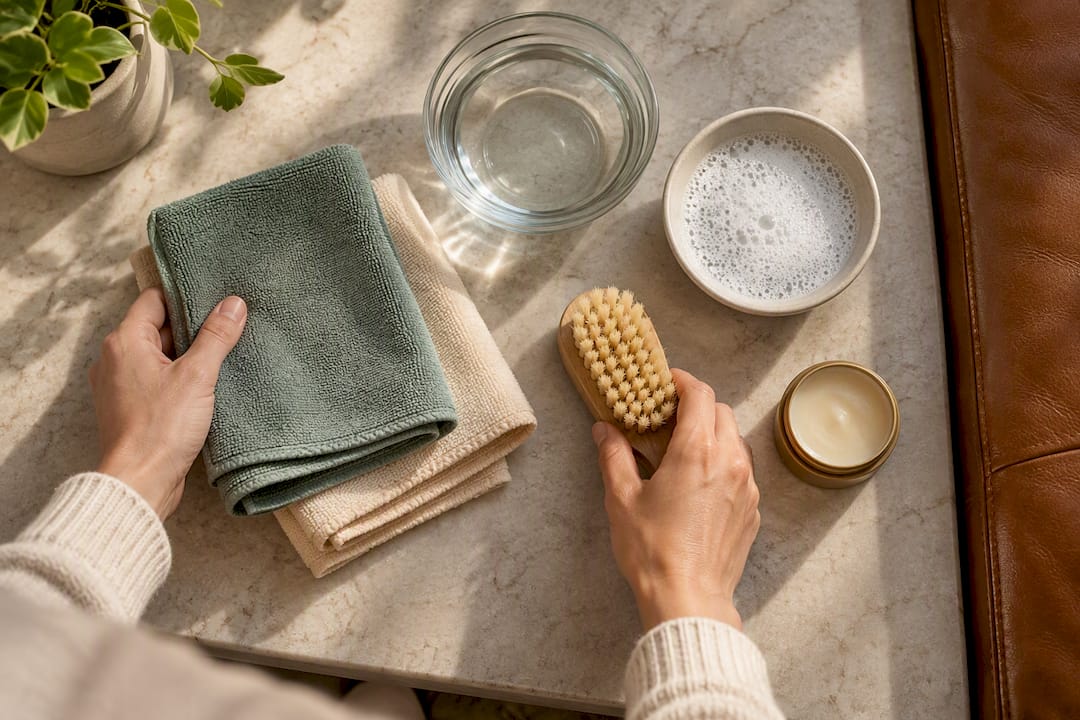
Pro Tip: Skip tap water when you can. Minerals in hard water can leave faint residue on leather over repeated cleanings, and distilled water avoids that entirely.
Good Housekeeping’s Cleaning Lab backs this same sequence for finished leather: wipe, clean with suds, rinse lightly, dry, then condition. It’s not complicated. It’s just consistent.
How Do You Get Different Stains Out of a Leather Sofa?
Not all stains behave the same way, and treating an ink spot like a wine spill is a fast way to make a small problem bigger. Work through these by stain type, and stop the moment something looks wrong.
Oil and grease stains:
- Blot immediately with a dry cloth without adding water, to avoid spreading oil further into the fibers
- Cover the spot with baking soda or cornstarch and leave it for several hours to allow the powder to absorb the oil
- Brush away the residue gently, then follow with a leather degreaser made for finished hides if a shadow remains.
- If the stain is still visible after that, stop trying home fixes. Some oil stains simply don’t lift with household methods and need professional-grade treatment.
Ink stains:
- Blot fresh ink right away, before it sets.
- Test rubbing alcohol on a hidden spot first. If the color holds, dab (don’t scrub) the stain with a cotton swab lightly dampened in alcohol, working from the outside in.
- Stop immediately if you see the dye lifting or the leather color changing. That’s your signal this needs a specialist. The ink removal case study shows how much difference the right first move makes.
Wine and other water-based spills:
- Blot up as much liquid as you can before it soaks in.
- Work mild soap suds into the spot with a sponge, using only the foam, not the liquid underneath.
- Rinse with a barely damp cloth using distilled water, then dry thoroughly and condition.
Consumer Reports backs this blot-first, suds-only approach as the safest route for most water-based marks on finished leather.
Gum and wax:
- Press an ice pack against the spot until the gum or wax hardens.
- Chip it away gently with a plastic scraper or your fingernail. Never use a metal tool.
- Clean the leftover residue with the same mild soap-suds method above.
Here’s the number that should guide every decision on this list: dye lifting or persistent discoloration after one careful attempt means you’ve hit the ceiling of what DIY can safely do. Large, set-in stains, or literally anything on aniline or unfinished leather, call for conservation-level handling rather than kitchen-cabinet chemistry, because those hides absorb dye and liquid too readily to risk experimenting.
How Often Should You Condition and Protect a Leather Couch?
Conditioning is the step most people skip, and it’s the one that determines whether your couch looks better or worse five years from now; for tips on maintaining various home surfaces, including stucco, see How to Repair Stucco Cracks Before Painting.
Use a pH-balanced conditioner suited to your specific leather type, and avoid saddle soap, furniture polish, or products containing vinegar Those products strip natural oils or leave a film that attracts dirt instead of protecting the hide.
Getting it right:
- Apply a small amount to a cloth, not directly onto the couch.
- Rub it in with even, circular motions, then buff off any excess so it doesn’t sit greasy on the surface.
- Test in a hidden spot first, every single time, even with a product you’ve used before.
- Recondition every 3 to 6 months, leaning toward the shorter end in dry climates or heavy-use households.
- Condition again right after any deep cleaning, since cleaning pulls oils out along with the dirt.
Beyond the bottle, protect the leather with everyday habits. Keep the couch out of direct sunlight, which dries and fades hides faster than almost anything else. Rotate cushions so wear spreads evenly, and toss a throw blanket where the family dog likes to curl up.
Pro Tip: If you’ve got a dog who treats the couch like a second bed, tackle odor before it sets into the leather. A quick odor-removal method works fast without soaking the hide.
When Should You Call a Professional Leather Cleaner?
Some jobs are DIY-friendly. Some aren’t. Know the difference before you start experimenting on a couch you can’t afford to ruin.
Call a professional when you’re facing:
- Unfinished, aniline, or nubuck leather with any real stain, since these absorb liquid and dye almost instantly.
- Large or old, set-in stains that have had time to work into the material.
- Dye transfer from jeans, upholstery, or another piece of furniture.
- Tears, deep scratches, or structural damage to the cushion or frame.
- Any stain where your test spot showed color loss or lifting.
A professional brings tools you don’t have at home: specialized degreasers formulated for leather, controlled wet-cleaning methods that avoid over-saturating the hide, and color-matching or patch work for spots that DIY simply can’t fix. Professional-grade processes reduce the risk of color loss and over-wetting compared to trial-and-error at home.
Before booking, ask a few pointed questions: Do they have direct experience with your leather type? Are they insured? Will they spot-test before treating the whole piece? What’s their guarantee if the stain doesn’t fully lift? A clear cost breakdown upfront tells you a lot about whether a company knows what it’s doing.
How Does Home Service Simple Approach Leather and Upholstery Care?
Home Service Simple built its upholstery process around the same rule this guide follows: figure out what you’re working with before you clean anything. That’s exactly how the ink removal case played out. Identify the leather, test small, then decide whether it’s a spot-treat job or a full professional visit.
What that looks like in practice:
- Inspecting the leather type and finish before touching a single product.
- Choosing between spot treatment and a full upholstery cleaning based on stain age, size, and leather category.
- Applying odor-removal techniques on pet-heavy households without over-wetting the hide.
- Providing services backed by a satisfaction guarantee, so you’re not left guessing whether it worked.
Booking a visit starts with the same inspection described above. No guesswork, no one-size-fits-all bottle of spray.
What Most Leather Care Advice Gets Backwards
Most guides treat leather cleaning like a checklist: spray this, wipe that, done. That’s backwards. The entire skill of leather couch cleaning is knowing when to stop, not knowing what to spray next.
The research is consistent on this point. Absorbents work for oil. Mild suds work for water-based stains. Conditioning every few months prevents most of the cracking people blame on “bad leather.” None of that is complicated. What separates a couch that looks great at year ten from one that looks ruined at year two is restraint: testing first, stopping at the first sign of color change, and accepting that aniline and unfinished leathers are a different game entirely.
I’d argue the biggest mistake homeowners make isn’t using the wrong cleaner. It’s pushing past the first failed attempt. Trying a second, harsher product on a stain that didn’t respond to a gentle one is how a $30 mistake becomes a $600 reupholstering job. If gentle doesn’t work, gentle was the ceiling. That’s your cue to call someone who does this for a living.
— chris
Get Your Couch Professionally Cleaned Without the Guesswork
Some stains just aren’t worth the risk of a DIY attempt gone sideways, especially on a couch you actually love. Home Service Simple’s upholstery cleaning service is built for exactly that moment: when a spot has set in, the leather type is uncertain, or you’d rather not gamble on a home fix.
Every visit starts with an inspection of your leather or fabric type, followed by a treatment plan matched to what’s actually on the couch, backed by a satisfaction guarantee. If your household deals with recurring spills, pet odor, or just wants routine care handled without repeat scheduling, the Simple Club membership covers that at a flat $20 or $40 a month depending on the plan you choose. Book an inspection through the upholstery page and get a straight answer on whether your couch needs a spot treatment or a full clean.
Sources
- Ultimate Stain-Removal Guide – Consumer Reports
- How to clean any couch – Good Housekeeping
- NPS Museum Handbook: Upholstery and textile conservation guidance
FAQ
What Is the Best Way to Clean a Leather Sofa?
Blot spills immediately, dust weekly with a soft brush attachment, and spot clean with mild soap suds on finished leather. Consumer Reports recommends always testing a cleaner on a hidden spot before applying it to the whole couch, then conditioning afterward to keep the hide from drying out.
Can I Put Dawn Dish Soap on Leather?
A few drops of a mild dish soap diluted in water, used as suds only, is generally safe on finished or pigmented leather when tested first on a hidden area. It’s not recommended for aniline, nubuck, or unfinished leather, which absorb liquid too readily and can stain or darken permanently.
How Do I Clean My Leather Couch?
Start by identifying your leather type, since finished leather tolerates mild soap and water while aniline leather does not. From there, dust weekly, spot clean with suds as needed, dry thoroughly, and condition every 3 to 6 months using a pH-balanced conditioner. If a stain doesn’t lift after one careful attempt, a professional upholstery service is the safer next step.
Is Murphy’s Oil Soap Good for Leather Furniture?
Murphy’s Oil Soap is formulated for wood, not leather, and it isn’t part of the standard leather-cleaning routine recommended by cleaning labs. Stick with a mild, pH-neutral soap or a cleaner made specifically for leather to avoid stripping the finish or leaving residue.
How Much Does Professional Leather Couch Cleaning Cost?
Pricing depends on the size of the piece, the leather type, and the extent of staining. Home Service Simple’s upholstery cleaning page has current details, and an inspection before booking gives you an exact number for your specific couch.