

Air duct sanitizing means applying an antimicrobial product to your ductwork after it’s been mechanically cleaned, usually by fogging or spraying, to kill bacteria, mold spores, or odor-causing organisms clinging to the metal. Here’s the short answer: it’s not something you need on a schedule. The EPA does not recommend routine duct cleaning or sanitizing unless there’s actual proof of a problem.
Before you call anyone about sanitizing, do this instead:
- Get your ducts physically inspected for visible mold, moisture, or pest activity.
- Prioritize mechanical cleaning and fixing the moisture source, since that solves most issues on its own.
- Only consider a chemical treatment if contamination is confirmed, not just suspected.
Key Takeaways
Air duct sanitizing works as a targeted fix for confirmed contamination, not a maintenance routine, and it only functions correctly after mechanical cleaning removes the dust and debris a chemical product cannot penetrate.
| Point | Details |
|---|---|
| Sanitizing isn’t routine | Reserve it for confirmed mold, water damage, vermin, or fire/flood cleanup, not a yearly checkbox. |
| Cleaning comes first | Sanitizers can’t penetrate dust or biofilm, so mechanical cleaning must happen before any chemical step. |
| Labels and registration matter | Only use products with an EPA registration number and a label specifically approved for HVAC application. |
| Porous liners often need replacement | No biocide is registered for fiberglass duct board, so contaminated sections usually get cut out and replaced. |
| Home Service Simple follows the checklist | Its Wichita duct cleaning service leads with mechanical cleaning and transparent labeling, treating chemicals as a last resort. |
Table of Contents
- What Is Air Duct Sanitizing, and How Is It Different From Cleaning?
- When Is Duct Sanitizing Actually Appropriate?
- Fogging, Spraying, and Encapsulants: What Each Method Actually Does
- What EPA Rules and Labels Actually Require
- How Do You Choose a Duct Cleaning Provider You Can Trust?
- What Happens During Service and Right After
- Keeping Your Ducts Clean So You Never Need to Sanitize
- How Home Service Simple Approaches Duct Cleaning the Right Way
- What the Evidence Actually Tells Homeowners to Do
- A Duct Cleaning Service That Shows Its Work
- Sources
- FAQ
What Is Air Duct Sanitizing, and How Is It Different From Cleaning?
Contractors throw around “clean,” “sanitize,” “disinfect,” and “deodorize” like they’re interchangeable. They’re not, and the difference matters when you’re paying for a service.
Cleaning is mechanical: vacuuming, brushing, and agitating dust and debris out of the ductwork with negative-pressure equipment. Sanitizing reduces the number of certain microorganisms on a surface to a safer level, but it doesn’t claim to eliminate them entirely. Disinfecting kills a broader range of germs and requires a stronger product with a specific label claim. Deodorizing just masks or neutralizes smell. It does nothing to the underlying contamination.
Here’s what most homeowners don’t realize: the sanitizers and disinfectants used in ductwork aren’t cosmetic products. They’re regulated as pesticides under the Federal Insecticide, Fungicide, and Rodenticide Act (FIFRA) whenever a company makes an antimicrobial claim. That means:
- The product must be EPA-registered for that specific use.
- It must carry a label explicitly approved for HVAC or duct application, not just general surface use.
- Applying an unregistered or mislabeled product in your ductwork is a violation of federal pesticide law, not just a quality issue.
Sanitizers also can’t replace cleaning. A chemical fog or spray sits on top of dust and debris. It doesn’t remove that material, and it often can’t even reach the organisms buried underneath it. Mechanical cleaning has to happen first, or the sanitizer is mostly wasted product sprayed into moving air. Mechanical cleaning and negative-pressure vacuuming come before any chemical step, not after.
When Is Duct Sanitizing Actually Appropriate?
Sanitizing earns its place only when there’s evidence, not suspicion, of a real problem. Think of it as a targeted repair, not preventive care.
The conditions that generally justify it include:
- Substantial visible mold growth on hard, non-porous duct surfaces (sheet metal, not insulation).
- Persistent water intrusion that’s had time to support microbial growth.
- Confirmed vermin contamination, including droppings or nesting material inside the ducts.
- Post-flood or post-fire cleanup where soot, smoke residue, or floodwater has entered the system.
- A household with an immunocompromised occupant, where a physician or industrial hygienist recommends extra precaution.
Notice what’s missing from that list: “it’s been a few years” or “the ducts look a little dusty.” Dust alone doesn’t justify chemical treatment. EPA guidance is explicit that routine cleaning isn’t recommended without a specific, visible reason.
Before anyone applies a product, verify the contamination is real. A quick flashlight look through a supply register isn’t proof of mold. Ask for photos from inside the duct, and if the growth is extensive or the stakes are high (say, a family member with asthma or a compromised immune system), a lab swab test settles the question instead of guessing.
There’s also a category where sanitizing isn’t the answer at all: replacement. Fiberglass duct liners and fiberglass duct board are porous. Once mold takes hold in that material, there’s no registered biocide that can clean it out. No biocides are currently EPA-registered for fiberglass duct liners, so the standard recommendation is to cut out and replace the contaminated section rather than treat it.
Pro Tip: If a contractor recommends sanitizing without ever mentioning replacement as an option for insulated or fiberglass-lined ductwork, ask why. That gap in the conversation is worth a second opinion.
Fogging, Spraying, and Encapsulants: What Each Method Actually Does
Not all sanitizing looks the same, and the method matters for both effectiveness and safety.
ULV fogging (ultra-low volume) atomizes the product into fine droplets, typically in the 5 to 50 micron range, and pushes them through the duct system to reach bends, joints, and areas a hand-held sprayer can’t touch. Smaller droplets travel farther and coat more surface area, but they also drift more, which is why containment matters.
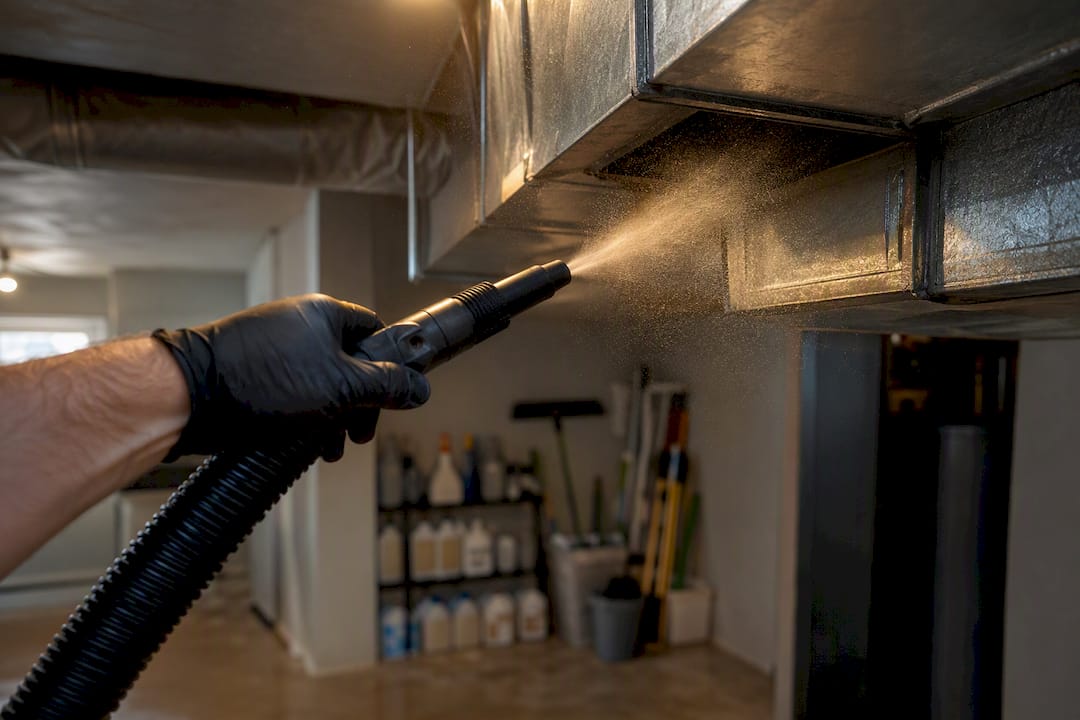
Direct surface application is more targeted: a technician sprays or wipes a specific section, usually where visible growth was confirmed, rather than treating the entire system.
Encapsulants are a different animal entirely. They’re sealants applied to interior duct surfaces to lock down remaining fibers, dust, or minor residue after cleaning. They are not disinfectants and don’t claim to kill anything. Encapsulants show up most often on fibrous glass duct board that’s structurally sound but slightly degraded, never as a substitute for treating actual microbial contamination.
Application mechanics that determine whether any of this actually works:
- Dwell time: most HVAC-labeled sanitizers require the product to stay wet on the surface for about 5 to 10 minutes, depending on the label. Wipe it off or run the system too soon, and it hasn’t done its job.
- Drying and ventilation: ducts need to dry fully and the space needs to air out before the system runs, or you’re circulating a wet chemical through your home.
- Pre-cleaning: skip the mechanical step and the product’s dwell time is meaningless. It can’t penetrate dust or biofilm no matter how long it sits.
Droplet size and dwell time aren’t marketing details. They’re the actual variables that separate a sanitizing job that works from one that’s just theater with a fog machine.
What EPA Rules and Labels Actually Require
This is the part homeowners skip past, and it’s the part that protects you.
The EPA has flagged a real problem: many antimicrobial products sold for general surface use are not registered for HVAC systems, and using them there creates exposure risks the label was never designed to address. HVAC application is treated as a distinct use site under EPA’s supplemental guidance, meaning a product approved for countertops or bathroom tile isn’t automatically safe or legal for your ductwork.
Here’s what to actually ask for before anyone sprays anything in your home:
- The product’s full label, including the section that specifically names HVAC or duct application as an approved use.
- The EPA registration number, which you can verify independently.
- Written confirmation that the product isn’t being applied to porous or insulated duct liners, since no biocide is registered for that material.
- A description of how they’ll protect your household during application, including whether you need to leave the home.
EPA’s own guidance puts it plainly: products not labeled for HVAC use may be ineffective, or worse, may pose exposure risks the label never accounted for. That’s not a technicality. It’s the difference between a treatment that works and one that puts fumes into your living room air with no proven benefit.
Occupant protection isn’t optional theater, either. A competent crew should maintain negative pressure in the work area so contaminants and chemical vapor don’t spread into the rest of the house, ventilate thoroughly after application, and tell you when it’s safe to run your HVAC system again. If anyone with asthma, allergies, or a compromised immune system lives in the home, ask whether you should be out of the house entirely during treatment, not just the room being worked on.
How Do You Choose a Duct Cleaning Provider You Can Trust?
Picking the right contractor comes down to paperwork and honesty, not sales pitch.
Run through this before signing anything:
- Ask about NADCA membership and ASCS (Air Systems Cleaning Specialist) certification, which signals actual training and a passed exam, not just a business license.
- Request photo or video proof of contamination before agreeing to any chemical treatment.
- Get a written scope of work that separates cleaning from sanitizing as two distinct line items.
- Ask to see the product label and EPA registration number in advance, not after the truck is already in your driveway.
- Confirm mechanical cleaning happens first, every time, regardless of whether sanitizing is also planned.
- Ask how they’ll contain dust and chemical vapor during the job.
Pro Tip: A legitimate technician will happily show you a product label. If they hesitate, change the subject, or tell you “it’s basically the same as what’s under your sink,” that’s your answer.
The red flags are consistent across the industry: sanitizing offered as an automatic upsell regardless of what the inspection found, refusal to produce product documentation, sanitizing pitched without any mechanical cleaning included, or high-pressure tactics pushing you to sign same-day. Applying a chemical to uncleaned ducts does little beyond adding cost and exposure, since the product can’t reach through dust and biofilm to the surface underneath.
On pricing, a quote that jumps dramatically once “mold” gets mentioned, with no photos or lab results to back it up, deserves a second opinion before you approve anything.
What Happens During Service and Right After
A properly run job follows a predictable sequence, and knowing it helps you spot shortcuts.
- Inspection first. A technician examines accessible duct sections, registers, and the air handler to identify actual conditions, not assumptions.
- Mechanical cleaning under negative pressure. This typically takes a few hours for an average home, using vacuum equipment that pulls debris out rather than just stirring it around.
- Targeted treatment, if warranted. Only applied to sections where contamination was confirmed, using an HVAC-labeled product with the correct dwell time.
- Drying and ventilation. The treated area needs to dry fully, and the space should air out before the system runs again.
- Final check. A visual walkthrough and, ideally, a photo record of the finished work.
Most straightforward jobs wrap in a single day. If sanitizing was involved, expect to wait until surfaces are fully dry, generally a few hours, before running your HVAC system.
After the crew leaves, replace your air filter immediately, since it likely caught loosened debris during the cleaning process. Keep supply and return grills covered until the system runs again, do a visual and odor check over the following days, and request documentation of what was cleaned, what was treated, and with what product. That paperwork matters if you ever need to reference it for a warranty claim or a future inspection.
Keeping Your Ducts Clean So You Never Need to Sanitize
The best sanitizing job is the one you never have to schedule. Most duct contamination traces back to a handful of preventable habits.
- Replace your HVAC filter regularly, more often if allergies are a concern in your household. A higher MERV-rated filter (MERV 11 to 13) traps more particulate without straining most residential systems.
- Keep coils and drain pans clean, since standing moisture there is a common starting point for microbial growth.
- Dry any water-damaged areas near ductwork within 24 to 48 hours. That window matters more than almost anything else on this list.
- Make sure outdoor air intakes aren’t positioned near vents, garbage areas, or standing water.
- Schedule periodic visual inspections of accessible duct sections rather than waiting for a smell or a symptom to prompt action.
Consistent upkeep beats crisis response every time. A scheduled maintenance plan, like Home Service Simple’s Simple Club, keeps filters, coils, and duct conditions checked on a routine instead of waiting until something’s visibly wrong.
How Home Service Simple Approaches Duct Cleaning the Right Way
Home Service Simple offers air duct cleaning as part of its Wichita-area service lineup, alongside carpet, upholstery, and mattress cleaning, all backed by a satisfaction guarantee. The approach mirrors exactly what this guide recommends:
- Mechanical cleaning comes first, always, regardless of whether a customer asks about sanitizing.
- Product labels and EPA registration details are shared openly, not treated as proprietary information.
- Chemical treatment gets recommended only when there’s an actual, verified reason for it, not as a default add-on to pad the invoice.
Home Service Simple’s Simple Club subscription model also means duct and system health get checked on a schedule, which is the single best way to avoid ever needing an emergency sanitizing call in the first place.
What the Evidence Actually Tells Homeowners to Do
The conventional advice around duct cleaning has always leaned toward “more is safer.” Annual cleaning, routine sanitizing, a fog treatment thrown in because it sounds thorough. The research doesn’t support that instinct. EPA and NIH guidance both land in the same place: fix moisture, clean mechanically when there’s a real reason, and treat chemically only when contamination is documented, not suspected.
What gets overlooked most is the labeling issue. Homeowners fixate on whether a product “kills mold” and rarely ask whether it’s legally registered for HVAC use at all. That’s backward. A product’s antimicrobial claim means nothing if it’s not approved for the space you’re putting it in.
If you take one thing from this guide, prioritize verification over urgency. Get proof of contamination before agreeing to any chemical treatment, and choose a provider willing to show you the label instead of just the invoice.
— chris
A Duct Cleaning Service That Shows Its Work
Home Service Simple is the straightforward alternative to contractors who push sanitizing as a default upsell. Every air duct job in the Wichita area starts with mechanical cleaning, not a fog machine, and product labels get shared before any treatment happens, not after you’ve already signed.
That transparency matters more than it sounds. A lot of homeowners get quoted for sanitizing they never actually needed, simply because nobody showed them proof of contamination first. Home Service Simple’s process skips that entirely: inspect, clean, verify, and only treat when there’s an actual reason to. Combine that with the Simple Club subscription plan, and your ducts, along with your carpets, upholstery, and other home surfaces, stay on a maintenance schedule instead of waiting for a problem to force an emergency call.
If your ducts haven’t been inspected in a while, or you’re not sure whether that “sanitizing recommended” quote from another company holds up, check availability and book an air duct cleaning with Home Service Simple to get a straight answer.
Sources
- Should You Have the Air Ducts in Your Home Cleaned? | US EPA
- Supplemental Guidance – Use of Disinfectants and Sanitizers in HVAC&R Systems | EPA
- DOHS Fact Sheet on HVAC Duct Cleaning | NIH Office of Research Services
FAQ
Is It Worth It to Sanitize Air Ducts?
Only when there’s confirmed contamination, like visible mold, water damage, vermin, or a post-flood cleanup. Otherwise, EPA guidance advises against routine sanitizing, since it adds cost without addressing an actual problem.
What Is the Best Disinfectant for Air Ducts?
There’s no single “best” product. The right choice is whatever is EPA-registered and specifically labeled for HVAC or duct application, verified by checking the registration number before treatment begins.
What Are the Downsides to Air Duct Cleaning?
When done unnecessarily or without proper containment, it can stir up dust temporarily, cost money for no measurable air quality benefit, and in rare cases damage older or fragile ductwork if performed aggressively.
What Do Duct Professionals Use to Clean Ductwork?
Reputable technicians rely on negative-pressure vacuum systems paired with mechanical agitation tools to dislodge and remove debris, following the same mechanical cleaning approach NIH and NADCA guidance recommend before any chemical treatment is considered. Home Service Simple uses this same cleaning-first sequence on every job in the Wichita area.