

Most homeowners should schedule a professional air duct cleaning every 3 to 5 years, per NADCA guidance, while doing a quick visual check yearly. The EPA takes an “as-needed” stance instead of a fixed calendar. Bottom line: follow the 3 to 5 year rule as your baseline, but call a local pro like Home Service Simple sooner if you spot mold, pests, or dust pouring out of your vents.
TL;DR:
- Most homes should plan for professional duct cleaning every 3 to 5 years, with annual visual inspections to identify issues early.
- Visible mold, persistent musty odors, pest evidence, dust blowing out of vents, or water damage require immediate cleaning regardless of the schedule.
- Homes with heavy pet shedding, indoor smoking, allergies, recent renovation, or water leaks may need more frequent cleaning, possibly annually.
- A thorough professional cleaning includes the coils, blower, drain pans, and ductwork using NADCA-recommended techniques, not just vent cleaning.
- Addressing the source of contamination and maintaining filters are crucial for better indoor air quality improvements than duct cleaning alone.
Table of Contents
- Air Duct Cleaning Frequency: What NADCA and the EPA Actually Recommend
- Five Signs You Should Skip the Calendar and Clean Now
- Factors That Shrink Your Cleaning Interval
- What a Legitimate Professional Duct Cleaning Actually Covers
- DIY Steps That Stretch the Time Between Professional Cleanings
- How to Vet a Duct Cleaning Contractor Before You Book
- How Home Service Simple Approaches Duct Cleaning Frequency
- Ready to Get Your Ducts Inspected?
- A Straight Answer on Duct Cleaning Frequency
- Sources
- FAQ
Air Duct Cleaning Frequency: What NADCA and the EPA Actually Recommend
Two respected authorities give homeowners two different answers, and both are right depending on what you need.
NADCA’s standard leans on a 3- to 5-year cleaning cycle for a typical home with normal occupancy, no pets shedding everywhere, and no recent construction dust. That number assumes average conditions. It is a baseline, not a guarantee that your ducts are fine until year four rolls around.
The EPA takes the opposite approach. Its position is that there is no universal schedule that fits every house, and cleaning should happen when there is actual evidence of contamination, not just because a certain number of years passed.
Here’s the practical fix that satisfies both camps:
- Do a visual inspection of your vents and accessible ductwork once a year.
- Schedule a full professional cleaning every 3 to 5 years as your default.
- Move that timeline up immediately if you see mold, smell something musty, or notice a pest problem.
- Treat the calendar as a floor, not a ceiling. Real evidence in your ducts always overrides the schedule.
Five Signs You Should Skip the Calendar and Clean Now
Some situations don’t wait for year three or four. If you see any of these, get an inspection scheduled this week, not next season.
- Visible mold growth. Mold inside metal ductwork or on the AC coil is a health issue, not a cosmetic one, and it spreads through your air supply every time the blower kicks on.
- A musty odor that follows you room to room. Persistent smell, especially when the system turns on, usually means moisture and buildup somewhere in the line.
- Evidence of pests. Rodent droppings, nesting material, or insect shells in a vent register mean something is living in your duct system, and that’s not a wait-and-see problem.
- Heavy dust blasting out of the registers. A little dust on the vent cover is normal. Dust clouds when the system kicks on means years of buildup are riding the airflow into your living room.
- Documented water damage. Flooding, a leaky roof, or a burst pipe near ductwork creates the exact moisture conditions mold needs to take hold.
Take photos of anything you find before calling a contractor. Timestamped pictures of mold, dust buildup, or water stains give a technician a faster read on the scope of the job and give you a record if you need to compare quotes.
Factors That Shrink Your Cleaning Interval
The 3 to 5 year rule assumes an average household. Plenty of homes aren’t average, and several common factors push that timeline much shorter.
Household conditions that speed things up:
- Pets that shed heavily
- Anyone who smokes indoors
- Household members with allergies, asthma, or a compromised immune system who need cleaner air sooner rather than later
- Recent renovation or construction work, which sends drywall dust and debris straight into the return vents
- A change in occupancy, like a new baby or an elderly relative moving in
- Any history of water leaks or flooding near the ductwork
- Older or physically damaged duct runs that trap debris in seams and dents
Your filter and HVAC setup matter too. A cheap, low-MERV filter lets more particles slip past into the ducts, while a high-static system with narrow returns tends to build up grime faster than a well-balanced one. Homes with big medical needs indoors, or systems handling constant renovation dust, might reasonably justify inspections every year or two instead of stretching to the five-year mark.
What a Legitimate Professional Duct Cleaning Actually Covers
A real cleaning job treats the HVAC system as one connected unit, not just a set of metal tubes. That means the coil, blower assembly, drain pans, and supply and return registers all get attention, along with the ductwork itself. Cleaning ducts alone while leaving a dirty blower or coil in place is one of the fastest ways to get recontaminated air within weeks.
NADCA-recommended methods rely on a few specific techniques:
- Mechanical agitation to knock loose dust and debris stuck to duct walls
- Continuous negative-pressure vacuuming that pulls contaminants out of the system instead of just stirring them up
- Containment and HEPA filtration so dislodged particles don’t end up back in your living space
- A proper sequence, cleaning the equipment side before the duct runs, to avoid dirtying clean sections with debris from dirty ones
Pro Tip: Ask any contractor to walk you through their sequence before they start. If they can’t explain how they prevent recontamination between the coil, blower, and duct runs, that’s a red flag worth asking more about.
Set your expectations honestly. A quality cleaning reduces dust and debris load, but research on indoor air quality improvements from duct cleaning alone shows mixed, inconsistent results. If allergies or breathing issues are your main driver, cleaning works best paired with fixing the actual source, whether that’s a leak, a bad filter, or unresolved mold. You can read more about realistic air duct cleaning benefits before booking anything.
DIY Steps That Stretch the Time Between Professional Cleanings
You can’t deep clean a duct system yourself, but a few habits genuinely slow down how fast grime builds up.
- Change your filter every 1 to 3 months, and use a MERV 8 to 13 filter for typical residential use. Higher isn’t always better if your system isn’t rated to handle the extra airflow resistance.
- Vacuum the register covers and vent grilles every few weeks, especially in high-traffic rooms.
- Pop the grilles off occasionally and wash them in warm soapy water, then let them dry completely before reinstalling.
- Peek into accessible duct openings with a flashlight once a season, just checking for dust buildup, moisture, or anything unusual.
- Stop the DIY approach and call a professional the moment you spot mold, pest activity, or damage you can’t explain.
Your HVAC system recirculates the air in your home multiple times a day, so small maintenance habits compound fast over months of use.
How to Vet a Duct Cleaning Contractor Before You Book
Not every company advertising duct cleaning does the job right. A few pointed questions separate the professionals from the corner cutters.
Ask directly:
- Are your technicians NADCA members, and do you follow ACR standards for the cleaning process?
- Will you clean the entire system, coils, blower, and drain pans included, or just the visible duct runs?
- What equipment do you use? A true negative-pressure vacuum system should be part of the answer.
- Are you insured, and can you show before-and-after photos from past jobs?
Get everything in writing. A legitimate contractor gives you an itemized scope of work upfront, along with follow-up recommendations like filter swaps or duct sealing, similar to what you’d expect when you demand an itemized estimate from any home service provider.
Pro Tip: Watch for a flat, suspiciously low price quoted over the phone with no inspection. Legitimate whole-system cleanings require an on-site look before anyone can give you an accurate number.
Red flags that should send you looking elsewhere: routine biocide fogging pitched as standard practice, pressure-only blasting with no vacuum containment, and any company that can’t describe how they prevent debris from spreading through your home during the job. If mold is part of the picture, read up on what to do about mold in air ducts before you sign anything, and remember that reducing dust at the source, including things like low-dust construction or door replacement practices, cuts down how much debris ever reaches your ducts in the first place.
How Home Service Simple Approaches Duct Cleaning Frequency
Some local companies offer air duct cleaning alongside carpet, upholstery, and mattress services, and may provide subscription options for homeowners who want recurring care without juggling appointments. Our approach starts with an inspection, not a sales pitch. We look at your actual system before recommending a cleaning, and we back the work with a satisfaction guarantee. Use the vetting checklist above with any contractor you call, including us.
Ready to Get Your Ducts Inspected?
If you’ve read this far and you’re still wondering whether your ducts fall into “clean now” or “wait a couple years,” an inspection settles it faster than guessing. Various local providers serve homeowners in Wichita and surrounding areas, typically inspecting the actual system, coils, and registers before recommending any cleaning.
Unlike a one-size-fits-all subscription plan, we check for the real triggers covered above: mold, dust load, pest signs, water damage, before we ever recommend a full cleaning. That means you’re not paying for work your system doesn’t need yet, and you’re not left guessing when it does.
You can book a duct inspection directly through our air duct cleaning for allergies page if breathing comfort is your main concern, or start with our main booking page to see current availability and get a straight answer on what your home actually needs.
A Straight Answer on Duct Cleaning Frequency
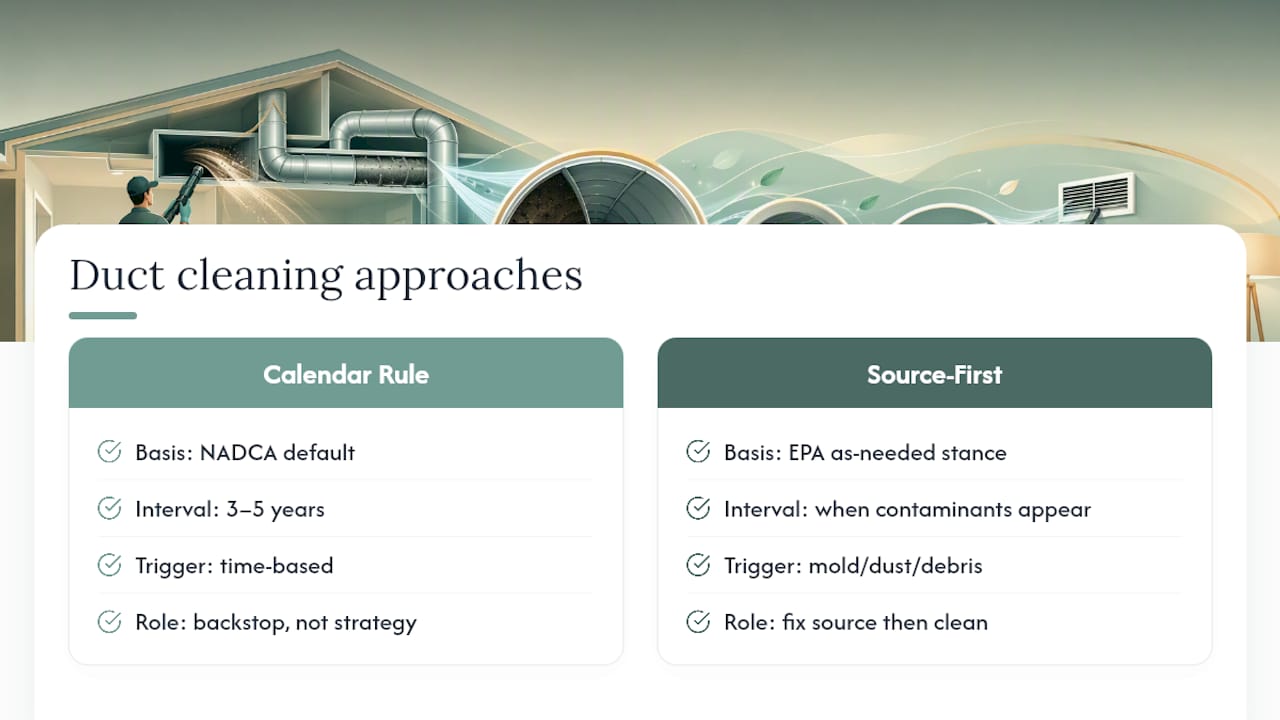
The 3 to 5 year rule gets treated like gospel in a lot of marketing material, and that’s a mistake. NADCA built that number as a reasonable default for an average home, not a magic interval that applies to every duct system regardless of what’s actually happening inside it. The EPA’s as-needed stance gets criticized for being vague, but it’s the more honest position: your ducts don’t know what year it is, they only know whether mold, dust, and debris are accumulating.
What gets underestimated is how much the source matters more than the cleaning itself. A pristine duct system downstream of a leaking roof or a shedding dog will recontaminate within months. Homeowners who fix the source first and clean second get far better results than those who clean on a strict schedule and ignore what’s causing the buildup in the first place. Treat the calendar as a backstop, not a strategy, and you’ll get more value out of every dollar you spend on this.
— chris
Sources
- Should You Have the Air Ducts in Your Home Cleaned? | US EPA
- ACR: The NADCA Standard (2021 edition)
- DOHS fact sheet on HVAC duct cleaning
FAQ
How often should air ducts be cleaned in a typical home?
Most homes do well on a 3 to 5 year professional cleaning cycle, with an annual visual inspection in between to catch problems early.
Does the EPA recommend a specific duct cleaning schedule?
No. The EPA recommends cleaning based on evidence of contamination rather than a fixed calendar, meaning visible mold, pests, or heavy debris matter more than time elapsed.
What signs mean I need duct cleaning sooner than the standard schedule?
Visible mold, a persistent musty smell, pest droppings, dust blowing out of vents, and any history of water damage are all reasons to schedule cleaning immediately rather than waiting.
Do pets or smoking affect how often I should clean my ducts?
Yes. Heavy shedding pets, indoor smoking, and household members with allergies or asthma all shorten the ideal interval between cleanings.
Can I clean air ducts myself instead of hiring a professional?
You can handle filter changes, vent grille washing, and visual checks yourself, but a full whole-system cleaning with negative-pressure vacuuming requires professional equipment. Home Service Simple offers full inspections in Wichita to determine what your system actually needs.
Does duct cleaning alone improve indoor air quality?
Not reliably on its own. Research shows inconsistent air quality gains from duct cleaning without addressing the contamination source, so pairing it with filter upgrades and leak repairs matters more than the cleaning by itself.