

Most carpet ripples you see after cleaning are temporary. They come from moisture swelling the backing or, more often, from an installation problem that was already there and just got exposed. Give it 48 hours while you run fans and a dehumidifier. If the ripples are still there after your carpet is fully dry, or if the backing feels soft and spongy, that’s your sign to call a professional for a restretch.
TL;DR:
- Most ripples after cleaning stem from installation flaws or backing issues, not the cleaning process itself, and often require professional restretching if they persist.
- Waiting 48 hours for the carpet to fully dry is crucial, as ripples caused by moisture swell will subside, but persistent ripples with soft backing indicate installation or delamination problems.
- Proper drying techniques, including extraction and airflow, can prevent ripples from becoming permanent, especially if done within the recommended time frame.
- Restretching requires a power stretcher to achieve the necessary tension; hand tools like knee kickers are insufficient for a thorough correction.
- Preventative measures such as power-stretch installation, correct padding, and choosing experienced cleaners can greatly reduce the risk of future ripples and buckling.
Table of Contents
- 1. What causes carpet ripples to show up after cleaning
- 2. Temporary vs permanent ripples: timeline and when to stop waiting
- 3. Safe DIY steps to speed drying and try simple fixes
- 4. Professional correction: what restretching involves and what to expect
- 5. How to prevent ripples in future: installation, padding, and cleaning best practices
- 6. How Home Service Simple handles ripples and drying on the job
- 7. What I tell homeowners about ripples every time
- Book a cleaning that won’t leave you guessing
- Sources
- FAQ
1. What causes carpet ripples to show up after cleaning
Here’s the thing folks get wrong: cleaning doesn’t usually cause ripples. It reveals them.
When water hits the backing during a cleaning job, the fibers and backing can swell a little, and if the carpet was never properly tensioned at installation, that swelling is enough to push it into visible waves. Think of it like a rug that was already a size too big for the room. It looked fine folded flat, but add a little moisture and it bunches right up.
The CRI technical bulletin on carpet wrinkles points to a handful of root causes, and cleaning almost never tops that list:
- Failure to power-stretch the carpet during the original installation
- Cheap or mismatched cushion and padding underneath
- Adhesive failure or delamination between the primary and secondary backing
- Humidity swings that repeatedly expand and contract the fibers over time
If your installer used a knee kicker alone and skipped the power stretcher, you were probably living on borrowed time. A hot, humid Wichita summer or a good steam cleaning was just the trigger that finally showed the flaw.
2. Temporary vs permanent ripples: timeline and when to stop waiting
Give your carpet time before you panic. Cleaners and the IICRC’s consumer carpet guidance both point to a 48 hour window as the standard wait before you call anyone about ripples.
A dry carpet in 24 to 48 hours cuts your mold risk dramatically, according to the EPA’s mold course guidance, which recommends drying porous materials within that window whenever possible. Surface-dry is not the same as fully dry. The top of the fiber can feel dry to the touch while the backing and pad underneath are still holding water, especially in a humid house with the windows shut and no fan running.
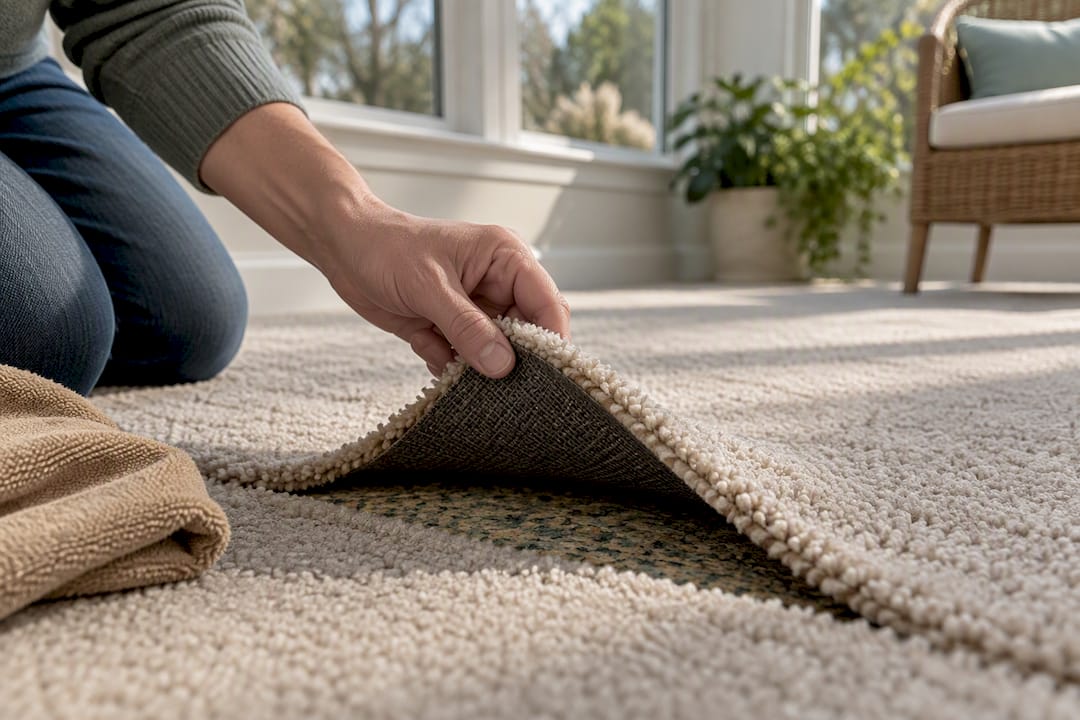
Run fans and a dehumidifier to shorten that window. High indoor humidity slows everything down, so a muggy back room will take longer than a bedroom with the air conditioning on.
If ripples are still sitting there once the carpet is truly dry, and especially if the backing feels soft, mushy, or you can see separation between layers, you’re not looking at a drying problem anymore. That’s a permanent installation or delamination issue, and it needs a professional.
3. Safe DIY steps to speed drying and try simple fixes
You’ve got a window to help things along without making anything worse. Here’s the order to work in:
- Extract standing water with a wet/dry vacuum, working from the center of the ripple outward so you’re not spreading anything.
- Lift damp edges where you can, propping them slightly so air can move underneath the carpet and pad.
- Point fans across the affected area and run a dehumidifier in the room, plus your HVAC system if the humidity allows it.
- Keep interior doors open for airflow, but manage exterior doors and windows based on outdoor humidity, since a muggy day outside won’t help you dry a damp room.
- Take photos of the ripple and the room now, before it dries, in case you need documentation for a cleaner’s warranty or an installer’s claim.
Pro Tip: Don’t try to stretch, tug, or “fix” a damp ripple by hand. Carpet set under tension while it’s still wet will often relax back into a wrinkle once it fully dries.
For a deeper look at drying technique and when dampness turns into a bigger problem, our guide on drying carpet within 48 hours walks through the same extraction and airflow steps in more detail.
4. Professional correction: what restretching involves and what to expect
A knee kicker is a hand tool. It’s fine for small touch-ups along an edge, but it can’t generate the tension a whole room needs. Professionals use a power stretcher instead, and for good reason.
The CRI’s restretching guidance calls for stretching carpet 1% to 1.5% in each direction, a level of tension a knee kicker simply cannot hold. Here’s what a proper restretch job looks like:
- The installer uses a power stretcher to pull the carpet taut in a controlled, measurable way
- Every connected room gets restretched together, not just the room with the visible ripple
- Skipping adjoining rooms just pushes the slack somewhere else, and the wrinkle reappears down the hall
- If the pad or adhesive has failed, restretching alone won’t hold, and partial replacement may be the more honest fix
Cost depends on square footage, how many rooms are connected, and whether the pad needs replacing too. A cleaner or installer who documents delamination before quoting a repair is doing you a favor.
5. How to prevent ripples in future: installation, padding, and cleaning best practices
Most of this comes down to decisions made before the carpet ever gets cleaned.
- Insist on power-stretch installation, not just a knee kicker, and ask your installer to confirm it in writing
- Choose pad thickness and density that match CRI-104 and CRI-105 standards for your carpet type
- Hire IICRC-trained cleaners who know how to avoid over-wetting during extraction
- Keep foot traffic light for 24 to 48 hours after installation or any adhesive work
- Vacuum on a regular cadence, since built-up dust and debris hold moisture longer and slow drying after any cleaning
| Prevention step | Why it matters |
|---|---|
| Power-stretch installation | Meets CRI tension standards and resists rippling from moisture |
| Correct pad thickness | Reduces dimensional instability under the carpet |
| IICRC-trained cleaner | Limits over-wetting during extraction |
| Regular vacuuming | Cuts dust buildup that traps moisture |
If you’re vetting a cleaner or installer before you hire one, our piece on what to ask before you book covers the questions that separate a careful crew from a rushed one. For a home improvement angle on how moisture moves through a house in the first place, how insulation controls moisture is worth a look too.
6. How Home Service Simple handles ripples and drying on the job
This company runs deep steam extraction, which pulls water back out of the carpet as part of the same pass rather than leaving it to soak. That approach limits how much moisture ever reaches the backing in the first place.
If a technician spots a ripple that was already there before cleaning, or one that shows up during the job, they’ll flag it and explain whether it looks like a drying issue or something that needs a certified installer for a restretch. Every job comes with a satisfaction guarantee, and honest pricing means you’re told upfront if a problem is outside the scope of cleaning.
7. What I tell homeowners about ripples every time
Here’s my rule of thumb: wait 48 hours unless you’re dealing with contaminated water or a safety issue, in which case don’t wait on anything.
If the ripple is still there once everything is bone dry, take pictures, note the date, and call whoever cleaned or installed the carpet. A good cleaner will tell you straight if it’s a drying issue or an installation flaw, because those are two different problems with two different fixes.
Sometimes replacement really is the smarter move. If the backing has delaminated in more than one spot, or the pad has broken down in a room with a history of moisture, restretching is a patch on something that’s already failing. Spend the money once instead of twice.
— chris
Book a cleaning that won’t leave you guessing
Home Service Simple runs deep steam extraction built to pull moisture back out instead of leaving it to sit, which is exactly the kind of over-wetting that turns a small ripple into a bigger headache. We handle carpet cleaning, area rug cleaning, and upholstery work across our service area, backed by a satisfaction guarantee on every job.

If you want cleanings on a set schedule instead of remembering to book one, the Simple Club membership covers that: the Standard Membership runs $20 a month and the Premium runs $40 a month, both through the Simple Club plans. Ready to get on the schedule? Book your carpet cleaning and let us handle the extraction the right way the first time.
Sources
- Guidance for Restretching to Remove Buckles, Wrinkles, and Bubbles
- IICRC consumer floor and furnishings care information (carpet topics)
- EPA mold course chapter 4: drying and remediation basics
FAQ
Do carpet ripples go away on their own?
Many do, once the carpet fully dries, because the ripple was caused by moisture temporarily swelling the backing. If it’s still there after the carpet is completely dry, the ripple is likely tied to an installation or adhesive problem and won’t resolve without a professional restretch.
How do you get ripples out of carpet without a stretcher?
You really can’t get a lasting fix without one. A power stretcher is needed to apply the 1% to 1.5% tension required to hold the carpet flat, and hand tools like a knee kicker can’t produce or hold that much tension.
How many times can you restretch carpet?
There’s no fixed limit, but each restretch depends on the backing and pad still being in good enough shape to hold tension. If the backing has delaminated or the pad has broken down, restretching stops being a durable fix and replacement becomes the more practical option.
How do you fix carpet that’s lumpy after it’s already installed?
Lumps usually point to pad problems or shifted carpet rather than a simple wrinkle, and the fix is the same kind of professional restretch used for ripples. A trained installer will check the pad and backing condition first, since restretching alone won’t hold if the pad underneath has failed.