

Scrape or vacuum off the dried wax first, then either transfer-melt it with warm paper for tough synthetic carpet or freeze-and-scrape it for delicate fibers, and finish by treating any leftover residue with a diluted detergent or safe solvent before rinsing thoroughly. Pretest any cleaner on a hidden patch of carpet before you touch the stain itself. If your carpet is wool, an unknown fiber, showing dye transfer, or the spill is large, stop and call a professional instead of pushing through with more product.
TL;DR:
- Scraping and mechanically removing the hardened wax is essential before applying heat, solvents, or other cleaning methods.
- Freezing wax with ice is safer for delicate fibers, wool, or unknown carpet types, but it takes longer than heat transfer.
- Using an iron and paper is effective on synthetic, heat-tolerant carpets but risks damaging fibers if not carefully monitored.
- Post-mechanical removal, a diluted detergent or solvent must be used carefully, with thorough rinsing to prevent re-soiling from residue.
- When dealing with large spills, wool, dye transfer, or persistent stains after DIY attempts, professional cleaning with hot water extraction is recommended.
Table of Contents
- How Do You Get Wax Out of Carpet?
- How to Remove Wax With the Iron and Paper Method
- When Should You Freeze Wax Instead of Melting It?
- How Do You Remove Wax Residue Without Damaging the Carpet?
- What Carpet Fibers Need Special Wax Removal Care?
- When Should You Call a Professional Instead of DIY?
- Fast Prevention and a 90-Second Cleanup Checklist
- What Twenty Years of Carpet Stains Teaches You About Wax
- When It’s Time to Bring in a Professional Carpet Cleaner
- Sources
- FAQ
How Do You Get Wax Out of Carpet?
Three approaches cover almost every wax spill you’ll face, and picking the right one comes down to two questions: how set is the wax, and what’s the carpet made of?
- Scrape first, always. Let wax harden completely, then lift the bulk off with a spoon edge or plastic scraper before anything else touches the carpet.
- Heat transfer. Best for colorfast, heat-tolerant synthetic carpet. Paper absorbs melted wax when warmed with an iron or hairdryer.
- Freeze and scrape. Best for delicate, unknown, or wool-blend fibers where heat is risky. Ice hardens the wax so it snaps off in chips.
- Solvent or detergent cleanup. A secondary step for whatever residue remains after mechanical removal, per CRI’s spot-solver guidance.
Skip steam cleaners and direct iron contact on the carpet itself. Both push wax deeper into the pile instead of pulling it out. Keep any room ventilated when solvents are in play, and never soak the carpet. Excess moisture is what turns a ten-minute stain into a callback to your cleaning crew.
How to Remove Wax With the Iron and Paper Method
This is the go-to move for synthetic, heat-tolerant carpet with a straightforward wax spill and no dye bleeding.
- Scrape off every bit of hardened wax you can lift with a spoon or dull knife.
- Lay a sheet of brown kraft paper or a plain white paper towel directly over the remaining wax.
- Set your iron to low or warm, with steam turned off completely.
- Press the iron on the paper for two or three seconds, then lift and check.
- Move to a clean, dry section of paper and repeat until no more wax transfers.
- Vacuum the area once it’s fully cool.
You’ll need brown kraft or butcher paper (plain paper towels work in a pinch), a low-heat iron, a few clean cloths, and a vacuum. UGA Extension backs this exact blot-and-transfer sequence, with one big caveat: it’s not safe on every fiber.
If the wax starts spreading instead of lifting, or the carpet fibers feel different under your hand, stop immediately. That’s a sign of heat damage, not a slow transfer. And if a colored ring remains after the wax itself is gone, don’t reach for something stronger. Move to the solvent guidance below and pretest before you touch it.
Pro Tip: Keep sliding to a fresh patch of paper every single time. Reusing warm, wax-loaded paper just presses the mess back into the carpet instead of pulling it out.
When Should You Freeze Wax Instead of Melting It?
Freezing is the safer default any time you’re unsure about the carpet fiber, dealing with wool, or working with a carpet you can’t afford to risk on heat.
Fill a plastic bag with ice cubes, or use a gel ice pack, and set it directly on the wax for several minutes until it turns brittle and pale. Lift the chips with a plastic spoon or the dull edge of a spatula, working gently so you don’t tug or flatten the pile underneath. Vacuum up every fragment, then move on to spot treatment for whatever thin residue remains.
You’ll want:
- An ice pack or bag of ice cubes
- A plastic spoon or spatula
- A vacuum with a hose attachment
- A few absorbent cloths for cleanup
This method takes longer than heat transfer, but it eliminates any risk of scorching, melting, or discoloring fibers you’re not 100% sure about. If the wax has soaked into a thick or high-pile carpet, work in small sections rather than trying to freeze the whole spill at once. Pressing too hard while scraping can crush the pile and leave a flat spot that outlasts the stain itself.
How Do You Remove Wax Residue Without Damaging the Carpet?
Once the bulk of the wax is gone, you’re usually left with a faint, greasy shadow. That residue is what causes most of the long-term damage people blame on “wax stains.”
CRI recommends a detergent solution of a quarter teaspoon of liquid dish detergent per cup of lukewarm water. That’s a deliberately weak mix. Stronger concentrations leave behind a sticky film that attracts dirt and causes the exact rapid re-soiling you’re trying to avoid.
Apply the solution to a clean cloth, never directly onto the carpet, and blot from the outer edge of the stain toward the center. Rubbing spreads the stain and can fray fibers; blotting lifts it. For any wax dye that won’t budge with detergent alone, rubbing alcohol diluted with water or a nonflammable dry-cleaning solvent applied the same way, cloth first, can help, though you should always pretest.
- Work in light passes. Two or three gentle applications beat one heavy soak.
- Rinse with plain water on a clean cloth after every treatment to pull the detergent back out.
- Wear gloves and keep the room ventilated when using solvents.
- Never let liquid reach the carpet backing. Over-wetting invites mold and pad damage.
According to the IICRC’s consumer guidance, visible wax removal isn’t the same as complete removal. Leftover residue you can’t see often surfaces days later as a darker, dirtier patch, which is exactly why the rinse step matters as much as the cleaning step.
What Carpet Fibers Need Special Wax Removal Care?
Check the carpet’s care tag or ask your landlord or installer for the fiber type before you commit to a method. Wool, wool blends, acrylic, and modacrylic all react differently to heat and chemicals than standard nylon or polyester.
- Wool: Skip heat entirely and avoid heavy wet cleaning. WoolSafe recommends identifying fiber composition first and leaning on freezing or professional low-moisture cleaning instead.
- Acrylic and modacrylic: These fibers can distort or melt under an iron, so UGA Extension flags heat transfer as unsafe here.
- Unknown or delicate blends: When in doubt, freeze first and pretest any cleaner on a hidden corner, checking after ten minutes for color change or fiber damage.
- Colored wax: If a dye halo remains after the wax is gone, stop before reaching for stronger chemicals. On light-colored or high-value carpet, that’s the moment to call a professional rather than gamble on a fix that could set the stain permanently.
If you’re dealing with a viscose or viscose-blend area rug rather than wall-to-wall carpet, treat it even more cautiously. Fiber-care guidance for viscose points out that these fibers weaken significantly when wet, which makes freezing and light blotting far safer than any solvent step.
When Should You Call a Professional Instead of DIY?
A few warning signs mean it’s time to stop experimenting and pick up the phone.
- Colored wax has left a dye halo that persists after mechanical removal.
- The spill is large, deep, or has soaked through to the carpet pad.
- The carpet is wool or you genuinely can’t identify the fiber.
- You’ve already tried one or two DIY passes without success.
- You’re seeing signs of backing damage, like a musty smell or a soft, spongy feel underfoot.
Professionals follow a sequence built on IICRC and IWTO standards: inspection and fiber identification, targeted pretreatment, hot water extraction or a low-moisture restorative clean for sensitive fibers, then a thorough rinse to pull out every trace of residue before controlled drying. That rinse step is exactly what most DIY attempts skip, and it’s why a spot that looked “clean” on day one comes back dirtier by day five.
Fast Prevention and a 90-Second Cleanup Checklist
The best wax removal is the one you never have to do. Use dripless candles, sturdy holders, and trays under anything with an open flame near carpeted rooms.
Keep a small kit on hand: a sheet or two of brown kraft paper, a few absorbent cloths, a gel ice pack, and a blunt plastic scraper.
The moment wax spills, work fast:
- Pick up any loose solid wax by hand or with the scraper.
- Ice it if the carpet is delicate or unknown, or cover it with paper and apply low heat if it’s sturdy synthetic.
- Vacuum up all chips and paper residue.
- Save detergent or solvent treatment for once the bulk is fully gone.
What Twenty Years of Carpet Stains Teaches You About Wax
Most people treat a wax spill like an emergency that needs an immediate chemical answer. It doesn’t. It needs patience, in the opposite order most people reach for.
The instinct is to grab a spray bottle and start scrubbing while the wax is still soft. That’s precisely backward, and it’s the single biggest reason wax stains turn into permanent ones. Wax that’s still warm just smears deeper into the pile when you attack it with liquid. Every credible source on this, from CRI to UGA Extension, agrees on the same sequence: let it harden, remove it mechanically, and only then think about chemistry.
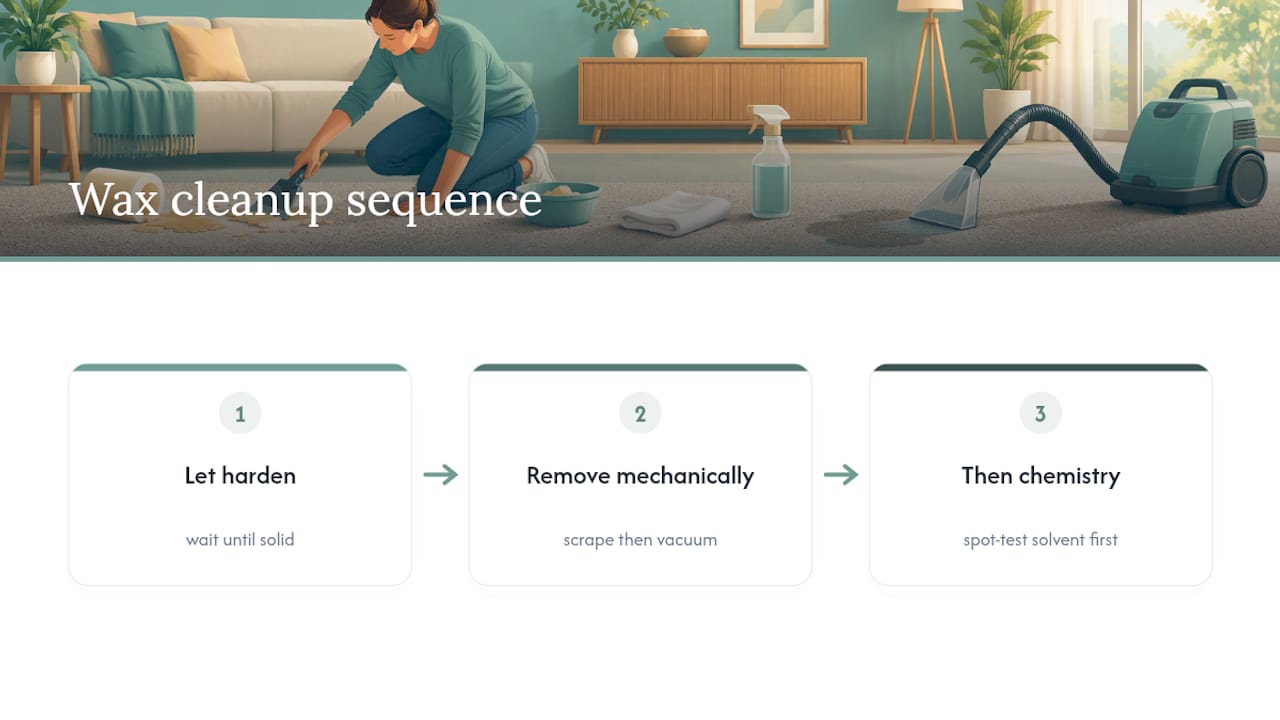
What people underestimate is the rinse step. DIYers treat the stain like it’s solved the moment the wax is visibly gone, but a detergent film left behind will pull dirt back into that exact spot within days. That’s not a wax problem anymore. It’s a residue problem, and it’s the reason a “successful” DIY fix sometimes looks worse a week later than the original spill did.
For related fast-acting fixes, nail polish spills and paint spots follow the same mechanical-first logic. Home Service Simple’s Simple Club exists precisely because carpet care compounds. A well-maintained carpet handles an occasional wax spill far better than one that’s overdue for a deep clean.
— chris
When It’s Time to Bring in a Professional Carpet Cleaner
Professional carpet cleaning is the option Wichita homeowners can consider when a wax spill outpaces what a spoon, an iron, and a bottle of dish soap can fix. Large spills, wool carpet, dye transfer, or a stain that’s already been through two failed DIY rounds all call for the same thing: hot water extraction and a real rinse cycle, not another round of guesswork.
Some professional carpet cleaning services offer a satisfaction guarantee, so you are not gambling on the outcome. If wax spills, pet accidents, or general wear keep showing up on your calendar more often than you’d like, some subscription cleaning plans handle it on a schedule instead of leaving you to remember every time. Book a carpet cleaning appointment and let a crew that does this daily finish the job your DIY kit started.
Sources
- UGA Extension — Remove stains from candle wax
- WoolSafe — The cleaning and maintenance of wool carpets (2020)
- IICRC — Consumer floor and furnishings care information (Tip Sheet)
- IWTO — Wool carpet care and maintenance guide (2024)
FAQ
Does Wax Come Off Carpet Completely?
Yes, in nearly every case, as long as you remove the solid wax mechanically before treating what’s left. The visible wax usually lifts easily, but according to the IICRC, thin residue can remain hidden and cause the spot to re-soil faster unless you rinse thoroughly.
Will Dawn Dish Soap Get Wax Out of Carpet?
A small amount of liquid dish detergent, diluted to roughly a quarter teaspoon per cup of lukewarm water per CRI’s guidance, helps break down leftover wax residue after the bulk has been scraped off. It won’t remove solid wax on its own, and using it too strong leaves a sticky film that attracts more dirt.
What Dissolves Dried Wax?
Dried wax responds best to mechanical removal first, either scraping it off after freezing or melting it into paper with gentle heat. For any residue left behind, diluted rubbing alcohol or a nonflammable dry-cleaning solvent applied to a cloth, never poured directly on the carpet, handles what scraping can’t.
How Do You Get Dried Wax Out of Carpet Without an Iron?
Freeze the wax with an ice pack or bag of ice until it turns brittle, then lift the chips with a plastic spoon or spatula and vacuum thoroughly. This method works well on any fiber where heat feels risky, including wool and unknown blends, and it’s the method UGA Extension recommends when heat transfer isn’t an option.