

Smoke smell in carpet is one of the toughest odors to beat, because carpet is built to hold on to things. The short version: open the house up, sprinkle on baking soda, vacuum with a HEPA filter, then wash the fibers. If the smell is still there after two honest tries, the smoke has settled deeper than a household product can reach, and it’s time for hot, deep steam cleaning. Here’s how to tell which situation you’re in, and what to do about it.
TL;DR
- Smoke is gas plus tiny particles. The gas soaks into carpet fibers and the particles settle on top, so surface sprays only mask the problem.
- Start with fresh air, baking soda left on for at least 2 hours (overnight is better), and slow vacuuming with a HEPA-equipped vacuum.
- Skip ozone generators and don’t mix cleaning products. Keep pets and kids off treated areas until they’re dry.
- If the smell returns after two rounds, or the smoke came from a fire or years of indoor smoking, call a professional.
- Carpet pad and subfloor can hold smoke too. That’s often why an odor “comes back” on a hot day.
Table of Contents
- Why smoke smell hangs on in carpet
- Figure out what kind of smoke you’re dealing with
- Round one: air, baking soda and a good vacuum
- Round two: wash the residue, don’t just perfume it
- What not to do
- DIY or professional: a quick comparison
- When it’s time to call a professional
- What deep steam cleaning does that DIY can’t
- Don’t forget the car
- Our take: stop chasing the smell
- FAQ
- Sources
Why smoke smell hangs on in carpet
Think of carpet like the infield dirt at a Saturday ballgame. It looks fine until somebody kicks it up, and then you realize how much has been sitting down in there. Carpet fibers, backing and pad make a huge, soft, porous surface, and smoke loves it.
Here’s what’s going on. Smoke is made of gases and particulate matter. According to FEMA’s guide to smoke damage in homes, soot and ash particles settle on surfaces, while the gases absorb into porous materials like carpet. The same guide notes that smoke exposure can cause respiratory irritation and worsen asthma. So this isn’t only about a nasty smell. For a family with allergy or asthma concerns, it’s about the air your kids breathe at floor level.
Then there’s the long game. The Thirdhand Smoke Resource Center explains that thirdhand smoke is chemical residue that lingers for months on surfaces like carpet, turning them into reservoirs of pollutants that are hard and expensive to remove. The same source warns that unless those reservoirs, including carpet backing and subflooring, are dealt with, odors and pollutants can be released again over time.
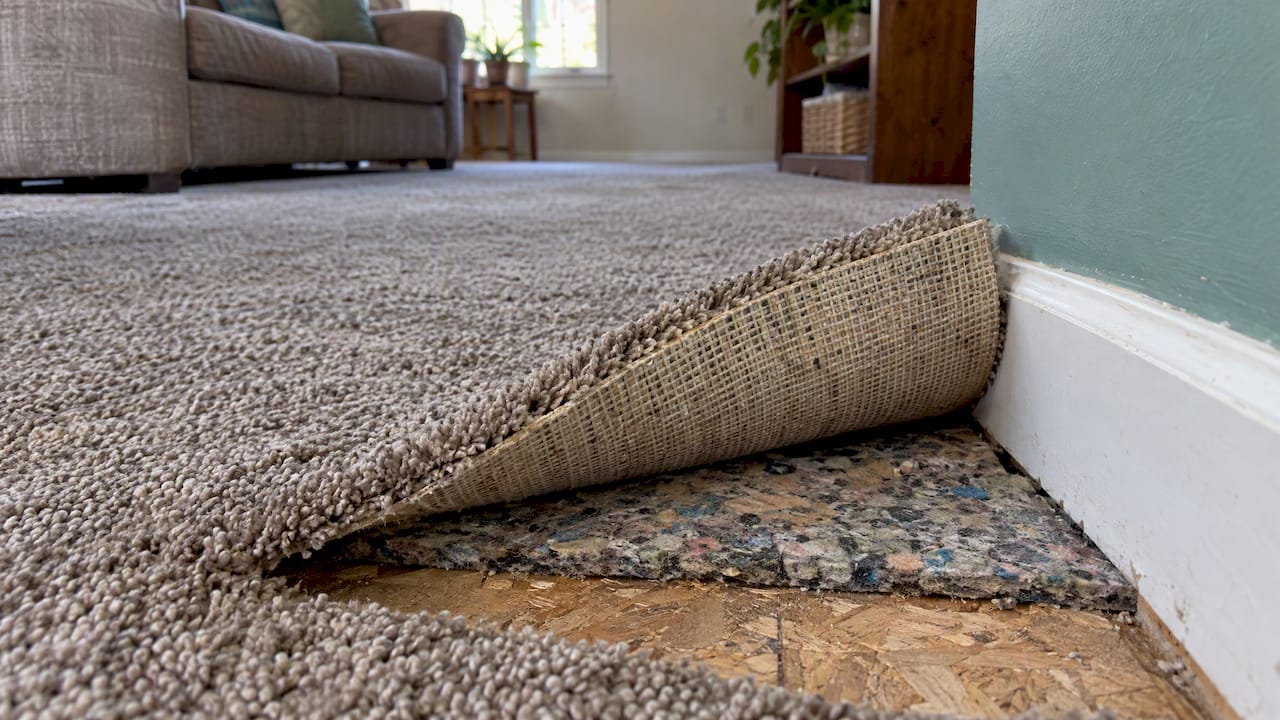
That’s the answer to “I cleaned it and it still smells.” You probably cleaned the top. The smell lives lower down.
Figure out what kind of smoke you’re dealing with
Not all smoke smell is the same, and the fix depends on the source. Quick sort:
- Cigarette or cigar smoke. Usually years of slow buildup. Light, sticky residue on everything: carpet, walls, curtains, the couch. Often the worst for carpet because it layers up over time.
- A kitchen fire or burnt-food incident. Heavy, sharp odor, often localized to one room and the rooms next to it.
- Wildfire or grass-fire smoke. Common on the Kansas plains in burn season. The smell comes in through doors, windows and the HVAC system and settles on soft surfaces.
- A house fire, even a small one. Soot, often oily, and often a smell that spreads through ducts and into every room.
- Fireplace or wood-stove backdraft. Usually mild and local, and the easiest to fix.
Why does it matter? Mild, recent smell can often be solved with the DIY steps below. Heavy soot, an oily film, or years of smoking is a different job. If you see dark smudges or greasy-looking marks, hold off on scrubbing. Rubbing oily soot into carpet can turn a small problem into a big one, and we cover that in our guide to soot stains on carpet.
Round one: air, baking soda and a good vacuum
Before you buy anything, do the free stuff. It works better than most people expect on light odors.
Ventilate first
Open windows, run fans pointed outward, and get air moving through the house. The Spruce lists ventilation as a key step in diluting and clearing smoke odors, using fans to push air to the outdoors. If it’s smoky outside, wait for a cleaner-air day. Opening up on a smoky day just invites more in.
Baking soda, then wait
- Vacuum the carpet first to pull up loose soot and dust.
- Sprinkle baking soda generously over the whole area, not just the spot that smells worst.
- Leave it. Bob Vila’s guide says baking soda needs at least 2 hours, preferably overnight, to absorb odors before you vacuum it up.
- Vacuum slowly in two directions. This Old House recommends a HEPA-equipped vacuum for this step, which helps keep fine particles from blowing right back into the room.
Empty the canister or change the bag outside when you’re done. Otherwise you’ve just moved the smell from the carpet to the vacuum, and then back to the carpet.
Repeat once
Baking soda is not a one-shot miracle. A second application the next day is reasonable for moderate odors. If you’ve done two rounds and the room still smells like an ashtray on a warm afternoon, stop and read the pro section below. More baking soda won’t fix a problem sitting in the pad.
Round two: wash the residue, don’t just perfume it
Smoke leaves residue, and residue needs to be cleaned off, not covered up. The Thirdhand Smoke Resource Center says that frequent HEPA vacuuming and washing surfaces with acidic solutions like white vinegar or alkaline cleaners can help reduce accumulated smoke residue. For carpet, the CDC’s general guidance for soft surfaces is to use a product with soap, detergent or another cleaner appropriate for the surface and to vacuum carpets and rugs.
In practice:
- Test first. Try any solution on a hidden corner, like inside a closet. Some dyes bleed, and some wool or natural-fiber carpets don’t like acid.
- Go light on the liquid. A damp cloth or a lightly misted solution beats soaking. Wet carpet that stays wet creates a different smell, and you can read about that in our post on musty carpet smell.
- Blot, don’t scrub. Scrubbing frays fibers and pushes residue down.
- Dry it fast. Fans and open windows. Don’t walk on it until it’s dry.
Pets and kids: read this part twice
Many of us in Wichita have a dog on the couch and a toddler on the floor. The CDC cautions that cleaning products can cause serious harm if misused, and its guidance says to never mix products or chemicals, never apply disinfectants directly to pets, and to wear the protective equipment listed on the product’s Safety Data Sheet. That means:
- Vinegar and bleach never go in the same bucket.
- Keep pets and kids out of the room while you treat and until the carpet is fully dry.
- Don’t spray anything on your pet to “help” with the smoke smell on its fur. Bathe the pet with a pet-safe shampoo instead.
There’s a good reason to be thorough with the floor, too. CDC and NIOSH researchers have noted that skin contact with surface residues like nicotine may be a primary route of exposure for children, which can’t be fully explained by breathing or dust ingestion alone. Little ones crawl, roll and play on carpet. That’s reason enough to treat the floor as more than a cosmetic problem.
If your carpet smell involves pet accidents on top of smoke, we have a separate guide on carpet deodorizing for pet owners.
What not to do
A few things that look helpful and aren’t.
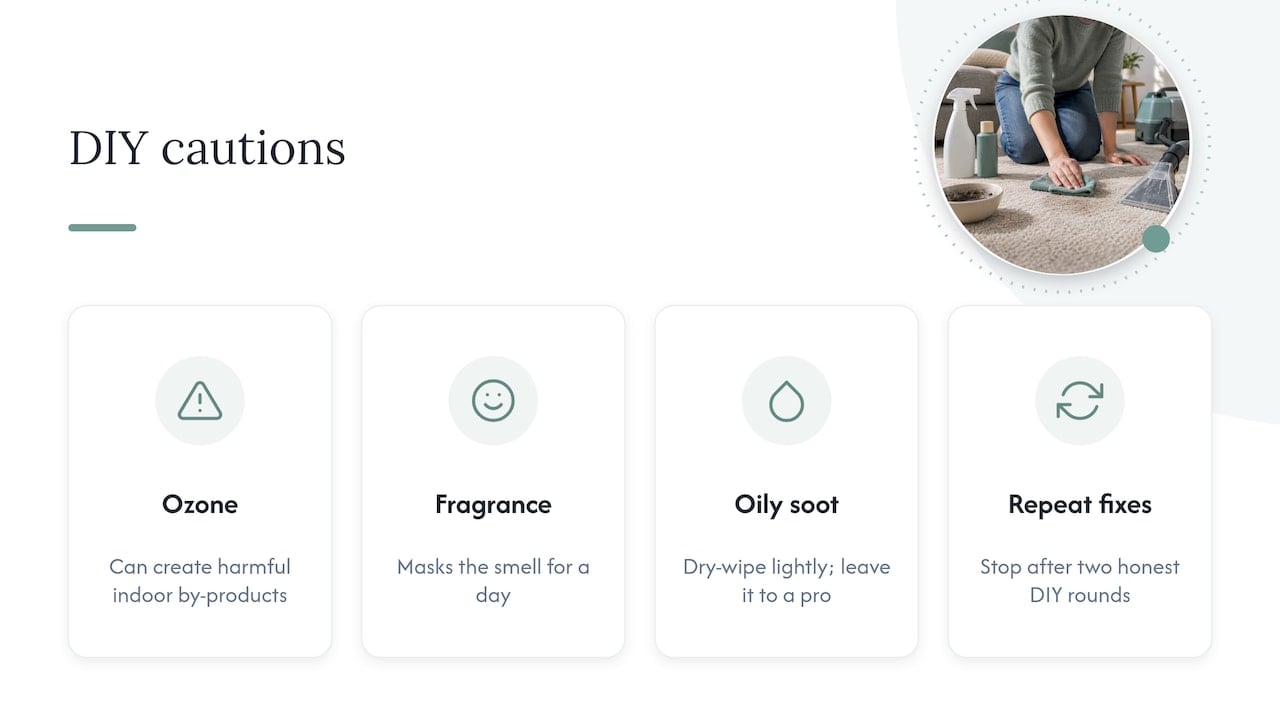
Don’t rent or buy an ozone generator. They’re sold as odor killers, but the EPA says ozone generators are generally ineffective at removing odors at safe concentrations and can create harmful by-products when ozone reacts with chemicals indoors. The EPA also points out that source control is the most effective way to cut indoor air pollution, followed by ventilation and air cleaning. Source control here means getting the smoke residue out of the carpet.
Don’t just add fragrance. Plug-ins, sprays and scented powders mask the smell for a day. They don’t remove anything, and now you have smoke plus lavender.
Don’t rub oily soot. If you can see a greasy film, dry-wipe lightly and leave it for a professional.
Don’t keep repeating the same fix. Our rule at the shop is two honest DIY rounds. After that you’re guessing, and the smell is telling you something. Our walkthrough on stopping carpet odors for good explains the same two-round idea in more detail.
DIY or professional: a quick comparison
| Situation | DIY is a fair try | Call a pro |
|---|---|---|
| Light, recent smell (a few days of smoke drift) | Yes: ventilate, baking soda, HEPA vacuum | Only if it lingers |
| Moderate odor, one room | Two rounds with baking soda and a surface-safe cleaner | If it returns after round two |
| Years of indoor smoking, rental or home you just bought | Not likely to be enough | Yes |
| Fire or heavy soot, visible film | No: avoid rubbing it in | Yes, and consider the pad and ducts |
| Smell worse on hot or humid days | Won’t reach the source | Yes: the backing or pad may hold residue |
| Anyone in the home with asthma or allergies | Helpful as a first step | Strongly consider it |
When it’s time to call a professional
This is the honest part. Sometimes carpet can’t be rescued with a box of baking soda.
InterNACHI’s tobacco odor guidance goes further than most: it recommends removing carpeting, since it’s nearly impossible to remove smoke particles from carpet, and says that if you can’t replace it, have it professionally cleaned. The American Cleaning Institute adds that smoke odors may require more than one cleaning and suggests seeking cleaners who specialize in smoke odor removal for items you can’t wash.
So call someone when:
- You’ve done two rounds and the smell is still there or keeps coming back.
- The smoke came from a fire, not just a smoker.
- The carpet has years of smoking in it.
- Someone in the house has asthma or serious allergies.
- You’re about to move in, or list the house, and the smell is the first thing people notice.
A note on what “professional” means for fire and smoke work. The restoration industry has a written standard: the ANSI/IICRC S700 Standard for Fire and Smoke Damage Restoration, published in 2025, covers assessing smoke residue and odor management, including restoration cleaning. It describes assessing the intensity of impact and the boundaries of fire residues, with standardized procedures. That matters for big fire losses, where a restoration company and your insurance may be involved. For everyday smoke smell in a living room, a deep carpet cleaning is often the right next step, and we’ll tell you straight if your situation needs more than we offer.
What deep steam cleaning does that DIY can’t
Here’s what we do on a smoke-smell job at Home Service Simple. We specialize in deep steam cleaning, which flushes dirt, allergens and odors out of carpet instead of just treating the surface, and it doesn’t leave a sticky residue behind. Sticky residue matters: leftover soap attracts new dirt and can hold odor molecules right where you don’t want them.
Big picture, a pro-grade extraction does three things you can’t match with a household vacuum and a spray bottle:
- Reaches deeper. Hot water and strong extraction pull contaminants from down in the fibers.
- Removes instead of masks. The dirty water goes into the machine, not back into the carpet.
- Dries faster. Controlled moisture means less risk of a damp, musty smell replacing the smoke.
If the odor lives in the pad or subfloor, no surface cleaning solves it entirely. We’ll tell you that during the visit rather than sell you a clean that won’t hold. That’s the honest-pricing, satisfaction-guarantee approach we try to live by.
Book a carpet cleaning
If you’re in Wichita or nearby and your carpet smells like smoke, our carpet cleaning service is the place to start. Call or text for a free quote and tell us where the smoke came from, how long ago, and what you’ve already tried. That saves everyone time.
A smoky carpet is rarely the only soft surface affected. Couches, chairs and mattresses soak up smoke too, so ask about upholstery cleaning and mattress cleaning in the same visit. If the smoke came through the vents, air duct cleaning may belong on the list as well.
Want to keep things fresh after the big clean? Our Simple Club memberships run $20 per month for Standard and $40 per month for Premium, and they save you from rescheduling every time.
Don’t forget the car
Smoke gets into vehicle carpet and upholstery the same way it gets into your living room, and the same order of steps applies: clean the surfaces first, then deal with the air. This guide to removing smoke odor from a car walks through deep cleaning the interior before treating the ventilation system, which is the right sequence for floor mats and carpet too.
Our take: stop chasing the smell
I’ve been cleaning carpet in Wichita long enough to know how this goes. Somebody calls, a little embarrassed, and says they’ve tried everything. Candles. Sprays. Three boxes of baking soda. The smell is still there, and now the room smells like smoke and vanilla.
Here’s what we tell them. The smell isn’t the problem. It’s a signal. Smoke is a residue, and residue lives in the carpet, the pad, and sometimes the air ducts. You can’t cover it, you have to get it out.
So here’s how we’d do it in your house:
- Open it up and let air move.
- Do the baking soda and the HEPA vacuum properly. Overnight, not 20 minutes.
- Wash gently, test first, keep the pets and kids out.
- Give it two real tries. Not ten.
- Then call someone who can pull the dirt out with hot extraction, and who’ll be honest if the pad needs to go.
We stand behind our work with a satisfaction guarantee, and we’d rather tell you what you need than sell you something you don’t. Like a good coach, we’d rather you win the game than pad our stats.
CALL OR TEXT FOR A FREE QUOTE. We’ll take a look, and we’ll tell you straight.
— chris
FAQ
How long does smoke smell stay in carpet?
Without cleaning, it can last for months or longer. The Thirdhand Smoke Resource Center describes smoke residue lingering for months on surfaces like carpet. If the carpet backing or pad holds residue, odor can be released again later, so fading is not the same as gone.
Does baking soda really get smoke smell out of carpet?
It helps with mild odors. Sprinkle it on, leave it at least 2 hours (overnight is better), then vacuum thoroughly. For heavy or old smoke, baking soda alone usually won’t be enough, because it only works on what it can touch at the surface.
Can steam cleaning remove cigarette smoke smell from carpet?
Often, yes, especially when the carpet is the main source and the pad hasn’t been soaked. Deep steam cleaning pulls out residue rather than masking it. Heavy, long-term smoking may need more than one cleaning, and in some homes the carpet and pad are better replaced.
Are ozone machines safe to use for smoke odor?
The EPA says ozone generators are generally ineffective at safe concentrations and can create harmful by-products indoors. Putting in the work to remove the residue from the carpet is the safer and more reliable route.
Sources
- FEMA: Homeowner’s Guide to Risk Reduction and Remediation of Residential Smoke Damage
- Thirdhand Smoke Resource Center: How can I remove thirdhand smoke from my home?
- The Spruce: How to Get Rid of Smoke Smells in Your Home
- Bob Vila: How to Get Smoke Smell Out of Your House
- This Old House: How To Get Smoke Smell Out of Your House
- CDC: When and How to Clean and Disinfect a Facility
- CDC/NIOSH: Assessment of the Contribution of Indoor Surface Residues
- US EPA: Ozone Generators that are Sold as Air Cleaners
- InterNACHI: Tobacco Odor Removal
- American Cleaning Institute: Ask ACI, Cigarette and Tobacco Smoke Smell
- IICRC: New Standard Published, ANSI/IICRC S700