

Vacuum the dry salt crystals first, mist with a diluted white vinegar solution and blot, then rinse with plain water and extract every drop of moisture before you let a fan finish the job. That order matters more than any product you buy. Skip the rinse and you’ll be back here in a week staring at the same white haze. If the stain has been sitting for two weeks or the padding underneath feels damp, stop and call Home Service Simple instead of making it worse.
TL;DR:
- Rinsing with plain water after vinegar treatment is essential, as skipping this step causes stains to reappear within days due to residual dissolved salt.
- For deposits older than two weeks or if the padding feels damp, professional deep extraction is necessary to prevent mold, delamination, and permanent damage.
- Common household vacuums and handheld extractors often fail to remove residual salt, making professional equipment vital for thorough cleaning and preventing recurrence.
- Use a vinegar solution diluted more for delicate carpets and always test an inconspicuous area before treatment, especially on dyed or natural fibers.
- Prevent salt buildup by using entry mats, no-shoe policies, and regular vacuuming during winter, reducing the need for more aggressive cleaning methods later.
Table of Contents
- How to Remove Salt Stains From Carpet Step by Step
- What You Need Before You Start
- How Do You Prevent Salt Stains on Carpet?
- When Should You Call a Professional Carpet Cleaner?
- Not All Salt Stains Are the Same
- Can Salt Damage Carpet Fibers Permanently?
- Do Baking Soda and Other Home Remedies Actually Work?
- How Do You Know If Your Salt Stain Needs a Bigger Fix?
- Why Most Salt Stains Come Back the Same Way
- Ready to Let a Pro Finish the Job?
- Sources
- FAQ
How to Remove Salt Stains From Carpet Step by Step
Salt stains on carpet aren’t really “stains” in the way spilled coffee is a stain. They’re mineral deposits, mostly sodium chloride or calcium chloride from ice melt, left behind after the water carrying them evaporates. That’s why scrubbing with a wet rag often makes things worse instead of better. You’re not lifting a stain. You’re trying to dissolve crystals and pull them back out before they lock into the fibers.
Here’s the sequence that actually works, in the order that actually matters.
-
Blot up any wet slush first. If someone just tracked in a slushy mess, press dry towels into the spot to soak up as much liquid as you can before it evaporates and leaves salt behind. Don’t rub. Just press and lift.
-
Let the area dry, then vacuum thoroughly. This step gets skipped constantly, and it’s the one that causes the most trouble. Vacuuming before any liquid touches the spot is critical, because wetting dry salt crystals first turns them into brine that soaks deeper into the padding instead of coming out. Run the vacuum in overlapping strokes, spending ample time per patch, on a suction-only setting if your machine has one.
-
Mix your vinegar solution. Combine white distilled vinegar and warm water in roughly equal parts for moderate staining, or dilute slightly more for delicate or lightly dyed carpets. The Spruce recommends this basic ratio for most household salt stains, and it works because vinegar’s mild acidity breaks down the alkaline mineral residue that plain water can’t touch.
-
Mist, don’t soak. Load the solution into a spray bottle and mist the stained area lightly. You want the fibers damp, not saturated. Over-wetting is how salt migrates into the pad and comes back to haunt you later.
-
Agitate gently. Work a soft nylon brush into the pile at roughly a 45-degree angle using short, gentle circular motions. You’re loosening crystals from the base of the fibers, not scrubbing a scuff mark off a shoe. A few seconds per spot is enough.
-
Blot with microfiber cloths. Press straight down, hold for a couple of seconds, and lift. Rotate to a clean section of cloth often. Once a cloth is loaded with dissolved salt, wiping with it just redeposits residue elsewhere on the carpet.
-
Rinse with plain cold water. Mist clean water over the treated spot and blot again. This step exists purely to flush out the vinegar and dissolved salt you just loosened. Skipping it is the single biggest reason salt stains reappear days later as a dull white ring.
-
Extract everything you can. A wet-dry vac or a rental carpet extractor pulls out the moisture, dissolved salt, and leftover cleaner in one pass. If you don’t have one, press dry towels down hard and repeat until they come up mostly dry. Chemical Guys stresses that thorough extraction, not just wiping, is what actually stops the residue from returning in vehicle carpet and floor mats.
-
Dry the area fast. Point a fan at the spot, run a dehumidifier if you have one, and keep foot traffic off it until it’s completely dry to the touch. Slow drying invites mildew and gives leftover salt a chance to wick back to the surface as the water evaporates.
-
Repeat if needed. Stubborn or older deposits often need two or three light treatment cycles rather than one aggressive one. Always test your vinegar mix on a hidden corner first, especially on wool or dyed carpet, before treating the visible area.
Pro Tip: Never use hot water on a fresh salt stain. Heat can set certain dyes and, on some carpets, actually accelerates how deep the salt migrates into the backing before you get a chance to extract it.
What You Need Before You Start
Gathering the right supplies before you touch the stain saves you a second trip to the closet mid-job, and it keeps you from reaching for something that’ll damage the carpet.
- A vacuum with a suction-only setting (skip the beater bar on delicate fibers)
- White distilled vinegar and a spray bottle for mixing your solution
- Several microfiber towels, plus extras once the first few gets loaded with residue
- A soft nylon brush for gentle agitation
- Plain water for the rinse step
- A wet-dry vac or a rented carpet extractor for pulling out moisture
Household steam cleaners and handheld extractors work fine for a single spot in a living room or a car’s floor mats. For a whole hallway or a room where salt has tracked in for weeks, a rented upright extractor with stronger suction will outperform a handheld unit every time, and it dries faster too.
Wool, silk, and other natural fibers need a gentler touch. Dial back your vinegar ratio, skip the brush entirely if the pile feels delicate, and always test an inconspicuous corner before treating the visible stain. Dyed carpets deserve the same caution. Avoid hot water, avoid alkaline cleaners like ammonia-based sprays (they react poorly with residual salt), and never scrub aggressively. Aggressive scrubbing frays fibers and pushes salt crystals deeper instead of lifting them out.
How Do You Prevent Salt Stains on Carpet?
The best salt stain removal is the one you never have to do. A little friction at the door saves a lot of scrubbing later.
- Put a rubber-backed mat outside your entry door and an absorbent indoor mat just inside it, so boots get scraped twice before they touch carpet
- Adopt a no-shoes rule for the worst weeks of winter, even if it’s just a shoe rack by the door
- Pull car floor mats out regularly, shake off dried salt, and vacuum them before tossing them back in
- Vacuum entryways and hallways more often once ice melt season starts, not just when you notice a stain
- Check high-traffic spots after every storm, since salt tracked in overnight sits longer than salt you catch right away
- Apply a carpet protector treatment before winter hits, which makes future spot-treating easier
Pro Tip: Build a five-minute weekly habit during ice melt season: vacuum the entryway, mist and blot any visible white haze, and rinse-extract only if the spot still looks dull. That small routine catches problems while they’re still easy fixes.
When Should You Call a Professional Carpet Cleaner?
Some salt stains are a fifteen-minute fix. Others are a sign the problem has moved past what a spray bottle and a vacuum can solve.
Watch for these red flags:
- A stain that fades after rinsing but comes back within a day or two (classic wick-back)
- A musty smell coming from the carpet, which usually means moisture got trapped in the pad
- Fibers that feel stiff or crunchy even after you’ve rinsed and dried the area
- Salt residue spread across a large area rather than one isolated spot
- Deposits that have been sitting for more than two weeks and have had time to work into the backing
Professionals bring tools DIY methods can’t match. Professional hot water extraction equipment systems pull far more moisture and dissolved salt out of carpet than a household wet vac, and the stronger suction means faster, more controlled drying. That matters because slow drying is exactly what causes mildew and lets salt migrate back to the surface. Pros also carry the fiber knowledge to know when a wool rug needs a completely different chemical approach than a synthetic hallway runner.
When you’re calling around for quotes, ask a few pointed questions: How much experience do they have specifically with salt and ice melt residue, not just general spills? What’s the expected drying time after treatment? Do they offer any kind of satisfaction guarantee if the stain reappears?
A typical professional visit follows a clear sequence: inspection of the affected area and padding, a pre-treatment pass matched to your fiber type, full extraction, controlled drying with commercial airflow equipment, and guidance on preventing a repeat. That’s the same vacuum-treat-rinse-extract-dry order you’d use at home, just with equipment that goes deeper and dries faster.
Not All Salt Stains Are the Same
Sodium chloride, the rock salt or table salt tracked in on boots, tends to leave a chalky white residue that sits mostly on the surface and responds well to the standard vinegar treatment. Calcium chloride and magnesium chloride, common in commercial ice melt products, are stickier and more hygroscopic, meaning they pull moisture out of the air even after you think the spot is dry. That’s why a stain treated with calcium chloride residue seems to “reappear” on humid days. It’s not coming back. It never fully left.
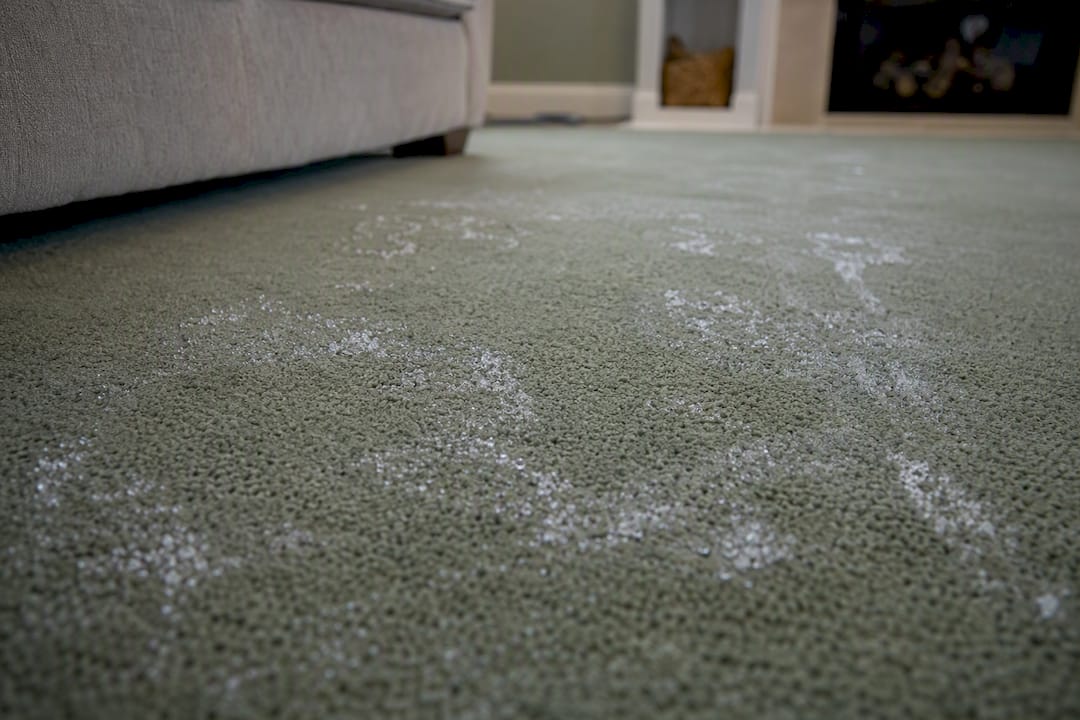
Older, set-in deposits behave differently than fresh tracked-in salt. Fresh crystals vacuum up easily because they’re still loose on top of the pile. Deposits that have been ground in by foot traffic for a week or more have often worked past the tips of the fibers and need a pre-treatment step, like a baking soda dusting left to sit for fifteen minutes before vacuuming, to loosen them enough for the vinegar solution to reach.
Rust-colored staining near a salt spot usually isn’t the salt itself. It’s often an interaction with metal fixtures, furniture legs, or minerals in tap water used during a previous cleaning attempt, and it needs a different approach entirely. If you see color beyond plain white haze, treat that as a separate problem rather than assuming stronger vinegar will fix it.
Can Salt Damage Carpet Fibers Permanently?
Salt residue does real damage the longer it sits, and understanding why helps explain why speed matters so much in the removal steps above.
Salt crystals are abrasive at a microscopic level. Every time someone walks across a spot with dried salt still in it, those crystals grind against the fiber surface like fine sandpraper, wearing down the protective coating on synthetic fibers and roughening natural ones. Over weeks, that shows up as a dull, fuzzy patch that never quite looks clean again, even after you remove the visible residue.
The bigger risk is what happens below the surface. Calcium and magnesium chloride ice melts are hygroscopic, meaning they continuously draw moisture from the air. That keeps the carpet backing and the padding underneath slightly damp for extended periods, which is exactly the environment mold and mildew need to take hold. Once moisture reaches the jute or synthetic backing that holds carpet fibers in place, that backing can weaken, leading to delamination where the fibers start separating from the base.
Dyed carpets face an additional risk. Concentrated salt residue left untreated for a long stretch can interact with certain dyes and cause slight discoloration that no amount of cleaning reverses. This is one more reason the two-week mark matters as a decision point. Past that window, you’re not just cleaning a stain anymore. You’re managing potential structural damage to the carpet itself.
Do Baking Soda and Other Home Remedies Actually Work?
Baking soda earns its reputation as a legitimate pre-treatment step, not a replacement for the vinegar-and-extraction method. Sprinkling a generous layer over an older, set-in salt stain and letting it sit for ten to fifteen minutes helps draw moisture and loosen crystallized residue before you vacuum, which makes the vinegar treatment that follows work faster and more evenly.
Club soda gets mentioned a lot in home remedy lists, and it does have mild lifting power thanks to its carbonation, but it’s not stronger than a proper vinegar solution and it still requires the same rinse-and-extract follow-up. Skip any remedy that skips that follow-up step, because the fizz alone doesn’t remove dissolved salt from the fibers.
Commercial carpet cleaning products marketed for salt and ice melt stains can work, but check the label for alkaline ingredients. Anything alkaline reacts poorly with residual salt and can leave its own chemical residue behind, which just swaps one white haze problem for another. If you go this route, dilute according to the label, spot test first, and rinse just as thoroughly as you would with a vinegar mix.
Steam alone, without extraction, is one of the least effective home remedies for salt specifically. Steam can loosen the crystals, but without suction to pull the dissolved salt back out, you’re just relocating the problem deeper into the pile.
How Do You Know If Your Salt Stain Needs a Bigger Fix?
A quick assessment before you grab any cleaning supplies saves time and tells you whether this is a fifteen-minute job or one that needs professional extraction.
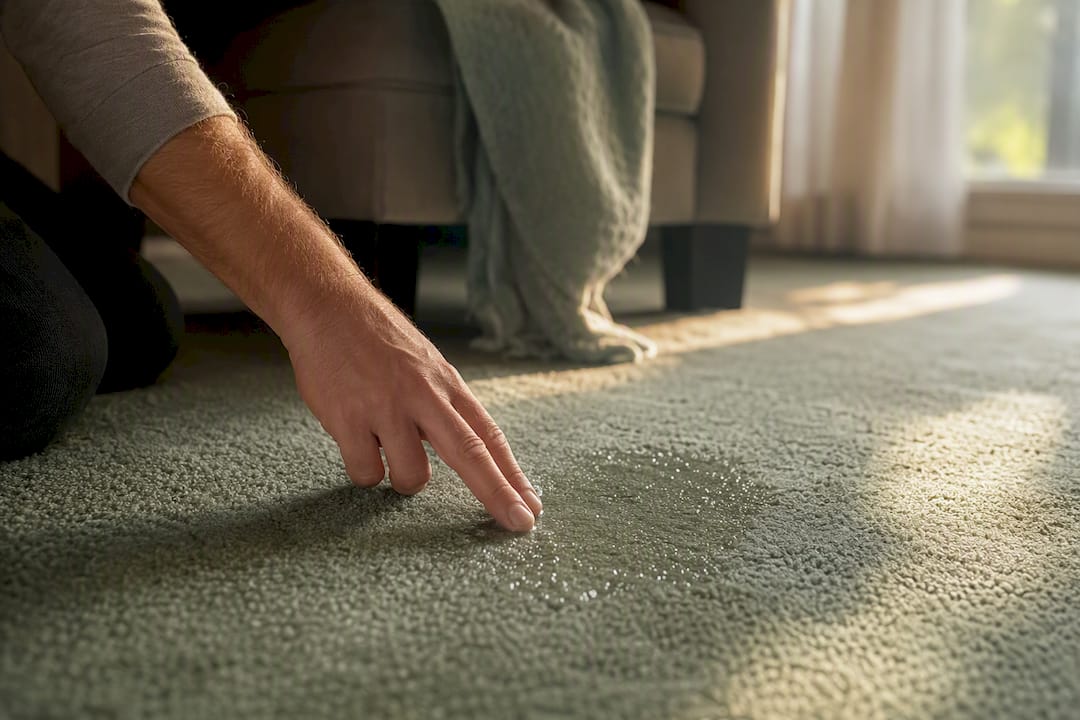
Start by pressing two fingers into the stained area. If the padding underneath feels damp or squishy, you’re dealing with more than surface residue, and treating just the visible carpet won’t solve it. Next, check the size. A stain smaller than a dinner plate usually responds well to the standard vacuum-vinegar-rinse method in one or two passes. Anything spreading across several square feet, especially near an entryway where traffic compounds the problem daily, often needs stronger extraction equipment than a household vacuum provides.
Smell the spot directly. A faint mustiness means moisture has been sitting long enough to start supporting mold growth, which changes this from a stain removal job to a moisture remediation job. Finally, note how long the stain has been there. Fresh tracked-in salt from this week responds fast to home treatment. Deposits sitting for more than two weeks have likely worked into the backing, and that’s the point where a home fix becomes a professional job. Rate your stain honestly on those four points before deciding your next move.
Why Most Salt Stains Come Back the Same Way
The pattern is almost always identical when a reader calls asking why their “fixed” salt stain returned: they skipped the rinse. It’s the most common shortcut people take because it feels redundant. You just cleaned the spot, so why hose it down with more water?
Here’s the part conventional wisdom gets backwards. Vinegar dissolves the salt, but dissolved salt is still salt. It’s just salt suspended in liquid now instead of sitting as a visible crystal. If you blot that liquid up without following through with a plain water rinse and full extraction, you’re leaving dissolved mineral content in the fibers to dry right back into place. The stain didn’t come back. It never actually left.
We built our entire approach around deep steam cleaning with the extraction step treated as non-negotiable, not optional. Our satisfaction guarantee exists because we’ve seen how often a “clean” carpet redevelops the same haze within a week when extraction gets shortchanged. For customers who deal with this every winter, the Simple Club subscription model handles it before it becomes a two-week-old problem, since consistent scheduled care catches early residue before it works into the padding. When salt has been sitting long enough to reach the backing, professional-grade extraction and controlled drying aren’t a luxury upgrade. They’re the only way to remove what a household vacuum physically can’t reach.
— chris
Ready to Let a Pro Finish the Job?
If you’ve vacuumed, treated, rinsed, and dried your carpet and that dull white haze is still hanging around, it’s time to bring in equipment that goes deeper than anything in your closet. Home Service Simple handles exactly this kind of set-in salt residue with truck-mounted hot water extraction, the same category of equipment mentioned earlier as the difference between a stain that fades for a week and one that’s actually gone.

A typical visit starts with an inspection of the affected area and the padding underneath, moves into a fiber-appropriate pre-treatment, then full hot water extraction, and finishes with controlled drying so you’re not stuck avoiding a room for two days. Every job comes backed by a satisfaction guarantee, and if salt and ice melt are a recurring headache every winter, the Simple Club subscription plan keeps scheduled cleanings on the calendar so residue never gets the two weeks it needs to become a real problem.
Before your appointment, jot down when you first noticed the stain, whether it’s come back after a previous cleaning attempt, and whether the padding feels damp when you press on it. That handful of details helps the technician diagnose the job accurately before they even walk in the door. Book a visit or check availability and get the spot handled properly instead of treating it again next month.
Sources
FAQ
What takes salt stains out of carpet?
A diluted white vinegar and water solution, applied by misting and blotting rather than soaking, dissolves the mineral residue. Follow it with a plain water rinse and full extraction so the dissolved salt doesn’t dry back into the fibers.
Are salt stains permanent?
Not usually, if you treat them within the first two weeks using the vacuum, treat, rinse, and extract sequence. Deposits left longer than that can work into the padding and backing, where they become far harder to fully remove without professional equipment.
Will salt ruin carpet?
Left untreated, salt crystals abrade fibers over time and hygroscopic ice melt residue can trap moisture in the backing, which risks mildew and delamination. Prompt vacuuming and treatment prevent most of that damage entirely.
What dissolves salt residue?
Mild acids dissolve salt residue effectively, which is why a 1:1 or 1:2 white vinegar and water mix is the standard treatment. Plain water alone won’t dissolve set-in mineral deposits, but it’s essential for rinsing the dissolved salt back out afterward.
When should I call Home Service Simple instead of doing it myself?
Call a professional if the stain reappears after rinsing, the padding feels damp, you notice a musty smell, or the deposit has been sitting for more than two weeks. Home Service Simple’s hot water extraction reaches residue that household vacuums and handheld extractors can’t pull out.