

For a fresh cat urine accident: blot immediately, dilute with cold water, apply an enzymatic cleaner generously, let it dwell, then extract with a wet/dry vac. That sequence handles most fresh spots. If the odor keeps coming back after proper treatment, or if you’re dealing with a large soaked area, the padding or subfloor is likely contaminated and a professional is your best call.
Act right now:
- Blot up as much urine as possible with paper towels. Press down firmly. Don’t scrub.
- Pour a small amount of cold water over the spot to dilute the urine, then blot again.
- Apply an enzymatic cleaner, saturating the area thoroughly so the product reaches the carpet backing.
- Extract with a wet/dry vac or carpet extractor. Let the area air dry completely.
Pro Tip: If the smell returns after the carpet dries, or if it gets stronger on humid days, the urine has soaked into the pad. Surface treatment alone won’t fix it at that point.
Key Takeaways
Enzymatic cleaners that physically reach the uric acid, combined with thorough extraction, are the only reliable way to permanently remove cat urine odor from carpet.
| Point | Details |
|---|---|
| Act fast on fresh accidents | Blot, dilute with cold water, and apply enzymatic cleaner within minutes to prevent deep saturation. |
| Enzymes are the only real fix | Vinegar and baking soda reduce surface smell but leave uric acid crystals intact; enzymes break them down. |
| Saturation and extraction both matter | Apply enough product to reach the pad depth, then extract thoroughly to remove dissolved material. |
| Blacklight maps hidden contamination | UV light reveals old stains invisible to the naked eye; treat 2–3 inches beyond every glowing edge. |
| Homeservicesimple for deep contamination | When pad or subfloor is involved, Homeservicesimple’s Wichita service offers sub-surface extraction and a satisfaction guarantee. |
Table of Contents
- What supplies do you need for cat urine cleanup?
- How to clean a fresh cat urine accident, step by step
- How do you find and treat old or set-in cat urine stains?
- Why enzymatic cleaners work (and why vinegar usually doesn’t)
- How do you stop your cat from urinating in the same spot again?
- What does DIY cleanup cost vs. hiring a professional?
- What should you do if the smell comes back or gets worse?
- When should you hire a professional carpet cleaner?
- What I keep seeing homeowners get wrong
- Homeservicesimple handles what DIY can’t reach
- Sources
- FAQ
What supplies do you need for cat urine cleanup?
The right tools make a real difference between a spot that’s actually clean and one that just smells okay until the next rainy day.
For a fresh spot, you need:
- Paper towels or clean white cloths (white so you can see what’s lifting)
- Cold water in a spray bottle
- An enzymatic cleaner spray (Nature’s Miracle, Rocco & Roxie, or Woolite Carpet Pet Urine Eliminator are solid options)
- A wet/dry vac or a stack of dry towels for extraction
For deeper treatment or older stains:
- Concentrated enzymatic solution (more product per square foot than a standard spray)
- A BISSELL pet-capable carpet machine or a rented carpet extractor for thorough flushing and extraction
- A UV blacklight to map contamination you can’t see
- Oxi-style boosters (OxiClean-type products) as a supplemental step after enzymatic treatment, not a replacement for it
A word on hydrogen peroxide: it can oxidize odors effectively, but it may bleach or discolor carpet fibers. Always test it in a hidden corner first. Same goes for any product on a delicate or dyed carpet.
Never use ammonia-based cleaners or bleach on cat urine. Ammonia smells similar to urine and can actually encourage your cat to mark the same spot again. Bleach creates toxic fumes when it contacts the ammonia compounds in urine. Both can permanently damage carpet fibers.
How to clean a fresh cat urine accident, step by step
Speed matters here. The faster you act, the less urine soaks into the backing and pad. PetMD recommends blotting, rinsing with cold water, and applying an enzymatic cleaner as the core sequence — and specifically warns against steam or hot water, which sets protein stains permanently into fibers.
- Blot, don’t scrub. Lay paper towels over the wet spot and press down with your foot. Replace them until no more yellow transfers. Scrubbing spreads the urine and pushes it deeper.
- Dilute with cold water. Pour a small amount of cold water directly on the spot. Blot again. This step dilutes the uric acid concentration before the enzymatic cleaner goes on.
- Apply enzymatic cleaner generously. Spray or pour enough product to soak through the carpet pile and backing. A light misting won’t reach the depth the urine traveled. The product needs to contact the uric acid to break it down.
- Let it dwell. Most enzymatic cleaners need 10–15 minutes minimum. Some concentrated formulas recommend up to 30 minutes. Read the label. Don’t rush this step.
- Extract thoroughly. Use a wet/dry vac to pull the product and dissolved material back out. If you have a BISSELL carpet machine or similar extractor, run a cold-water rinse cycle over the area.
- Air dry completely. Open windows, run a fan, or use a dehumidifier. Don’t put furniture back until the area is fully dry — usually 24–48 hours.
Avoid steam cleaning or hot water on a fresh or recent stain. Home carpet shampooers and steam cleaning can make protein-based urine odors worse by bonding the proteins into the fibers at high heat.
Vinegar and baking soda are popular home remedies. They can reduce the surface ammonia smell short-term, but they don’t dissolve uric acid crystals and won’t permanently remove the odor. Use them only as a temporary measure while you get an enzymatic cleaner.
Pro Tip: Apply enough enzymatic cleaner to match the depth the urine traveled. A small cat can deposit urine that wicks several inches outward and down through the backing into the pad. If the spot looks like a quarter, treat an area the size of a dinner plate.
How do you find and treat old or set-in cat urine stains?
Old urine is a different problem. The uric acid has crystallized, bonded to fibers, and likely soaked into the padding. Surface treatment alone usually fails.
Start with a blacklight. Turn off the lights and scan the carpet with a UV blacklight. Uric acid crystals glow under UV light, revealing spots you’d never find by smell alone. Mark each glowing area with painter’s tape or sticky notes. Treat a zone at least 2–3 inches beyond the glowing edge, because urine wicks outward under the carpet.
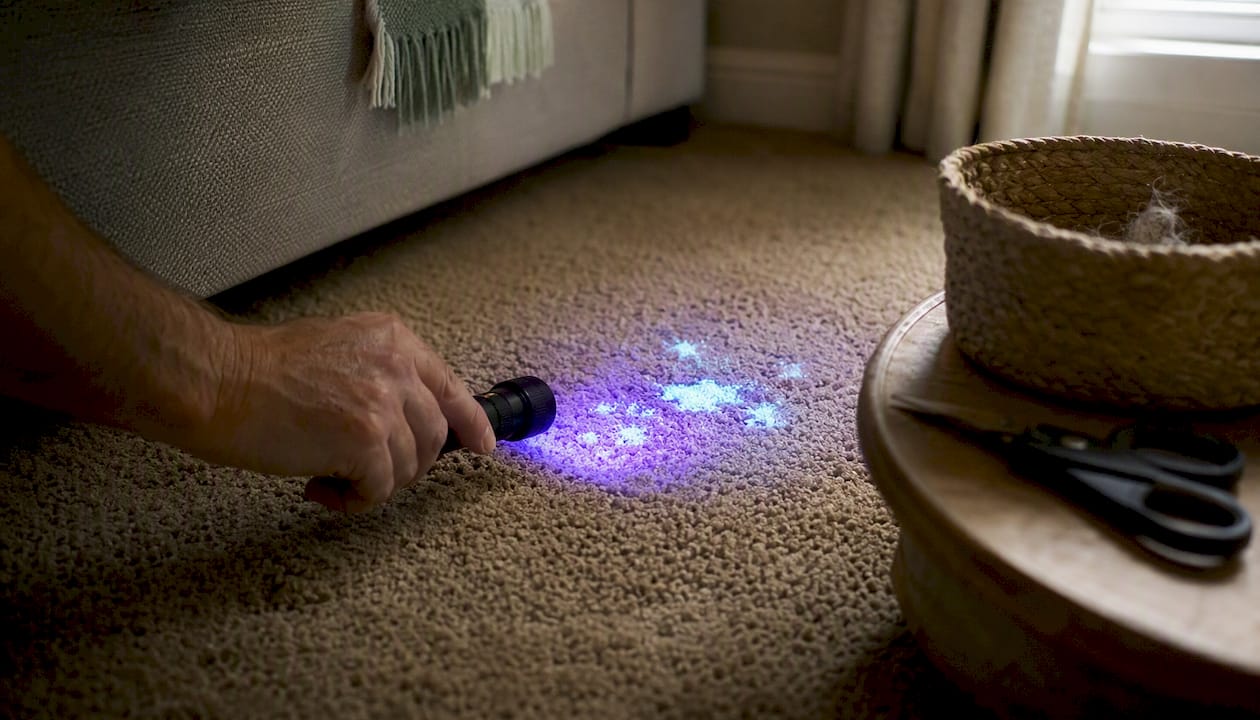
Many homeowners don’t expect that a small surface spot can indicate contamination many times larger below the carpet. This is well documented here. Urine wicks under the backing, and professionals regularly find contaminated areas 5–10 times the visible surface area. That’s why a spot that looks small can still smell terrible.
For set-in stains, the process is:
- Saturate the area with concentrated enzymatic solution. More product than you think you need.
- Let it dwell for at least 20–30 minutes, keeping the area moist (cover with plastic wrap if needed).
- Extract thoroughly with a wet/dry vac or carpet extractor.
- Repeat the treatment 24–48 hours later if odor remains.
- If odor returns after two treatments, especially on humid days, the pad is contaminated.
Uric acid crystals reactivate with humidity, which is why a carpet can smell fine in dry weather and reek when it rains. That reactivation is your clearest sign the contamination is deeper than the carpet surface.
Pro Tip: When pad contamination is confirmed, the only reliable fix is pad removal and replacement, plus sealing the subfloor. A shellac-based primer applied to the subfloor before new pad and carpet installation prevents urine residue from re-wicking up into fresh materials.
Why enzymatic cleaners work (and why vinegar usually doesn’t)
Cat urine contains uric acid, and uric acid is the problem. It forms crystals that bind to carpet fibers, padding, and subfloor materials. Water doesn’t dissolve them. Vinegar doesn’t dissolve them. Baking soda neutralizes surface ammonia smell temporarily, but the crystals stay put and reactivate every time humidity rises.
Enzymatic cleaners work because they contain biological enzymes that digest uric acid and other organic compounds at the molecular level. The odor disappears because the source material is actually broken down, not just masked.
Why DIY remedies fall short:
- Vinegar and baking soda address surface ammonia but leave uric acid crystals intact
- Steam cleaning heats the proteins in urine and bonds them more firmly to fibers
- Ammonia-based cleaners smell like urine to cats, inviting repeat marking
- Hydrogen peroxide oxidizes odor molecules but doesn’t digest uric acid
For enzymatic cleaners to work, two things have to happen: the product must physically reach the uric acid (which means saturating through the carpet backing), and it must have enough dwell time to complete the chemical reaction. A quick spray and blot won’t do it.
Some professional formulas go further, combining peroxide-based oxidizers, wetting agents, and probiotics that continue digesting residue after the initial treatment. That’s part of why professional enzymatic products often outperform retail options on severe contamination.
How do you stop your cat from urinating in the same spot again?
Clean thoroughly, remove the scent completely, and address whatever caused the accident in the first place. Cats return to spots where they can smell urine, so incomplete odor removal is one of the biggest drivers of repeat marking.
- Check litter box setup. The general guideline is one box per cat, plus one extra. Boxes should be scooped daily and fully cleaned weekly. Location matters too — cats avoid boxes near loud appliances or in high-traffic areas.
- Look for recent changes. New furniture, a new pet, construction noise, or a schedule change can trigger stress-related marking. Identify and reduce the stressor where possible.
- Use a deterrent on cleaned spots. After full enzymatic treatment, a citrus-scented spray or double-sided tape on the area discourages re-marking while the scent memory fades.
- Watch for medical signs. Sudden changes in urination frequency, straining to urinate, blood in urine, or urinating outside the box after years of good habits are all reasons to call your vet. Urinary tract infections, kidney disease, and feline idiopathic cystitis are common in cats and often show up as inappropriate elimination first.
- Schedule a vet visit if the behavior is new. A cat that suddenly starts missing the box is often telling you something is wrong physically, not just behaviorally.
What does DIY cleanup cost vs. hiring a professional?
Knowing what to budget helps you decide how far to take the DIY route before calling in backup.
DIY cost ranges:
- Enzymatic cleaner sprays (Nature’s Miracle, Rocco & Roxie, Woolite): $10–$30 per bottle
- Concentrated enzymatic solutions: $20–$60
- UV blacklight: $10–$30
- Wet/dry vac: $80–$300 to own, or $50–$200 to rent for a day
- BISSELL pet carpet machine or similar extractor: $150–$400 to own, or available at most hardware stores for daily rental
Professional service ranges (US, 2026 ballpark):
- Targeted spot treatment for 1–3 areas: $75–$150
- Full-room enzyme pre-treatment and hot water extraction: $150–$300
- Sub-surface extraction with pad removal and subfloor sealing: $300–$800+, depending on room size and contamination depth
Timeline expectations:
- Immediate blot and dilute: do it within minutes of the accident
- Enzymatic dwell time: 10–30 minutes per application
- Extraction and drying: 24–72 hours depending on ventilation and humidity
- Repeat treatments for set-in stains: allow 24–48 hours between applications
Stat to know: Professional technicians using sub-surface extraction tools can reach contamination that standard home machines simply can’t access — which is why a $200 DIY attempt sometimes leads to a $500 professional job anyway when the odor returns.
What should you do if the smell comes back or gets worse?
Run through this checklist before giving up or calling it a lost cause.
- Re-scan with a blacklight. You may have missed spots, or the original treatment didn’t reach the full contaminated area.
- Re-saturate with enzymatic cleaner. Apply more product than last time. Cover with plastic wrap for 20–30 minutes to keep it from evaporating before the reaction completes.
- Extract more aggressively. Flushing with product and pulling it back out removes neutralized material. Leaving it in the carpet can create a residue that holds odor.
- Check the pad. Lift a corner of the carpet in the affected area. If the pad is stained, discolored, or smells strongly, surface treatment is not going to solve it.
- Avoid heat and ammonia. Steam, hot water, and ammonia-based products all make protein stains worse. If you used any of these, enzymatic re-treatment is still your best next step.
- Call a pro if odor returns after two proper treatments. At that point, the contamination is almost certainly in the pad or subfloor, and professional sub-surface extraction is the right tool.
Common mistakes that make things worse: scrubbing instead of blotting, using a steam cleaner on a fresh stain, applying ammonia-based household cleaners, and under-saturating the enzymatic product so it never reaches the uric acid.
When should you hire a professional carpet cleaner?
Call a pro when the odor returns after proper enzymatic treatment, when you’ve confirmed pad contamination, or when you’re dealing with multiple spots across a large area. Surface cleaning often fails when urine has soaked into padding or subfloor — and that’s exactly where professional tools make the difference.
What professional technicians do differently:
- Blacklight mapping of the full contaminated zone before treatment begins
- Application of concentrated enzymatic or oxidizer formulas not available in retail stores
- Sub-surface extraction tools (like the Water Claw) that pull contamination out of the pad without removing the carpet
- Honest assessment of whether the pad needs replacement or whether treatment can save it
- Subfloor sealing with shellac-based primer when contamination has reached the wood
Professional remediation often uses concentrated enzymatic solutions, deeper extraction tools, and may replace padding when saturation is severe. That combination addresses contamination at every layer, not just the surface.
What to expect from a professional visit: A thorough inspection, a clear explanation of what they found, and an honest answer about whether the carpet and pad can be saved or whether replacement is the smarter call. A good technician won’t promise results they can’t deliver.
Homeservicesimple in Wichita, KS offers exactly this kind of thorough pet urine remediation — inspection, enzyme pre-treatment, deep extraction, pad and subfloor work when needed, and a satisfaction guarantee. For Wichita homeowners dealing with persistent cat urine smell in the house, that combination of services and local accountability is hard to beat.
What I keep seeing homeowners get wrong
The most common mistake is scrubbing. You see the wet spot, you grab a rag, and you scrub. That pushes urine deeper into the backing and spreads it outward. Blotting with firm pressure is always the right move.
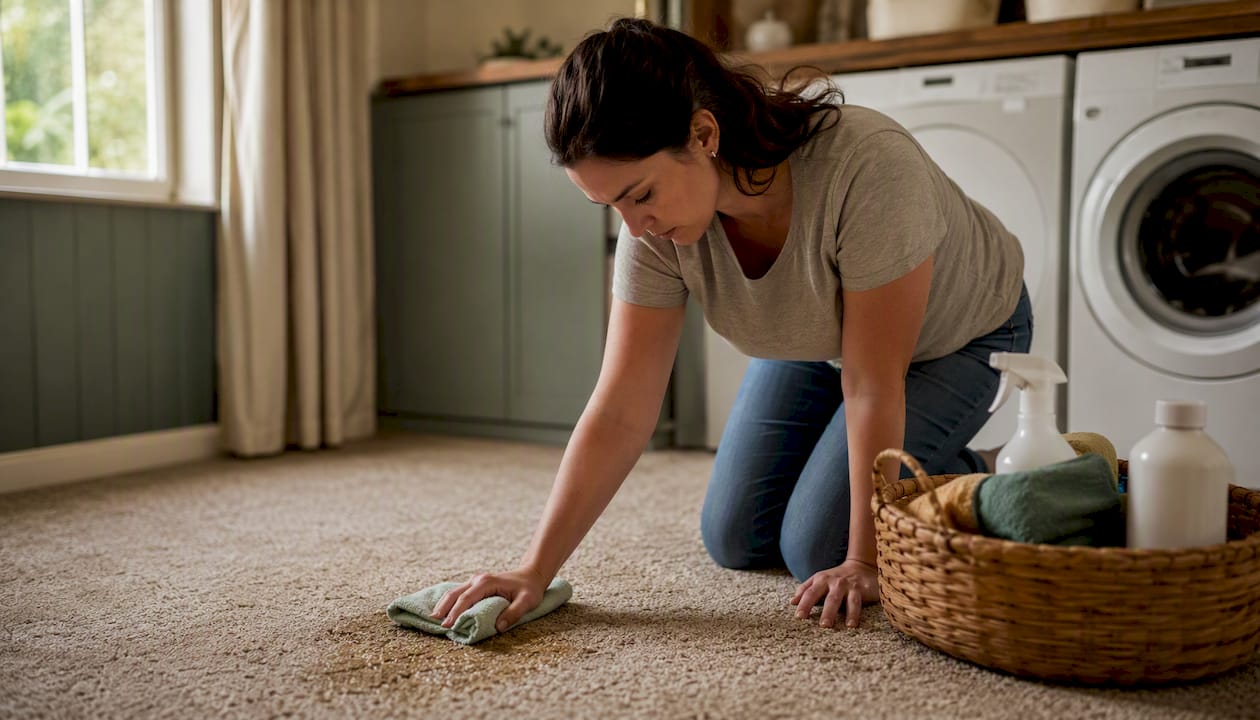
The second most common mistake is reaching for whatever cleaner is under the sink. Ammonia-based cleaners, bleach-based products, and general-purpose degreasers all make the problem worse in different ways. Ammonia invites re-marking. Bleach creates dangerous fumes. Degreasers don’t touch uric acid.
A few habits that actually improve long-term results: map every spot with a blacklight before you treat anything, so you’re not guessing at the edges. Apply enzymatic cleaner generously — more than feels necessary. Document repeat spots on the same area of carpet, because a cat that keeps returning to one zone is telling you the scent is still there, even if you can’t smell it. And if the behavior is new, call your vet before you call a carpet cleaner. Medical causes are more common than most people realize.
Homeservicesimple handles what DIY can’t reach
When the smell keeps coming back no matter what you try, the problem is almost always below the carpet surface. That’s where Homeservicesimple comes in.
Homeservicesimple’s pet urine remediation service in Wichita, KS starts with a full inspection and blacklight mapping, then moves to enzyme pre-treatment, deep extraction, and sub-surface work including pad removal and subfloor sealing when the contamination warrants it. No guesswork, no surface-only fixes. Every job comes with a satisfaction guarantee, and the Simple Club subscription keeps your carpets on a regular cleaning schedule so small problems don’t turn into expensive ones.
Ready to stop fighting the smell and get a guaranteed result? Request an estimate from Homeservicesimple and get your Wichita home smelling clean again.
Sources
- How to Remove Dog and Cat Urine Smell from Carpet
- Get Dog or Cat Urine Smell Out of Carpet | PetMD
- A Complete Guide to Removing Cat Urine Odor from Carpet
- How To Get Rid of Cat Pee Smell From Carpet, Clothes …
FAQ
Will cat urine smell ever go away on its own?
No. Uric acid crystals bind to carpet fibers and reactivate with humidity, so the odor returns repeatedly until the crystals are broken down with an enzymatic cleaner and extracted.
Why does my carpet smell like cat pee when I don’t have a cat?
A previous resident’s cat may have left uric acid contamination in the padding or subfloor. A UV blacklight scan will reveal old stains, and enzymatic treatment followed by extraction can address them.
What should you never use to clean cat pee?
Avoid ammonia-based cleaners (they smell like urine and encourage re-marking), bleach (toxic reaction with urine compounds), and steam or hot water (heat bonds protein stains permanently into fibers).
What’s the first thing to do when a cat pees on carpet?
Blot immediately with paper towels — don’t scrub. Then dilute with cold water, blot again, and apply an enzymatic cleaner like Nature’s Miracle or Rocco & Roxie, letting it dwell before extracting.