

Choose carpet tiles for high-traffic, repair-sensitive zones. Choose broadloom for large, quiet spaces where seamless aesthetics and cushion matter most. That’s the short version. Here’s how it plays out across real project types:
- Lobbies, open-plan offices, corridors, rental units: Carpet tiles. Modular replacement keeps you from ripping out an entire floor when one lane wears out.
- Hotel guest rooms, executive suites, ballrooms, bedrooms: Broadloom. The seamless look and padded underfoot feel are worth the trade-off.
- Mixed commercial spaces: A hybrid approach, broadloom in reception and tiles in the work zones, often delivers the best of both.
Both formats require a maintenance plan that meets IICRC S100 standards. Hot water extraction (HWE) is the restorative cleaning method for either. And if you’re specifying carpet tiles, buy attic stock at installation so future repairs don’t look like bright patches on a faded field.
Key Takeaways
Carpet tiles deliver lower lifecycle costs in high-traffic commercial spaces; broadloom wins on seamless aesthetics and upfront material cost in low-traffic, comfort-focused areas.
| Point | Details |
|---|---|
| Lifespan difference | Commercial broadloom lasts 7–10 years; carpet tile reaches 10–15 years through selective tile replacement. |
| Upfront vs. lifecycle cost | Tiles cost more per square foot in material but often yield lower total cost over time in busy spaces. |
| Installation speed | Carpet tile installs up to roughly 40% faster on comparable commercial projects, reducing downtime. |
| Maintenance standard | IICRC S100 designates hot water extraction as the restorative method for both formats; specify it by zone. |
| Homeservicesimple | Homeservicesimple provides professional HWE cleaning in Wichita, KS, supporting the maintenance schedules both formats require. |
Table of Contents
- How do carpet tiles and broadloom actually compare?
- How does installation actually differ between the two?
- Where does broadloom win, and where does it cost you?
- Where do carpet tiles shine, and what are the trade-offs?
- What does the real cost look like over 10 years?
- What maintenance schedule actually protects your carpet?
- Which spaces are actually best for each format?
- What questions should you ask before signing a flooring contract?
- When does mixing both formats in one project make sense?
- The part most flooring guides skip
- Homeservicesimple keeps your carpet performing longer
- Useful sources
- FAQ
How do carpet tiles and broadloom actually compare?
The table below maps the eight dimensions that typically decide the choice. Cost ranges reflect typical U.S. commercial and residential market pricing.
| Dimension | Broadloom | Carpet Tile | Quick Guidance |
|---|---|---|---|
| Installation method | Glue-down or pad + stretch; seam work required | Modular placement; releasable pressure-sensitive adhesive | Tiles are faster and more forgiving on subfloor imperfections |
| Upfront cost (material + labor) | $3–$7/sq ft material; $1–$3/sq ft labor | $4–$7/sq ft material; $1–$2/sq ft labor | Broadloom is usually cheaper per sq ft upfront |
| Lifecycle / replacement cost | Higher: full-room replacement when a lane wears | Lower: replace only worn tiles | Tiles win on lifecycle in high-traffic settings |
| Maintenance & cleaning | HWE restorative; pad absorbs moisture, longer dry time | HWE restorative; tiles can be lifted for subfloor cleaning | Tiles dry faster; broadloom needs careful moisture management |
| Durability / traffic performance | 7–10 years commercial; lane wear is permanent | 10–15 years commercial; worn tiles are swappable | Tiles last longer in busy spaces |
| Aesthetics / pattern continuity | Seamless; large-scale patterns flow uninterrupted | Grid transitions visible; modular patterns only | Broadloom wins for large-area visual continuity |
| Repairability | Difficult; dye-lot matching is risky | Straightforward; lift and replace individual tiles | Tiles are far easier to repair |
| Best-suited spaces | Guest rooms, ballrooms, executive suites, bedrooms | Offices, corridors, rental units, zones with rolling loads | Match format to traffic and function |
Installation disruption, lane wear, and replacement economics are the three dimensions that most often tip the decision. If any of those three is a serious concern for your project, tiles usually win.
How does installation actually differ between the two?
This is where the choice gets practical fast.
Broadloom installation starts with subfloor prep. Any imperfection, a dip, a ridge, a seam in the concrete, telegraphs straight through the finished surface. Installers use a pad-and-stretch method for residential work (tack strips around the perimeter, pad stapled or glued down, broadloom stretched over it) or a direct glue-down for commercial. Seam placement matters: a bad seam in a high-traffic lane will delaminate or fray. Waste runs higher too, typically 10–15% on complex floor plans, because you’re cutting from a 12-foot roll around columns, doorways, and angles.
Carpet tile installation is a different rhythm. Tiles arrive pre-cut, usually in 18×18 or 24×24 inch squares or plank formats, with attached backing. A releasable pressure-sensitive adhesive goes down first, tiles drop in, and you’re done. Subfloor imperfections are more forgiving because each tile bridges small variations independently. Installation can run significantly faster on comparable commercial projects, and waste typically drops to 5% or less.
For a 2,000 sq ft open office, a broadloom crew might need two to three days including subfloor prep, seam work, and stretch. A tile crew on the same footprint can often finish in one day, sometimes less, which means less downtime for your business.
- Confirm subfloor flatness before signing any contract (both formats, but critical for broadloom).
- Ask whether the adhesive is releasable or permanent (tiles only; releasable allows future access to subfloor utilities).
- Verify the installer’s seam strategy for broadloom before work begins.
- For tiles, confirm pile direction is consistent across the layout to avoid a checkerboard effect.
- Schedule broadloom installation during low-occupancy periods; tile work can often proceed in phases.
Pro Tip: For broadloom, ask your installer to place seams perpendicular to the primary light source and away from high-traffic lanes. Seams parallel to foot traffic and natural light are the ones that show first.
Where does broadloom win, and where does it cost you?
Broadloom is carpet manufactured in wide rolls, typically 12 feet across, and installed wall-to-wall. It comes in two primary installation systems: pad-and-stretch for residential and light commercial, and direct glue-down for heavy commercial. The pad-and-stretch method adds cushion and acoustic performance; glue-down is firmer and more stable under rolling loads.
The case for broadloom is real. A seamless floor with no visible grid lines reads as more upscale in large spaces. Padded broadloom absorbs sound better than hard-backed tiles in most residential and hospitality settings. And on a pure material-cost basis, broadloom often comes in lower per square foot than comparable carpet tile.
“Broadloom supports continuous pattern flow and seam control for large hospitality floorplates — a design advantage that modular tile simply cannot replicate at scale.”
— Dalton Hospitality Carpet
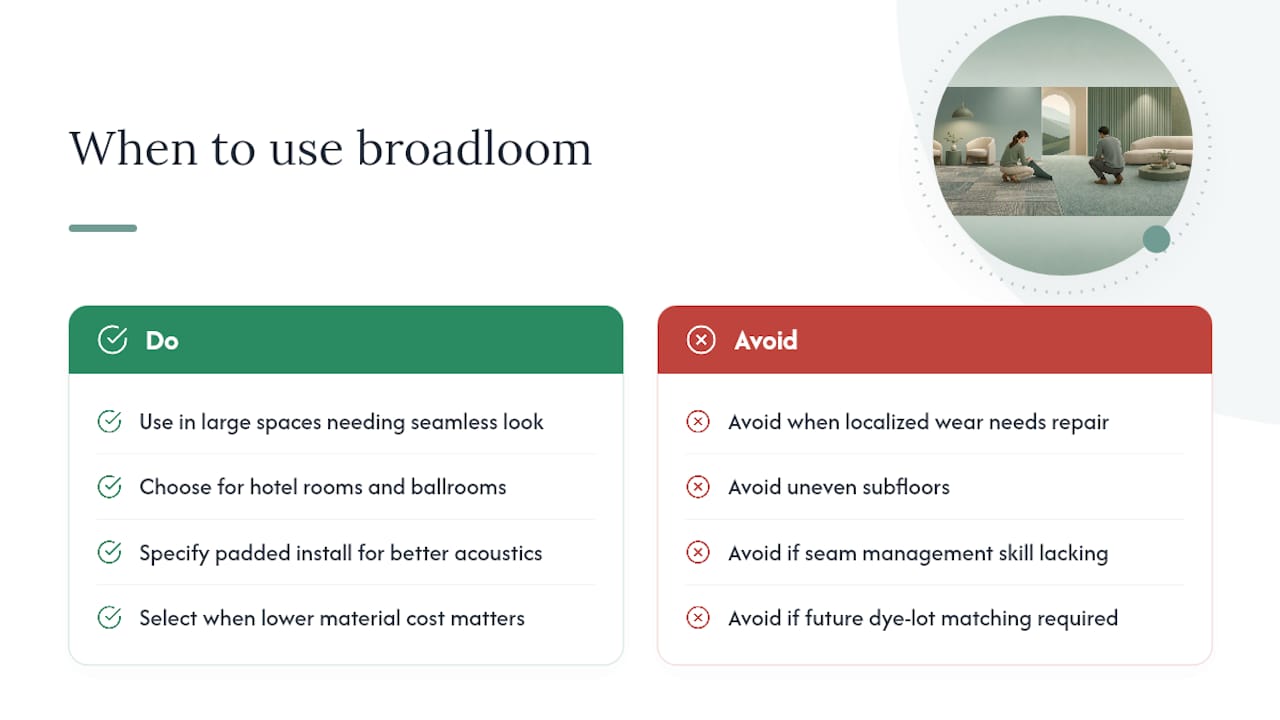
The limitations are just as real. When a traffic lane wears out, you’re looking at a whole-room replacement. Subfloor prep is non-negotiable; small imperfections telegraph through broadloom more readily than through modular tiles. Seam management is a skill, and a bad seam is a permanent problem. Dye-lot matching for future repairs is nearly impossible once the original production run is gone.
Best spaces for broadloom: hotel guest rooms, ballrooms, executive suites, large conference rooms, master bedrooms, and any space where seamless aesthetics and underfoot comfort outweigh operational flexibility.
Where do carpet tiles shine, and what are the trade-offs?
Carpet tiles are modular flooring units, typically 18×18 or 24×24 inch squares or plank formats, installed with releasable pressure-sensitive adhesives. The backing is attached, the adhesive is pre-applied or rolled on-site, and individual tiles can be lifted without damaging adjacent ones.
The operational advantages are significant:
- Targeted lifecycle economics: Selective replacement in worn lanes extends the system life to 10–15 years in commercial settings.
The trade-offs are worth knowing upfront. Tiles show grid lines. In a large open space, those seams create a visual pattern that some designers find busy. Plushness is lower than padded broadloom; tiles feel firmer underfoot. And dye-lot replacement risk is real: tiles installed today may not match tiles from the same manufacturer three years from now. That’s why buying 5–10% attic stock at installation is standard practice, not optional.
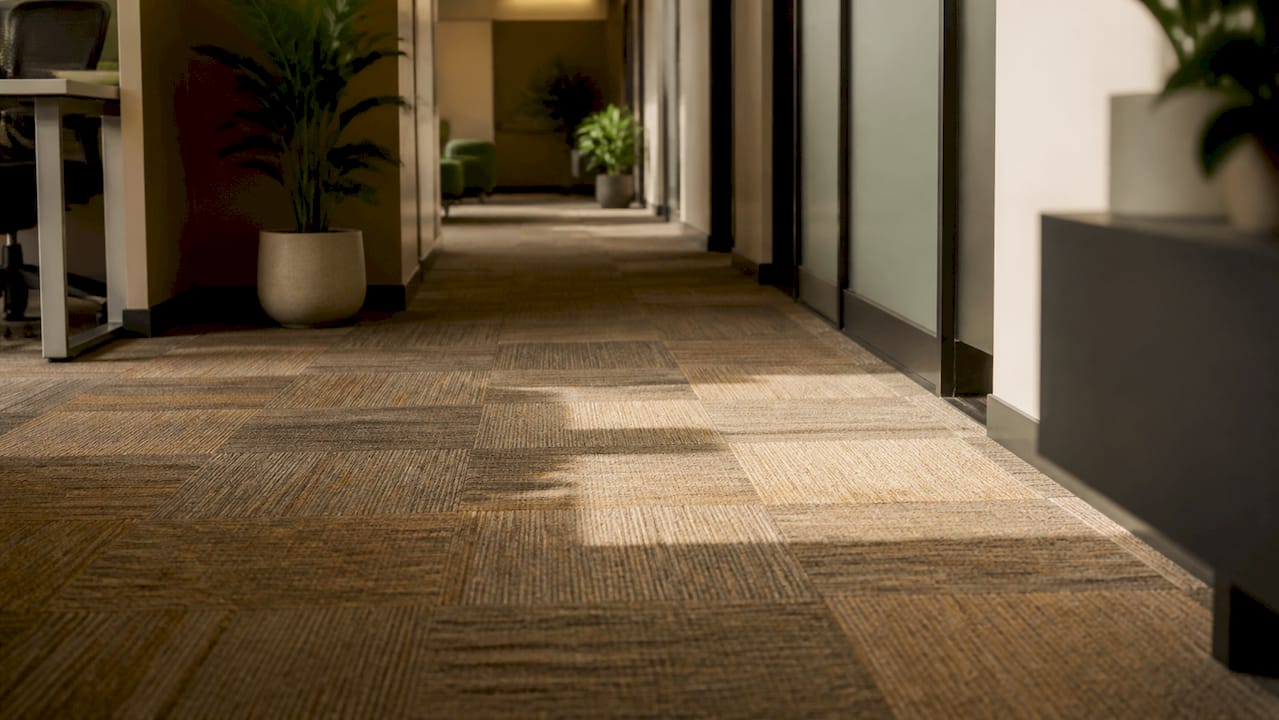
Best spaces for carpet tiles: open-plan offices, corridors, rental units, retail back-of-house, basements, and any zone with rolling loads like carts or hand trucks.
What does the real cost look like over 10 years?
Sticker price is the wrong number to compare. Here’s what a 10-year window looks like for a 2,000 sq ft commercial office with one high-traffic lane.
| Cost Factor | Broadloom | Carpet Tile |
|---|---|---|
| Material cost (est.) | $3–$7/sq ft | $4–$7/sq ft |
| Labor cost (est.) | $1–$3/sq ft | $1–$2/sq ft |
| Installation waste | 10–15% | ~5% |
| Attic stock | Not applicable | 5–10% of material cost |
| Year 5 lane repair | Full-room replacement likely | Replace worn tiles only |
| Lifespan (commercial) | 7–10 years | 10–15 years |
| Downtime for repair | 1–3 days (full install) | Hours (tile swap) |
Carpet tiles tend to cost more per square foot in material than comparable broadloom. But when a high-traffic lane wears out at year five, broadloom means a full replacement: new material, full labor, and two to three days of downtime. Tiles mean pulling the worn units and dropping in attic stock, often in a few hours. That difference in replacement economics is what makes tiles the better lifecycle value in busy settings, even when the upfront material cost is higher.
What maintenance schedule actually protects your carpet?
The IICRC S100 standard is the governing framework for commercial carpet care in the U.S. It classifies hot water extraction as the restorative cleaning method and treats interim methods like encapsulation as maintenance-only, not restorative. The Carpet and Rug Institute (CRI) maintains a certification program for vacuums and extraction equipment; specifying CRI-certified equipment in your maintenance scope of work is a simple way to protect your warranty.
Backing and pad differences matter for drying. Broadloom with a thick pad holds moisture longer after HWE, which raises mold risk if the space isn’t well-ventilated. Carpet tiles with hard-backed construction dry faster, and individual tiles can be lifted to dry the subfloor if needed.
| Traffic Zone | Daily Action | Interim Cleaning | HWE (Restorative) |
|---|---|---|---|
| High traffic (corridors, entries) | Vacuum daily | Encapsulation every 4–6 weeks | Every 3–4 months |
| Medium traffic (open offices) | Vacuum 3x/week | Encapsulation every 2–3 months | Every 6 months |
| Low traffic (private offices, guest rooms) | Vacuum weekly | Spot clean as needed | Annually |
Pro Tip: When writing your maintenance scope of work, specify CRI-certified vacuums, a named HWE schedule by traffic zone, and a spot-response time (e.g., within 24 hours of a spill). Vague SOW language is the single biggest reason carpets fail before their rated lifespan.
Which spaces are actually best for each format?
Traffic, function, and aesthetics each pull in a direction. Here’s how common spaces map out.
Broadloom fits best in: hotel guest rooms, ballrooms, large conference rooms, executive suites, master bedrooms, and residential living rooms. These spaces share two traits: lower rolling-load traffic and a design priority for visual continuity.
Carpet tiles fit best in: open-plan offices, building corridors, rental apartments, retail stockrooms, basements, and any zone where carts, dollies, or heavy foot traffic are daily realities.
A few spaces deserve a specific warning. Wet-entry vestibules are a bad fit for broadloom; moisture wicks into the pad and creates a mold problem fast. Broadloom in a basement with any history of moisture intrusion is a similar risk. Tiles, with their hard backing and releasable adhesive, handle those conditions better.
“Large hospitality and event spaces often specify broadloom for seam control and uninterrupted pattern scale; carpet tile is favored in administrative and segmented back-of-house areas where modular replacement is prioritized.”
— Dalton Hospitality Carpet
Hybrid example: A hotel property might run broadloom through guest room corridors for the seamless look, then switch to tiles in the administrative wing and housekeeping areas. The transition strip between the two formats is a small design detail that pays off in years of easier maintenance.
What questions should you ask before signing a flooring contract?
Don’t sign until you have answers to these.
- What subfloor prep is included? Get the flatness tolerance in writing (typically 3/16 inch over 10 feet for broadloom).
- Is the adhesive releasable or permanent? Releasable matters if you need future subfloor access or want to swap tiles later.
- What warranty covers the installation, and what voids it? Moisture, improper cleaning, and wrong adhesive are common exclusions.
- What attic stock percentage do you recommend, and will you source it from the same dye lot? The answer should be 5–10% for tiles; anything less is a red flag.
- What is the expected downtime for installation and for future repairs?
- What fiber type, face weight, and backing type are you specifying? These drive durability; get them in the scope of work.
- Does the scope reference CRI or IICRC maintenance standards? If not, add it.
Red flags to watch: an installer who can’t name the adhesive type, a bid with no attic stock line item, a broadloom proposal with no seam placement diagram, or any scope of work with no mention of moisture mitigation.
When does mixing both formats in one project make sense?
More often than you’d think. The hybrid approach, broadloom in aesthetics-first zones and tiles in operational zones, is a standard specification strategy in commercial interiors.
The logic is straightforward. Reception areas and conference rooms benefit from broadloom’s seamless look and acoustic softness. Work areas, corridors, and service zones benefit from tiles’ repairability and faster install. You get the design intent where it matters and the operational flexibility where you need it.
“Hybrid strategies — specifying broadloom in reception and meeting areas and modular tile in work zones — are common and reduce lifecycle costs while preserving design intent.”
— Pace Flooring
Installation sequencing matters. Tiles typically go in first; broadloom is installed last and trimmed to the tile edge. Use a metal transition strip at the boundary, and make sure pile direction on both formats runs the same way relative to the primary entry point. Coordinate dye lots as closely as possible, and protect broadloom roll edges during tile work to prevent fraying.
A practical layout for a 10,000 sq ft office floor: broadloom in the reception lobby and two large conference rooms (roughly 2,500 sq ft), carpet tiles everywhere else. That split keeps the design statement intact while making the other 7,500 sq ft fully repairable without a full-floor shutdown.
The part most flooring guides skip
Here’s what I keep seeing property owners get wrong: they pick a format based on the sample board, not the traffic map. A beautiful broadloom in a corridor that takes 300 foot-falls a day is going to look rough by year three, no matter how good the fiber is. And a carpet tile spec with no attic stock is just a future repair problem waiting to happen.
The maintenance plan is not an afterthought. It’s part of the specification. A floor that gets vacuumed daily and HWE’d on schedule will outlast a better-spec’d floor that gets cleaned whenever someone gets around to it. The IICRC S100 framework exists for a reason, and the facilities managers who follow it consistently get more years out of their investment.
One more thing: the hybrid approach is underused in residential settings. A lot of Wichita homeowners I talk to don’t realize you can run broadloom in the bedrooms and living room, then use tiles in a finished basement or home office. Different zones, different needs. That’s not a compromise; it’s smart planning.
Homeservicesimple keeps your carpet performing longer
Whether you’ve got broadloom in the guest rooms or tiles running through the office, the floor only holds its value if it gets cleaned right. That’s where Homeservicesimple comes in.
Homeservicesimple offers professional deep steam cleaning (hot water extraction) for both carpet tiles and broadloom in Wichita, KS, the exact restorative method the IICRC S100 standard calls for. No sticky residue. No guesswork on drying time. Just a clean floor that lasts. The Simple Club subscription plan takes the scheduling off your plate entirely, so your maintenance SOW runs on autopilot. Upholstery, tile and grout, air duct, and mattress cleaning round out the service list for property owners who want one reliable team.
Ready to put a real maintenance plan behind your flooring investment? Get a quote from Homeservicesimple and see what a scheduled HWE program does for your carpet’s lifespan.
Useful sources
| Source | What it covers |
|---|---|
| Dalton Hospitality Carpet | Broadloom vs. carpet tile in hospitality: pattern continuity, seam control, and modular replacement |
| Pace Flooring | Installation speed advantage (~40% faster for tiles), waste reduction, and hybrid strategy guidance |
| Opora Supply | IICRC S100 maintenance playbook: HWE as restorative standard, encapsulation as interim, SOW language |
| FlooringClarity | Material cost comparison (tiles higher per sq ft) and lifecycle value analysis |
| BuildDirect | Design and texture comparison: grid transitions in tiles vs. seamless broadloom pattern continuity |
| The Carpet Guys Blog | Attic stock guidance (5–10%) and tile rotation practices for facilities managers |
FAQ
What is the main difference between broadloom and carpet tile?
Broadloom is manufactured in wide rolls (typically 12 feet) and installed wall-to-wall for a seamless look; carpet tile is modular, installed in squares or planks with releasable adhesive, and allows individual tile replacement without disturbing the rest of the floor.
Are carpet tiles better than broadloom for commercial spaces?
In high-traffic commercial settings, carpet tiles typically outperform broadloom on lifecycle cost because worn tiles can be swapped individually, extending the system life to 10–15 years versus 7–10 years for broadloom.
What are the disadvantages of carpet tiles?
Carpet tiles show visible grid seams that interrupt large-area pattern continuity, feel firmer underfoot than padded broadloom, and require 5–10% attic stock at installation to avoid mismatched replacement tiles from a different dye lot.
Is it cheaper to install carpet or carpet tiles?
Broadloom usually costs less per square foot in material, but carpet tiles often carry lower total installation cost due to reduced labor time and less waste. Over a 10-year window in a busy space, tiles frequently deliver lower lifecycle cost despite the higher upfront material price.
Can you use broadloom and carpet tile in the same space?
Yes. A hybrid installation, broadloom in reception or conference areas and tiles in work zones and corridors, is a common commercial strategy that preserves design intent while keeping high-traffic areas fully repairable.